






Manila Bulletin
 Business
The Economy
₱100/liter near? Fuel prices keep rising for second straight week
Business
The Economy
₱100/liter near? Fuel prices keep rising for second straight week
Business
The Economy
₱100/liter near? Fuel prices keep rising for second straight week
₱100/liter near? Fuel prices keep rising for second straight week
Published Mar 11, 2026 06:48 pm


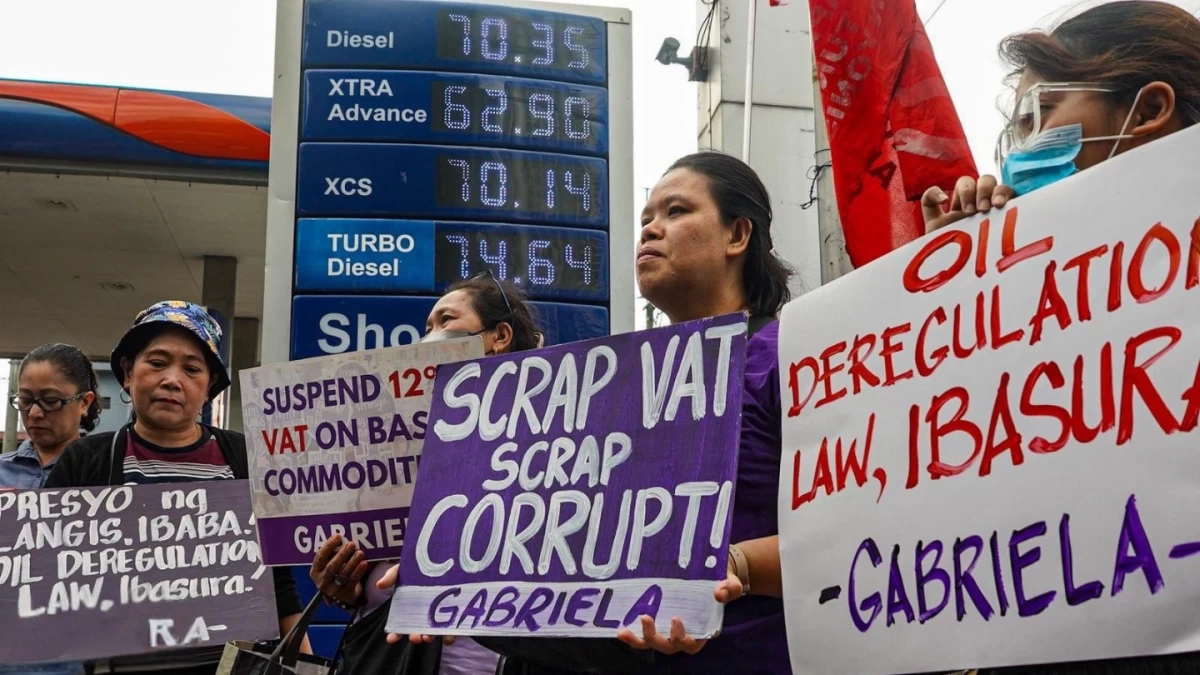
Members of transport group PISTON and consumer rights advocates picket a gasoline station at the corner of Blumentritt and España in Manila on Tuesday, March 10, 2026. The groups are calling for government intervention as diesel prices are projected to breach the ₱80-per-liter mark following another “big-time” fuel price hike. (Photo by John Louie Abrina I MB)
Fuel prices are poised to surge by double digits for a second consecutive week as escalating Middle Eastern geopolitical tensions continue to roil global energy markets.
Early projections based on the Mean of Platts Singapore (MOPS) trading suggest that the local market is bracing for another wave of record-breaking adjustments in the third week of March.
Industry estimates based on the first two days of regional trading indicated that gasoline prices may climb by ₱13 to ₱15 per liter, while diesel is expected to see a sharper increase of ₱16 to ₱18 per liter.
Kerosene, which has borne the brunt of recent volatility, is signaled to rise by an average of ₱9.50 per liter. This follows a period of extreme volatility where pump prices have consistently trended toward the ₱100-per-liter threshold.
The anticipated hikes come as oil companies conclude a series of staggered price implementations designed to cushion the immediate impact of global crude spikes.
Effective March 12, major players including Shell Pilipinas Corp. and Petron Corp. will implement their final tranches of adjustments.
Kerosene prices are set to rise by ₱3.60 to ₱6.50 per liter, effectively pushing pump prices to as high as ₱122.67 per liter from the current average of ₱103.17.
Diesel rates are expected to increase by ₱2.50 to ₱3.80 per liter, bringing the price range at retail stations to between ₱68 and ₱84.75 per liter. Gasoline will see a more modest third-round adjustment of ₱0.85 to ₱1.80 per liter, resulting in a price range of ₱62.90 to ₱72.90 per liter.
Other retailers participating in the staggered adjustments coordinated with the Department of Energy include Chevron Philippines Inc., Jetti Petroleum Inc., Total Philippines, and Seaoil Philippines Inc.
The cumulative adjustments for this week alone stand at ₱8.75 per liter for gasoline, ₱24.25 for diesel, and ₱36 for kerosene—the highest weekly movement in Philippine history.
The Department of Energy (DOE) has noted that the staggered approach was adopted by fuel stations to prevent a singular, massive price shock to the economy.
In response to the spiraling costs, President Marcos Jr. has ordered the immediate release of a ₱5,000 fuel subsidy for public utility vehicle drivers, who are disproportionately affected by the surge in diesel prices.
Executive Secretary Ralph Recto indicated that the financial aid will be distributed in coordination with Metro Manila local government units before expanding to other regions next week.
Meanwhile, the DOE is reportedly exploring alternative sourcing to ensure a stable domestic supply amid the protracted international crisis.