ADVERTISEMENT

Is it really that easy to fly a plane for humanitarian work in a war zone? PAF weighs in

Published Mar 10, 2026 03:36 pm
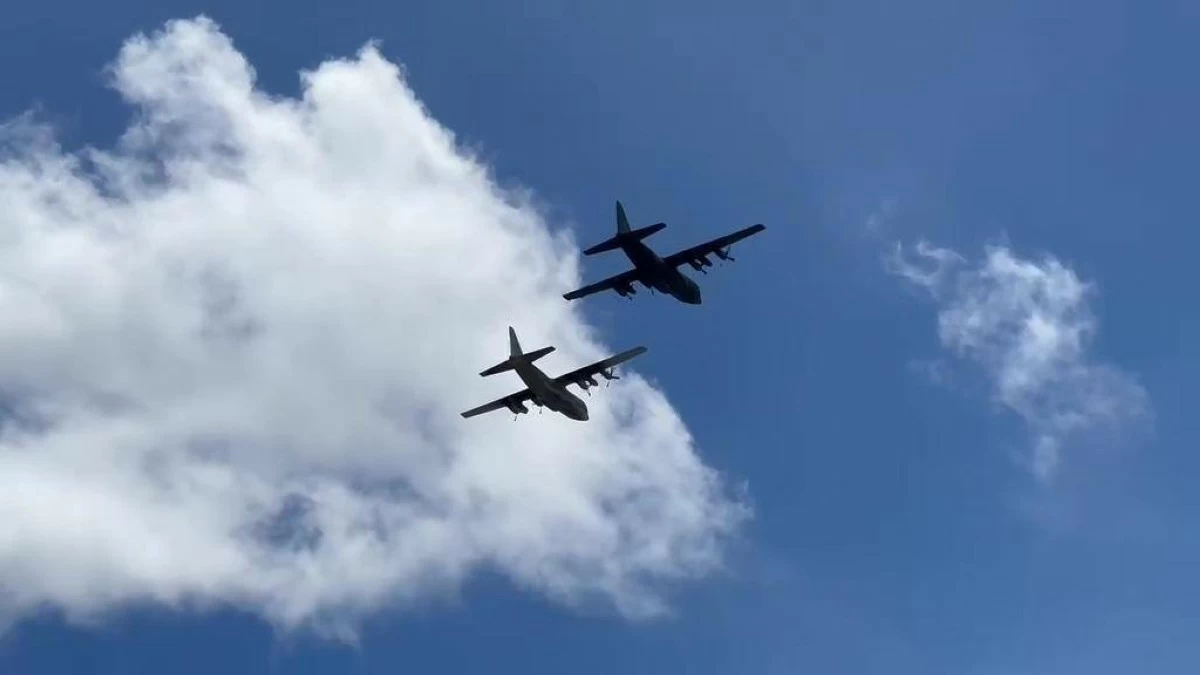
Philippine Air Force (PAF) and Japan Air Self-Defense Force (JASDF) C-130 aircraft conduct a joint flight following a bilateral air drop in Tacloban City on Oct. 9, 2025 as part of the Doshin-Bayanihan 5-25 Exercise. (Photo: PAF)
Sending aircraft into a conflict zone in the Middle East to rescue overseas Filipino workers (OFWs) is not as simple as it sounds, the Philippine Air Force (PAF) said on Tuesday, March 10.
Colonel Ma. Christina O. Basco, PAF spokesperson, emphasized that while the intent to bring OFWs home is immediate, the execution requires comprehensive planning due to international protocols and high-stakes diplomacy.
She explained that prepositioning of forces, ground control, coordination on the ground, and diplomatic clearances are crucial, underscoring the complex logistics and safety considerations involved in the operations.
“We have to consider several things like our prepositioning, ground control, and coordination on the ground, and this is miles away. It’s quite far. Then there are also issues about diplomatic clearances, as well as consolidation, repatriation, and extraction. It requires a very comprehensive plan. This is just to ensure that our transport is safe,” Basco said matter-of-factly.
Nonetheless, the PAF said it is coordinating with the Department of Migrant Workers (DMW), Department of Foreign Affairs (DFA), and Department of National Defense (DND) should the government decide to deploy transport aircraft to fetch distressed OFWs.
“We are maintaining a high level of preparedness,” Basco said.
And even the Philippine Navy (PN) expressed readiness to send its ships to transport the affected OFWs, saying similar missions were conducted in the past.
“Your Philippine Navy is always ready to respond but we will also wait for instructions coming from higher headquarters regarding the repatriation. If you could recall, during the COVID and during the [Middle East conflict] in 2020, we sent ships indeed to India and to Oman. So with this, we are capable. Your Navy is very capable,” Captain Marissa Martinez, PN spokesperson, said.
Earlier, Vice President Sara Duterte criticized the government for its supposed slow response in repatriating OFWs affected by the escalating tensions in the Middle East.
She noted that the government can swiftly arrange a flight to bring back Filipinos from the Middle East, drawing on her experience as Davao City mayor when COVID-19 funds were used to transport stranded residents.
However, the Palace stressed that the government was unable to deploy aircraft to the conflict zone because the airspace remains closed due to ongoing missile and bomb attacks.
To date, the DMW has arranged chartered and commercial flights to safely repatriate Filipinos from Middle East countries amid the ongoing conflict.
The Palace said 16 OFWs from Tel Aviv traveled by land to Eilat, crossed into Egypt, and will take a Cairo–Muscat–Manila flight arriving on March 11 at 9:30 p.m.
Meanwhile, 20 OFWs and nine dependents from Dubai will cross into Oman and fly Muscat–Manila, arriving March 10 at 9:30 p.m.
Flights for Filipino repatriates from Riyadh, Saudi Arabia, were also being arranged, with the earliest departure scheduled on March 14.
The Palace said that more than 400 Filipinos have returned to Manila since the conflict in the Middle East began.

Related Tags

AFP Philippine Air Force humanitarian repatriation conflict zone Middle East Vice President Sara Duterte
ADVERTISEMENT
.most-popular .layout-ratio{ padding-bottom: 79.13%; } @media (min-width: 768px) and (max-width: 1024px) { .widget-title { font-size: 15px !important; } }

{{ articles_filter_1561_widget.title }}

.most-popular .layout-ratio{ padding-bottom: 79.13%; } @media (min-width: 768px) and (max-width: 1024px) { .widget-title { font-size: 15px !important; } }

{{ articles_filter_1562_widget.title }}

.most-popular .layout-ratio{ padding-bottom: 79.13%; } @media (min-width: 768px) and (max-width: 1024px) { .widget-title { font-size: 15px !important; } }

{{ articles_filter_1563_widget.title }}

{{ articles_filter_1564_widget.title }}

.mb-article-details { position: relative; } .mb-article-details .article-body-preview, .mb-article-details .article-body-summary{ font-size: 17px; line-height: 30px; font-family: "Libre Caslon Text", serif; color: #000; } .mb-article-details .article-body-preview iframe , .mb-article-details .article-body-summary iframe{ width: 100%; margin: auto; } .read-more-background { background: linear-gradient(180deg, color(display-p3 1.000 1.000 1.000 / 0) 13.75%, color(display-p3 1.000 1.000 1.000 / 0.8) 30.79%, color(display-p3 1.000 1.000 1.000) 72.5%); position: absolute; height: 200px; width: 100%; bottom: 0; display: flex; justify-content: center; align-items: center; padding: 0; } .read-more-background a{ color: #000; } .read-more-btn { padding: 17px 45px; font-family: Inter; font-weight: 700; font-size: 18px; line-height: 16px; text-align: center; vertical-align: middle; border: 1px solid black; background-color: white; } .hidden { display: none; }
function initializeAllSwipers() { // Get all hidden inputs with cms_article_id document.querySelectorAll('[id^="cms_article_id_"]').forEach(function (input) { const cmsArticleId = input.value; const articleSelector = '#article-' + cmsArticleId + ' .body_images'; const swiperElement = document.querySelector(articleSelector); if (swiperElement && !swiperElement.classList.contains('swiper-initialized')) { new Swiper(articleSelector, { loop: true, pagination: false, navigation: { nextEl: '#article-' + cmsArticleId + ' .swiper-button-next', prevEl: '#article-' + cmsArticleId + ' .swiper-button-prev', }, }); } }); } setTimeout(initializeAllSwipers, 3000); const intersectionObserver = new IntersectionObserver( (entries) => { entries.forEach((entry) => { if (entry.isIntersecting) { const newUrl = entry.target.getAttribute("data-url"); if (newUrl) { history.pushState(null, null, newUrl); let article = entry.target; // Extract metadata const author = article.querySelector('.author-section').textContent.replace('By', '').trim(); const section = article.querySelector('.section-info ').textContent.replace(' ', ' '); const title = article.querySelector('.article-title h1').textContent; // Parse URL for Chartbeat path format const parsedUrl = new URL(newUrl, window.location.origin); const cleanUrl = parsedUrl.host + parsedUrl.pathname; // Update Chartbeat configuration if (typeof window._sf_async_config !== 'undefined') { window._sf_async_config.path = cleanUrl; window._sf_async_config.sections = section; window._sf_async_config.authors = author; } // Track virtual page view with Chartbeat if (typeof pSUPERFLY !== 'undefined' && typeof pSUPERFLY.virtualPage === 'function') { try { pSUPERFLY.virtualPage({ path: cleanUrl, title: title, sections: section, authors: author }); } catch (error) { console.error('ping error', error); } } // Optional: Update document title if (title && title !== document.title) { document.title = title; } } } }); }, { threshold: 0.1 } ); function showArticleBody(button) { const article = button.closest("article"); const summary = article.querySelector(".article-body-summary"); const body = article.querySelector(".article-body-preview"); const readMoreSection = article.querySelector(".read-more-background"); // Hide summary and read-more section summary.style.display = "none"; readMoreSection.style.display = "none"; // Show the full article body body.classList.remove("hidden"); } document.addEventListener("DOMContentLoaded", () => { let loadCount = 0; // Track how many times articles are loaded const offset = [1, 2, 3, 4, 5, 6, 7, 8, 9, 10]; // Offset values const currentUrl = window.location.pathname.substring(1); let isLoading = false; // Prevent multiple calls if (!currentUrl) { console.log("Current URL is invalid."); return; } const sentinel = document.getElementById("load-more-sentinel"); if (!sentinel) { console.log("Sentinel element not found."); return; } function isSentinelVisible() { const rect = sentinel.getBoundingClientRect(); return ( rect.top < window.innerHeight && rect.bottom >= 0 ); } function onScroll() { if (isLoading) return; if (isSentinelVisible()) { if (loadCount >= offset.length) { console.log("Maximum load attempts reached."); window.removeEventListener("scroll", onScroll); return; } isLoading = true; const currentOffset = offset[loadCount]; window.loadMoreItems().then(() => { let article = document.querySelector('#widget_1690 > div:nth-last-of-type(2) article'); intersectionObserver.observe(article) loadCount++; }).catch(error => { console.error("Error loading more items:", error); }).finally(() => { isLoading = false; }); } } window.addEventListener("scroll", onScroll); });

Sign up by email to receive news.