







Why gas prices rise today for oil bought weeks ago
Published Mar 9, 2026 07:22 pm


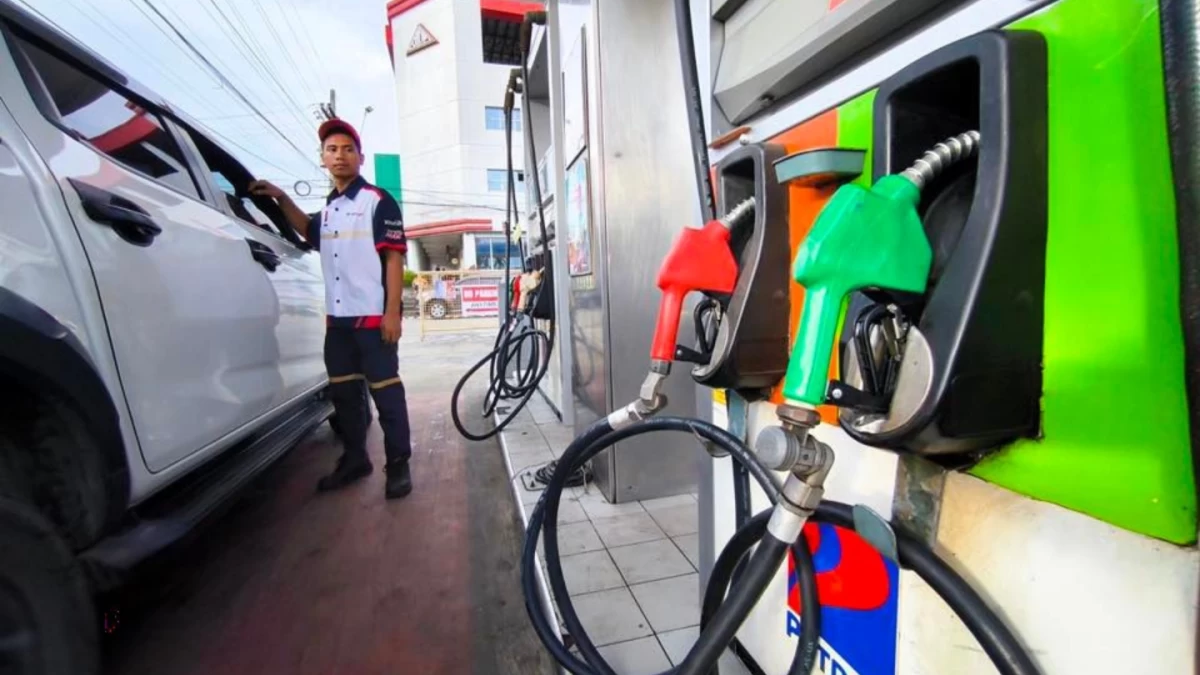
A gas station attendant refuels a vehicle in Iloilo City on Monday, March 9. While this fuel was purchased at lower rates weeks ago, retailers have raised prices to reflect “replacement costs”—the higher price they must pay to restock inventory amid global supply fears. (Photo by Tara Yap I MB)
If the gas in a station’s tank was bought weeks ago at lower rates, why are drivers paying more for it today? It’s a question being asked by everyone from tricycle drivers to truckers as oil prices spike once again.
In a deregulated market, the answer lies in replacement cost accounting. Philippine oil companies price their current inventory not on what they paid for it, but on what it will cost to buy the next shipment.
During a media briefing on Monday, March 9, Energy Secretary Sharon Garin explained that fuel retailers in the country utilize the cost-pricing system based on historical weekly averages. This allows firms to estimate the capital required to replenish supply for the following week.
Even with a mandatory 15- to 30-day inventory buffer, this week’s retail prices reflect current market volatility. By raising prices immediately, retailers secure the cash flow necessary to purchase more expensive future shipments—effectively hedging against the rising cost of the next “batch.”
“Market forces dictate the value, whether moving upward or downward,” said Michael Ricafort, chief economist at Rizal Commercial Banking Corp.
He noted that since the industry was deregulated in 1998, prices are tethered to the Mean of Platts Singapore (MOPS), the regional benchmark for refined products. “Global price movements lead to a market value shift regardless of when the oil was physically delivered.”
Under the Downstream Oil Industry Deregulation Act, the Department of Energy (DOE) is prohibited from capping prices or dictating how retailers set their margins. The agency’s mandate is limited to monitoring for “unjustified” adjustments that deviate from standard market behavior.
“Competition also helps determine the market price, though it remains subject to local regulations,” Ricafort told Manila Bulletin, suggesting that pump prices are as much a reflection of local rivalry as they are of global benchmarks.
The current price pressure stems from a perfect storm in the Middle East. Dubai crude is trading at $99.14 per barrel following the closure of the Strait of Hormuz, a critical chokepoint for global oil transit.
Supply fears have intensified following Israeli strikes on Iranian oil facilities and retaliatory measures from neighboring states.
The fallout hits the transport sector hardest. According to DOE data, the transport sector consumes nearly 85 percent (approx. 5,558 million liters) of the nation’s gasoline and 65 percent (approx. 5,851 million liters) of the nation's distillate fuel. of its diesel.
The commercial sector and power generation industries follow, though the DOE is now scrambling to diversify sources as traditional suppliers like China, South Korea, and Japan move to hoard production for domestic use. Potential new partners include Brazil, Venezuela, the United States (US), and India.
For now, the DOE warned that the outlook remains entirely unpredictable.
When asked about the future trajectory of the market, Garin offered a blunt assessment of the volatility: “Only God knows.”