ADVERTISEMENT

Philippines and South Korea sign MOU to build rocket launch framework, advance Philippine spaceport plans

Published Mar 9, 2026 09:39 am
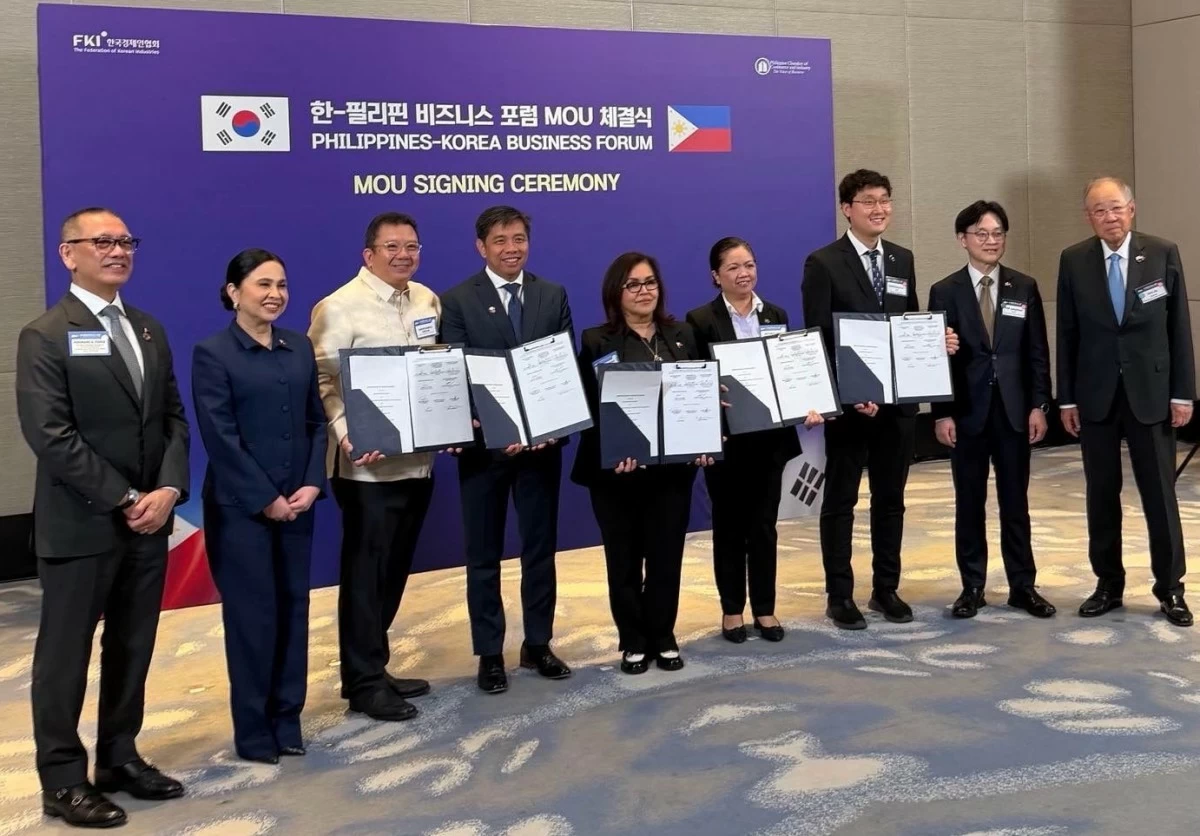
(From left) Philippine Chamber of Commerce and Industry President Ferdinand Ferrer; DTI Sec. Ma. Cristina A. Roque; Ascend President Ramon C. Garcia Jr.; DICT Secretary Henry R. Aguda; CEZA Administrator and CEO Sec. Katrina Ponce Enrile; PhilSA Ad Interim Director General Gay Jane P. Perez; Perigee Aerospace CEO Dong Yoon Shin; MOTIR Minister Kim Jung-kwan; and Federation of Korean Industries Chairman Jin Ryo Ryu. (Photo by Ramon Garcia Jr via LinkedIn)
The Philippine Space Agency (PhilSA) has signed a Memorandum of Understanding (MOU) with South Korean rocket firm Perigee Aerospace and three Philippine government bodies to establish a framework for rocket development training and experimental launches in the country, a key step toward building a dedicated Philippine spaceport.
The agreement was signed on March 4, 2026, during the Philippines–Korea Business Forum at Conrad Manila, coinciding with the state visit of Republic of Korea President Lee Jae Myung to the Philippines. Signatories included PhilSA Ad Interim Director General Gay Jane P. Perez, Department of Information and Communications Technology (DICT) Secretary Henry R. Aguda, Cagayan Economic Zone Authority (CEZA) Administrator and CEO Secretary Katrina Ponce Enrile, Perigee Aerospace CEO Dong Yoon Shin, and Ascend International Gateway President Ramon C. Garcia Jr. The signing was witnessed by DTI Secretary Ma. Cristina A. Roque and South Korean Minister of Trade, Industry and Resources Kim Jung-kwan.
During the Philippines-Korea Forum, President Ferdinand "Bong Bong" Marcos Jr, said: "All of these will ripple into significant partnerships that will generate projects, investments, and of course, livelihood."
Why the Philippines?
The Philippines' geography makes it a strong candidate for a regional launch hub. Its position near the equator reduces the fuel required to reach orbit, while its eastern coastline faces the open Pacific Ocean — enabling safe rocket launch trajectories and recovery operations over open water. These factors can lower launch costs, improve operational efficiency, and attract both research institutions and commercial space operators.
Building on Existing Technical Exchange
The MOU builds on a technology transfer and training program completed between October and November 2025, during which PhilSA engineers traveled to South Korea to work alongside Perigee Aerospace. The program covered launch vehicle systems through lectures and hands-on training in rocket assembly and testing.
The new agreement formalizes the next phase of that collaboration, which may include localized rocket assembly, testing, and launch operations within Philippine territory.
High-Level Political Backing
The MOU was signed as part of a broader set of bilateral agreements between the Philippines and South Korea spanning shipbuilding, nuclear energy, critical minerals, and health. During the forum, President Ferdinand R. Marcos Jr. highlighted the significance of the deals, stating that the business agreements across industries "demonstrate our enthusiasm for our private sector to deepen our strong economic relations."
"All of these will ripple into significant partnerships that will generate projects, investments, and of course, livelihood," the President said.
What Comes Next
PhilSA and its partners are positioning the experimental launches under this MOU as a proof of concept for a permanent Philippine spaceport. If realized, the facility would serve not just domestic space ambitions but potentially regional and international launch customers — making the Philippines a commercial and scientific gateway to orbit in Southeast Asia
ADVERTISEMENT
.most-popular .layout-ratio{ padding-bottom: 79.13%; } @media (min-width: 768px) and (max-width: 1024px) { .widget-title { font-size: 15px !important; } }

{{ articles_filter_1561_widget.title }}

.most-popular .layout-ratio{ padding-bottom: 79.13%; } @media (min-width: 768px) and (max-width: 1024px) { .widget-title { font-size: 15px !important; } }

{{ articles_filter_1562_widget.title }}

.most-popular .layout-ratio{ padding-bottom: 79.13%; } @media (min-width: 768px) and (max-width: 1024px) { .widget-title { font-size: 15px !important; } }

{{ articles_filter_1563_widget.title }}

{{ articles_filter_1564_widget.title }}

.mb-article-details { position: relative; } .mb-article-details .article-body-preview, .mb-article-details .article-body-summary{ font-size: 17px; line-height: 30px; font-family: "Libre Caslon Text", serif; color: #000; } .mb-article-details .article-body-preview iframe , .mb-article-details .article-body-summary iframe{ width: 100%; margin: auto; } .read-more-background { background: linear-gradient(180deg, color(display-p3 1.000 1.000 1.000 / 0) 13.75%, color(display-p3 1.000 1.000 1.000 / 0.8) 30.79%, color(display-p3 1.000 1.000 1.000) 72.5%); position: absolute; height: 200px; width: 100%; bottom: 0; display: flex; justify-content: center; align-items: center; padding: 0; } .read-more-background a{ color: #000; } .read-more-btn { padding: 17px 45px; font-family: Inter; font-weight: 700; font-size: 18px; line-height: 16px; text-align: center; vertical-align: middle; border: 1px solid black; background-color: white; } .hidden { display: none; }
function initializeAllSwipers() { // Get all hidden inputs with cms_article_id document.querySelectorAll('[id^="cms_article_id_"]').forEach(function (input) { const cmsArticleId = input.value; const articleSelector = '#article-' + cmsArticleId + ' .body_images'; const swiperElement = document.querySelector(articleSelector); if (swiperElement && !swiperElement.classList.contains('swiper-initialized')) { new Swiper(articleSelector, { loop: true, pagination: false, navigation: { nextEl: '#article-' + cmsArticleId + ' .swiper-button-next', prevEl: '#article-' + cmsArticleId + ' .swiper-button-prev', }, }); } }); } setTimeout(initializeAllSwipers, 3000); const intersectionObserver = new IntersectionObserver( (entries) => { entries.forEach((entry) => { if (entry.isIntersecting) { const newUrl = entry.target.getAttribute("data-url"); if (newUrl) { history.pushState(null, null, newUrl); let article = entry.target; // Extract metadata const author = article.querySelector('.author-section').textContent.replace('By', '').trim(); const section = article.querySelector('.section-info ').textContent.replace(' ', ' '); const title = article.querySelector('.article-title h1').textContent; // Parse URL for Chartbeat path format const parsedUrl = new URL(newUrl, window.location.origin); const cleanUrl = parsedUrl.host + parsedUrl.pathname; // Update Chartbeat configuration if (typeof window._sf_async_config !== 'undefined') { window._sf_async_config.path = cleanUrl; window._sf_async_config.sections = section; window._sf_async_config.authors = author; } // Track virtual page view with Chartbeat if (typeof pSUPERFLY !== 'undefined' && typeof pSUPERFLY.virtualPage === 'function') { try { pSUPERFLY.virtualPage({ path: cleanUrl, title: title, sections: section, authors: author }); } catch (error) { console.error('ping error', error); } } // Optional: Update document title if (title && title !== document.title) { document.title = title; } } } }); }, { threshold: 0.1 } ); function showArticleBody(button) { const article = button.closest("article"); const summary = article.querySelector(".article-body-summary"); const body = article.querySelector(".article-body-preview"); const readMoreSection = article.querySelector(".read-more-background"); // Hide summary and read-more section summary.style.display = "none"; readMoreSection.style.display = "none"; // Show the full article body body.classList.remove("hidden"); } document.addEventListener("DOMContentLoaded", () => { let loadCount = 0; // Track how many times articles are loaded const offset = [1, 2, 3, 4, 5, 6, 7, 8, 9, 10]; // Offset values const currentUrl = window.location.pathname.substring(1); let isLoading = false; // Prevent multiple calls if (!currentUrl) { console.log("Current URL is invalid."); return; } const sentinel = document.getElementById("load-more-sentinel"); if (!sentinel) { console.log("Sentinel element not found."); return; } function isSentinelVisible() { const rect = sentinel.getBoundingClientRect(); return ( rect.top < window.innerHeight && rect.bottom >= 0 ); } function onScroll() { if (isLoading) return; if (isSentinelVisible()) { if (loadCount >= offset.length) { console.log("Maximum load attempts reached."); window.removeEventListener("scroll", onScroll); return; } isLoading = true; const currentOffset = offset[loadCount]; window.loadMoreItems().then(() => { let article = document.querySelector('#widget_1690 > div:nth-last-of-type(2) article'); intersectionObserver.observe(article) loadCount++; }).catch(error => { console.error("Error loading more items:", error); }).finally(() => { isLoading = false; }); } } window.addEventListener("scroll", onScroll); });

Sign up by email to receive news.