






Manila Bulletin
 Business
Banking & Finance
Stocks, peso tumble as Middle East conflict stirs oil crisis
Business
Banking & Finance
Stocks, peso tumble as Middle East conflict stirs oil crisis
Business
Banking & Finance
Stocks, peso tumble as Middle East conflict stirs oil crisis
Stocks, peso tumble as Middle East conflict stirs oil crisis
By James A. Loyola and Derco Rosal
Published Mar 9, 2026 09:20 am
|
Updated Mar 9, 2026 05:52 pm


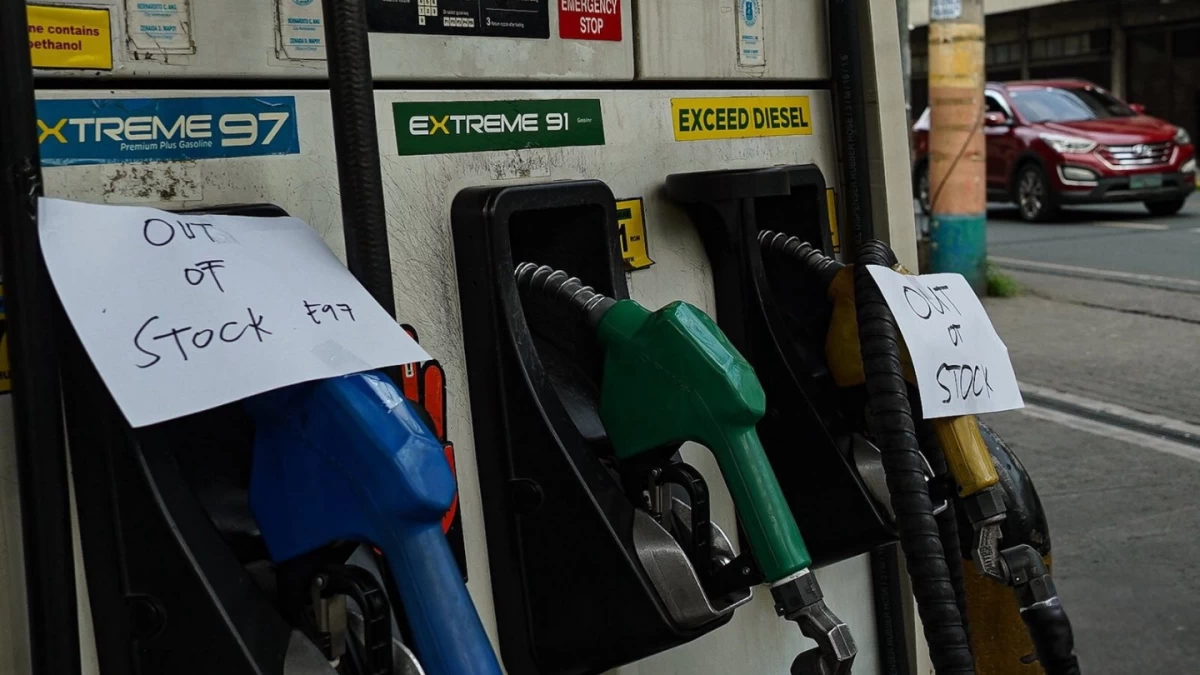
A fuel station in Paco, Manila stands dormant after exhausting its supply on Monday, March 9, 2026. Domestic energy concerns have intensified following the effective closure of the Strait of Hormuz, a move that has sent global crude prices toward $100 a barrel and triggered a “risk-off” contagion across Philippine financial markets. (Photo: John Louie Abrina I MB)
Philippine financial markets endured a dual drubbing on Monday, March 9, as an escalating crisis in the Middle East sparked a global flight to safety, sending the local equity benchmark toward a five-month low and the peso to a record weakness.
The Philippine Stock Exchange index (PSEi) retreated 4.97 percent, or 314.19 points, to close at 6,006.22. The sell-off was relentless from the opening bell, with the gauge hitting an intraday low of 5,965.03 before a modest recovery late in the session.
All 30 components of the blue-chip index ended in the red amid broad-based liquidation of positions as investors weighed the impact of the potential disruption to energy supplies through the Strait of Hormuz.
The broader All Shares index followed suit, shedding 4.24 percent to end at 3,346.75. Among sectors, holding firms were the worst performers, sliding 5.94 percent as conglomerate valuations buckled under the weight of systemic risk.
Even the mining and oil sub-index, which typically finds support during commodity spikes, succumbed to the general market panic as global risk-off sentiment overrode sector-specific fundamentals.
The equity rout was mirrored by a historic decline in the foreign exchange market. The Philippine peso weakened to a record low of 59.50 per dollar, surpassing the previous trough of 59.44 set on Jan. 14. The currency started the week at 59.25 and faced consistent pressure throughout the day as the greenback firmed globally.
Analysts noted that the "risk-off" sentiment is being driven by fears that a prolonged surge in oil prices will cripple the domestic economy and force the Bangko Sentral ng Pilipinas (BSP) to maintain a hawkish stance to defend the currency and tame inflation.
Global crude benchmarks spiked following reports of strikes on civilian targets and oil depots in the Middle East. West Texas Intermediate traded as high as $108.25 per barrel, while Brent crude jumped to $103.54, roughly 15 percent above Friday’s close.
For the Philippines, a net oil importer, the surge represents a significant threat to its trade balance and price stability.
BSP Governor Eli Remolona has signaled that the country faces substantial risks to energy costs and remittance inflows. Market participants are now bracing for the possibility of a “double pressure” scenario where a weakening currency and high energy prices trigger a feedback loop of rising costs and slowing growth.
The local bourse followed a wider slump across Asia, where Japan’s Nikkei 225 plunged more than five percent and South Korea’s Kospi sank six percent. While the 6,000-point level has served as a psychological floor for the PSEi in recent months, market analysts warn that further downside remains likely if geopolitical tensions fail to de-escalate.
Michael L. Ricafort, chief economist at Rizal Commercial Banking Corp., noted that while the index attempted to claw back above the 6,000 line, the breach of that level early in the day signals a shift in sentiment.
He warned of further downside potential as the looming oil crisis threatens to breach long-term support levels.
The dual sell-off across the nation’s financial markets reflects growing anxiety that a prolonged energy crisis will cripple the domestic economy and send inflation targets into disarray.
Jonathan Ravelas, senior adviser at Reyes Tacandong & Co., said the “risk-off” sentiment is being driven by the inflationary impact of oil, which will likely necessitate higher interest rates for longer, dampening the prospects for a near-term economic rebound.
Juan Paolo Colet, managing director at ChinaBank Capital Corp., characterized the market as being in full retreat in the face of oil prices hovering around $100 per barrel.
He warned that the prospect of a prolonged war would exacerbate the hardship for ordinary Filipinos as pump prices are expected to surge in the coming days. Analysts at Abacus Securities Corp. added that the market had previously underpriced the risk of a regional escalation.
With the Strait of Hormuz effectively closed for the first time in modern history, there is significant uncertainty regarding the global energy supply chain. Stephen Innes of SPI Asset Management described the situation as an “oil alarm bell” that sounded like a fire siren for macro traders.
Surging oil and gas prices, if they persist, could ripple across the globe, further complicating matters for countries still adjusting to higher tariffs and shifting trade policies.
Senior officials of Southeast Asian countries were meeting this week in Manila, where they were expected to discuss ways to counter the shock from higher energy costs.
Ipek Ozkardeskaya of Swissquote noted that while oil prices will eventually reach a peak, they are likely to fluctuate at elevated levels for weeks or months, reviving inflation globally and weighing notably on growth. The combination of a weak economy and high inflation remains a worst-case scenario for investors, leaving central banks with few effective tools to address both issues simultaneously.