






Manila Bulletin
 Philippines
National
PAGASA declares end of La Niña; neutral climate conditions return
Philippines
National
PAGASA declares end of La Niña; neutral climate conditions return
Philippines
National
PAGASA declares end of La Niña; neutral climate conditions return
PAGASA declares end of La Niña; neutral climate conditions return
Published Mar 9, 2026 07:14 pm


PAGASA PHOTO
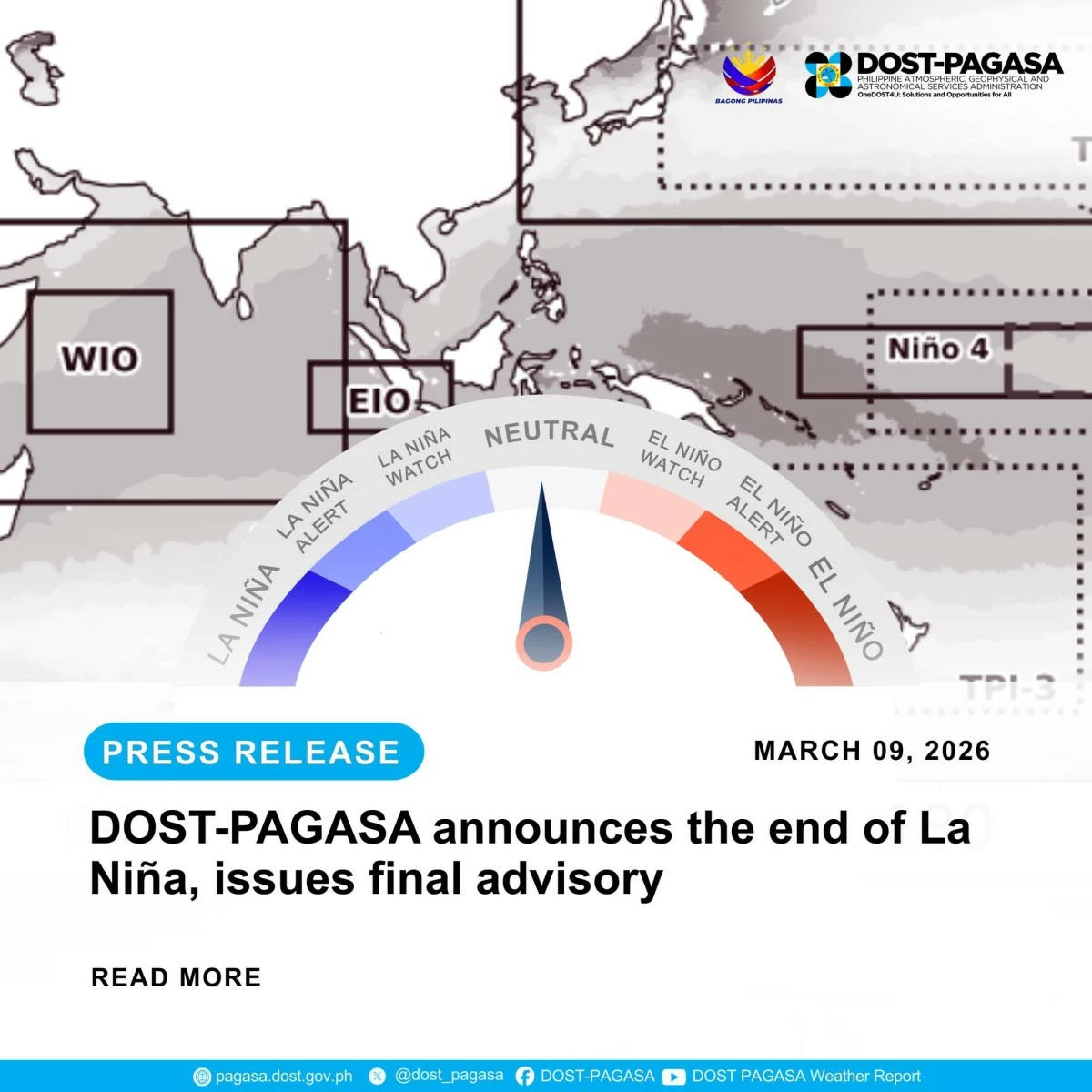
The Philippine Atmospheric, Geophysical and Astronomical Services Administration (PAGASA) on Monday, March 9 announced the end of the La Niña phenomenon, saying climate conditions in the tropical Pacific have returned to neutral levels.
In an advisory, PAGASA said the Oceanic Niño Index in the tropical Pacific now indicates a return to El Niño–Southern Oscillation (ENSO)-neutral conditions, prompting the agency to release its final advisory for the 2025–2026 La Niña episode.
With this development, PAGASA said its ENSO Alert and Warning System has been lowered to ENSO-neutral status.
ENSO-neutral refers to a climate state when neither El Niño nor La Niña is present.
During this phase, sea surface temperatures in the equatorial Pacific Ocean are generally near average and the atmosphere-ocean system does not strongly favor either wetter or drier climate conditions.
Model forecasts also suggest that ENSO-neutral conditions are likely to persist from the January–February–March season through the June–July–August 2026 period.
PAGASA earlier raised a La Niña Alert on Sept. 15, 2025, indicating a high likelihood that the phenomenon would develop between October and December 2025.
The agency later confirmed the onset of La Niña in early December 2025 and said the weak episode could persist until the first quarter of 2026.
La Niña is characterized by cooler-than-normal sea surface temperatures in the central and eastern equatorial Pacific Ocean, a condition that typically enhances rainfall in parts of the Philippines and increases the likelihood of floods and landslides.
Despite the end of La Niña, PAGASA said other weather and climate systems may still influence rainfall distribution across the country.
Rain-bearing weather systems could still bring occasional heavy rainfall that may trigger flash floods and rain-induced landslides in vulnerable areas.
PAGASA said it will continue to monitor weather and climate conditions in the country and provide updates when necessary, while advising the public and concerned government agencies to remain vigilant and take appropriate precautionary measures to minimize the impacts of weather- and climate-related hazards.