






 Business
The Stock Market
Oil spike, weak peso wipe out ₱672 billion from Philippine stocks
Business
The Stock Market
Oil spike, weak peso wipe out ₱672 billion from Philippine stocks
Oil spike, weak peso wipe out ₱672 billion from Philippine stocks


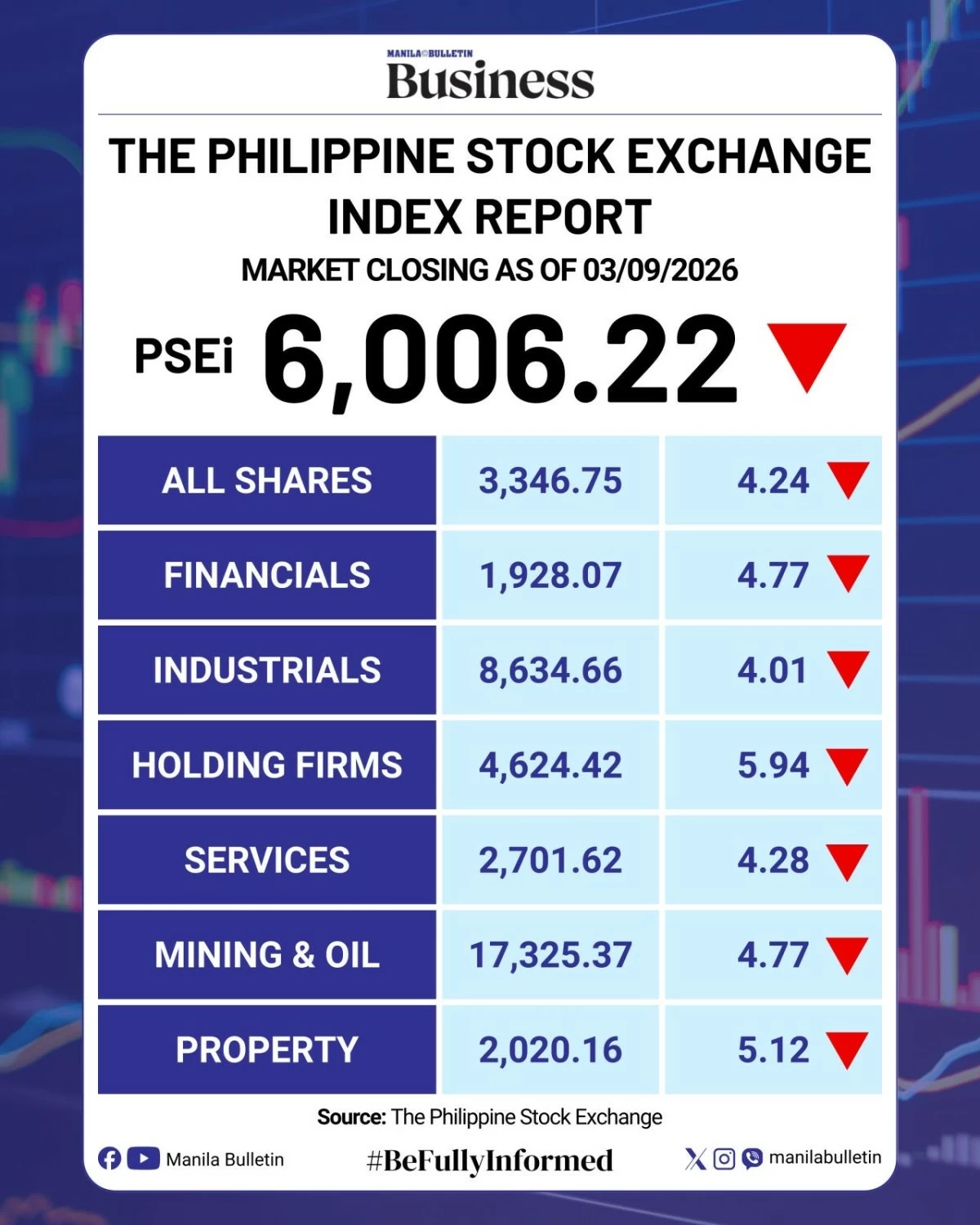
The local stock market lost ₱671.7 billion in market capitalization on Monday, March 9, as the benchmark Philippine Stock Exchange Index (PSEi) plunged to the 6,000 level after the Iran war fueled a surge in oil prices while the peso plunged to a new record low.
Philippine Stock Exchange (PSE) data showed that market capitalization fell to ₱18.47 trillion on Monday from ₱19.14 trillion last Friday, March 6, after the index dropped by 314.19 points, or 4.97 percent, to close at 6,006.22. The PSEi visited the 5,900 level in early trades as investors engaged in panic selling.
Conglomerates saw the biggest loss among all sectors as 205 stocks lost ground while 28 gained and 41 were unchanged. Volume rose to 2.54 billion shares worth ₱11.08 billion.
“The Philippine market declined sharply amid escalating tensions in the Middle East, which dampened investor sentiment and risk appetite across global markets,” said Regina Capital Development Corp. managing director Luis Limlingan.
He noted that global oil prices surging above $100 per barrel raised inflation concerns and increased the risk of tighter monetary policy from the Bangko Sentral ng Pilipinas (BSP).
Unicapital Securities Inc. research head Wendy Estacio-Cruz said the drop was largely driven by a global risk-off reaction to escalating Iran-Middle East tensions, which pushed oil prices higher amid concerns about potential disruptions in the Strait of Hormuz, a critical artery for global oil supply.
For the Philippines, a net oil importer, the spike in crude raises near-term inflation risks and could delay monetary easing, dampening sentiment toward consumer and property plays.
She added that, “The geopolitical uncertainty has also triggered a flight to safe-haven assets, strengthening the United States (US) dollar and prompting foreign outflows from emerging markets (EMs), including the Philippines.”
Philstocks Financial Inc. research manager Japhet Tantiangco said, “Worries rose as the spike in oil prices and the depreciation of the peso are expected to pose upside risks to inflation.”
Rizal Commercial Banking Corp. (RCBC) chief economist Michael L. Ricafort pointed out that if local inflation breaches the two- to four-percent target, there could be a BSP rate hike, as signaled by Governor Eli M. Remolona Jr. last Friday.
He added that rising oil prices and higher inflation would also reduce the odds of future US Federal Reserve (Fed) rate cuts.