






Manila Bulletin
 Philippines
National
Beyond 'duck, cover, and hold': OCD to pilot test family, business, gov't service survival plans in March 12 drill
Philippines
National
Beyond 'duck, cover, and hold': OCD to pilot test family, business, gov't service survival plans in March 12 drill
Philippines
National
Beyond 'duck, cover, and hold': OCD to pilot test family, business, gov't service survival plans in March 12 drill
Beyond 'duck, cover, and hold': OCD to pilot test family, business, gov't service survival plans in March 12 drill
Published Mar 9, 2026 02:57 pm


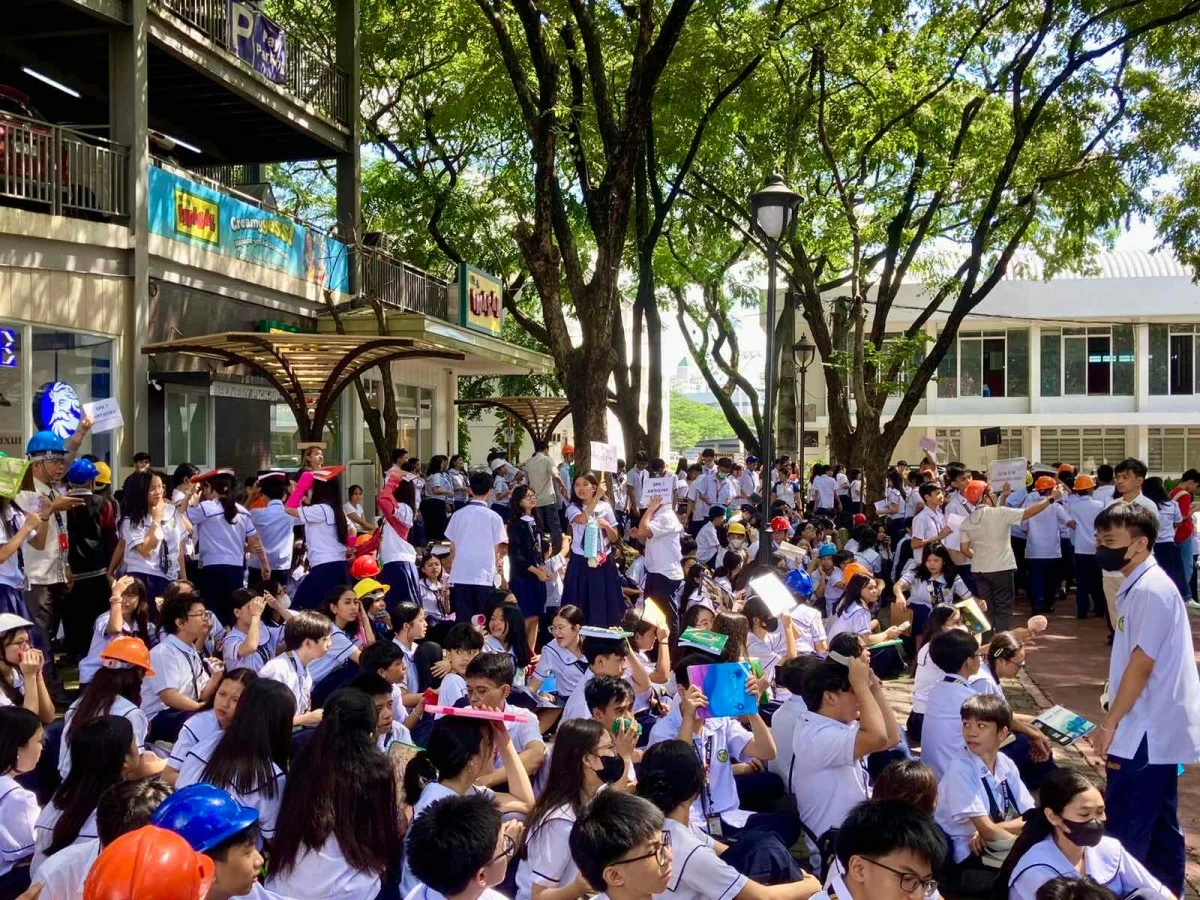
Students are seen participating in the city-wide earthquake simulation drill at the Marikina Freedom Park on Oct. 20, 2025. (Photo from Marikina LGU)
The Office of Civil Defense (OCD) will expand the focus of the upcoming first quarter Nationwide Simultaneous Earthquake Drill (NSED) beyond the usual “duck, cover, and hold” response as it will test how families, government offices, and businesses continue functioning after the shaking stops.
OCD spokesperson Junie Castillo said the drill will be conducted on Thursday, March 12, at 3:30 p.m. which seeks to highlight preparedness plans that go beyond the first minute of a strong quake.
“Kung drill ang pag-u-usapan, duck, cover, and hold—and beyond. Kasi ang duck cover and hold that’s for the first 60 seconds (If we are talking about drills, it should be duck, cover, and hold—and beyond. Because duck, cover, and hold is only for the first 60 seconds),” he said on Monday, March 9.
“And then for the next 60 minutes, dapat may ginagawa pa tayo, mag-evacuate, mag-accounting ng kumpleto ba papunta sa evacuation area. Saan ang evacuation? After that, mag-iinspect ng building ang safety officers, so may iba pang dapat gawin (And then for the next 60 minutes, we should still be doing something like evacuating, accounting for everyone to check if all have reached the evacuation area. Where is the evacuation site? After that, safety officers should inspect the building, so there are still other things that need to be done),” he added.
The quarterly NSED is a nationwide preparedness exercise conducted by the OCD to improve public response during earthquakes. The drill has long promoted the “duck, cover, and hold” technique which involves taking cover under sturdy furniture while protecting the head and neck during shaking.
The OCD explained that while the basic response must be automatic, it is no longer enough since the goal is to ensure that families can reunite and essential services can survive a major tremor.
Public service and business continuity plans
This year's advocacy will highlight the Public Service Continuity Plan (PSCP) for government offices which outlines how agencies will maintain “non-negotiable” functions during a disaster.
“Alam ba sa opisina kung anong role nila sa PSCP? Ang PSCP kasi basically plano ito sa gobyerno kung paano maitutuloy-tuloy, ang serbisyo (Do those in the office know their roles in the PSCP? The PSCP is basically a plan for the government on how to ensure the continuous delivery of services),” Castillo explained.
This includes identifying the backup power supply, staffing composition, activation of the disaster control group, and defining their roles and functions.
“Mayroon din itong counterpart sa private sector, ito naman ang Business Continuity Plan (BCP) (There is also a counterpart for the private sector which we call the Business Continuity Plan),” Castillo noted.
Castillo mentioned that the focus on BCP stemmed from lessons learned during the COVID-19 pandemic when “everything shut down.”
He said the OCD aims to prevent a total shutdown of the economy by ensuring businesses have a roadmap for service or product delivery even when infrastructure is compromised.
Essentially, the PSCP ensures that public services like health, security, and social welfare do not stop when a disaster strikes while the BCP aims to protect business assets, personnel, and sees to it that products or services remain available to customers.
Family reunification plan
Another critical component of the upcoming earthquake drill is the family reunification plan, where each member of the family knows where to go so they could reunite in the event of a disaster.
Castillo said that if a disaster strikes at daytime, many households are separated since parents are often at work while children are in school.
He explained that families should agree on meeting points even if communication lines fail.
“Dapat napag-uusapan ito. Paano kung walang signal? Paano tayo magkikita-kita? Paano natin malalaman saan tayo pupunta? (This should be discussed. What if there is no signal? How will we meet each other? How will we know where to go?),” he said.
“Maraming pamilya o schools na ang mayroong family reunification plan. Meaning napag-usapan nila saan ba tayo magkikita-kita. Hindi tayo magkokontakan pero doon tayo pupunta sa ganito (Many families or schools already have a family reunification plan. It means they have discussed where they will meet. They may not be able to contact each other but they know they will all go to that specific place),” he added.
Muscle memory
Castillo urged local government units, large companies, and business districts to join the earthquake drill.
He said repeated drills remain necessary so the response becomes automatic or a “muscle memory.”
“Kailangan pa rin natin gawin ito kasi ‘yung duck, cover, and hold, itinaas natin ang kamalayan ng mga kababayan natin para maging muscle memory siya. Ibig sabihin, kapag lumindol hindi ka na nag-iisip kung ano ang gagawin mo kasi automatic na ‘yun ang gagawin natin (We still need to do this because through duck, cover, and hold, we have raised the awareness of our fellow citizens so that it becomes muscle memory. It means that when an earthquake strikes, you no longer have to think about what to do because it will automatically be your response),” he explained.
If some establishments cannot join the exact time of the nationwide drill, Castillo said they should still conduct their own exercises.
“Doon sa hindi pa sumusunod, if these are under locality, we have partnerships with private sectors, we advocate that. Kung hindi sumabay, at least dapat ginagawa on a separate date (For those who are not yet complying, if they are within a locality, we have partnerships with the private sector and we advocate that. If they cannot join the drill at the same time, they should at least conduct it on a separate date),” Castillo concluded.