






 Business
Trade & Industry
ACEN profit drops 60% on weaker prices despite higher renewable output
Business
Trade & Industry
ACEN profit drops 60% on weaker prices despite higher renewable output
ACEN profit drops 60% on weaker prices despite higher renewable output


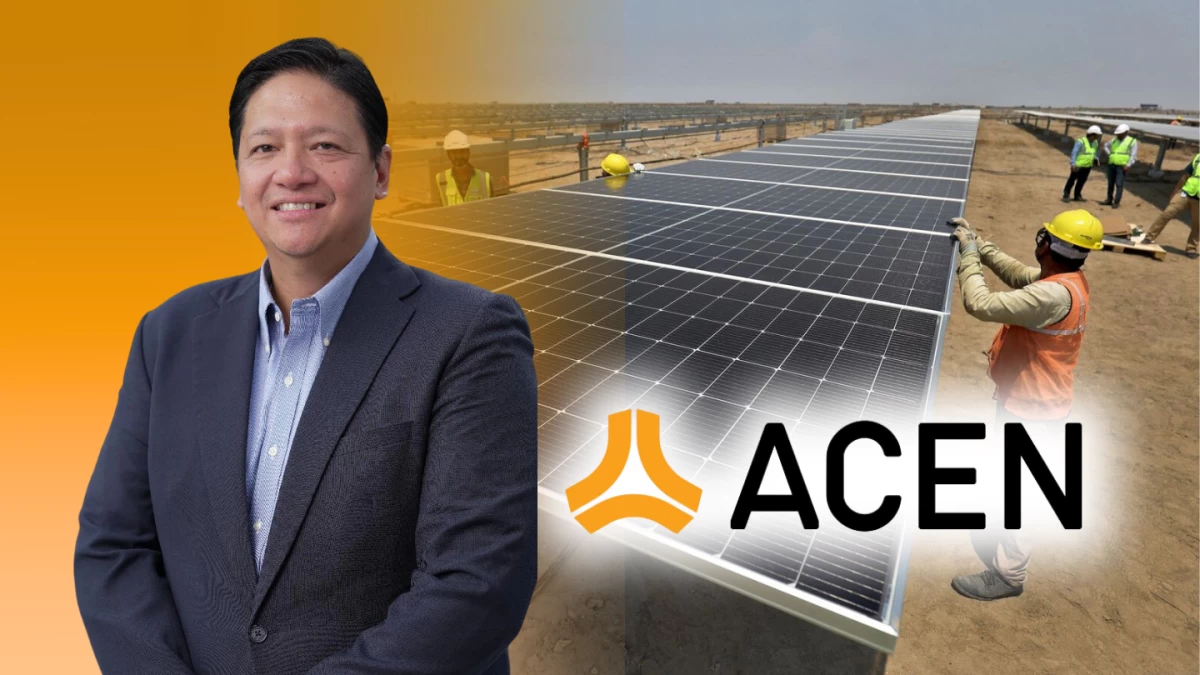
Ayala-led ACEN Corp. announced that lower wind generation, reduced solar irradiance, and weaker prices at the Wholesale Electricity Spot Market (WESM) dragged down its consolidated net income by 60 percent despite better renewable output in 2025.
In a disclosure to the Philippine Stock Exchange (PSE) on Monday, March 9, ACEN reported that its net income dropped significantly to ₱3.8 billion from ₱9.36 billion in 2024.
According to the renewable energy (RE) firm, lower WESM prices locally and in Australia also decreased statutory revenues by 14 percent to ₱32 billion.
Weaker solar irradiance and offline wind projects in northern Luzon, even after resuming operations, also affected the company’s financial performance.
ACEN’s RE output, however, expanded by 24 percent to 7,009 gigawatt-hours (GWh). This was driven by new operating assets in its international investments, particularly the Stubbo solar in Australia and Monsoon wind in Laos.
In its domestic market, RE generation marginally increased by two percent to 1,866 GWh, slightly boosted by wind turbine repairs in Ilocos Norte province in the last quarter of the year. Its RE solutions, on the other hand, reached 482 megawatts (MW), expanding its customer base by 753. New clients include San Beda College Alabang, Avida Towers Asten, and Eastwood Excelsior Condominium.
Based on the latest data, ACEN Renewable Energy Solutions (ACEN RES) holds a 57-percent market share of the Green Energy Option Program (GEOP), which allows electricity consumers—especially large users—to choose RE sources for their power supply instead of automatically buying from conventional or fossil fuel-based grids.
Australia’s renewable output likewise grew 84 percent to 1,400 GWh due to the 520-MW Stubbo solar project, which began operating last year. The company’s 200-MW New England battery energy storage system (BESS) is set to finish construction in the first half of next year.
In India, RE production marginally increased by seven percent to 769 GWh as its Masaya solar project and the partial commissioning of the Maharashtra hybrid project began contributing to the company’s overall renewable generation.
Construction is advancing on several key projects, including the 420-MW Tejorupa solar, 399-MW Sheo 2 hybrid, 389-MW Sheo 1 hybrid, and 120-MW Bijapur wind, all of which are slated for substantial completion between 2026 and 2027.
Last month, ACEN consolidated the ACEN-UPC Renewables joint venture (JV) through its subsidiary, ACEN Renewables International Pte. Ltd. (ACRI). This move gave the company full ownership of more than 1,059 MW of operational and under-construction projects, along with a pipeline of nearly seven gigawatts (GW) of additional renewable assets.
Laos also saw a 29-percent improvement in its RE output to 1,866 GWh, driven by the Monsoon wind project, the full-year impact of the 2024 acquisition of an additional stake in its JVs, and better average wind speeds.
In 2025, ACEN’s other international markets generated 1,068 GWh, marking a 19-percent increase from the previous year.
Power output from ACEN’s Salak and Darajat geothermal power plants in Indonesia inched up three percent year-on-year, while the 40-MW Salak unit 7 expansion is 38-percent complete and expected to start operations by 2027. - Gabriell Christel Galang