






Manila Bulletin
 Philippines
National
Stratbase: Maritime coercion in WPS should be met with firm, decisive pushback
Philippines
National
Stratbase: Maritime coercion in WPS should be met with firm, decisive pushback
Philippines
National
Stratbase: Maritime coercion in WPS should be met with firm, decisive pushback
Stratbase: Maritime coercion in WPS should be met with firm, decisive pushback
Published Mar 8, 2026 03:28 pm


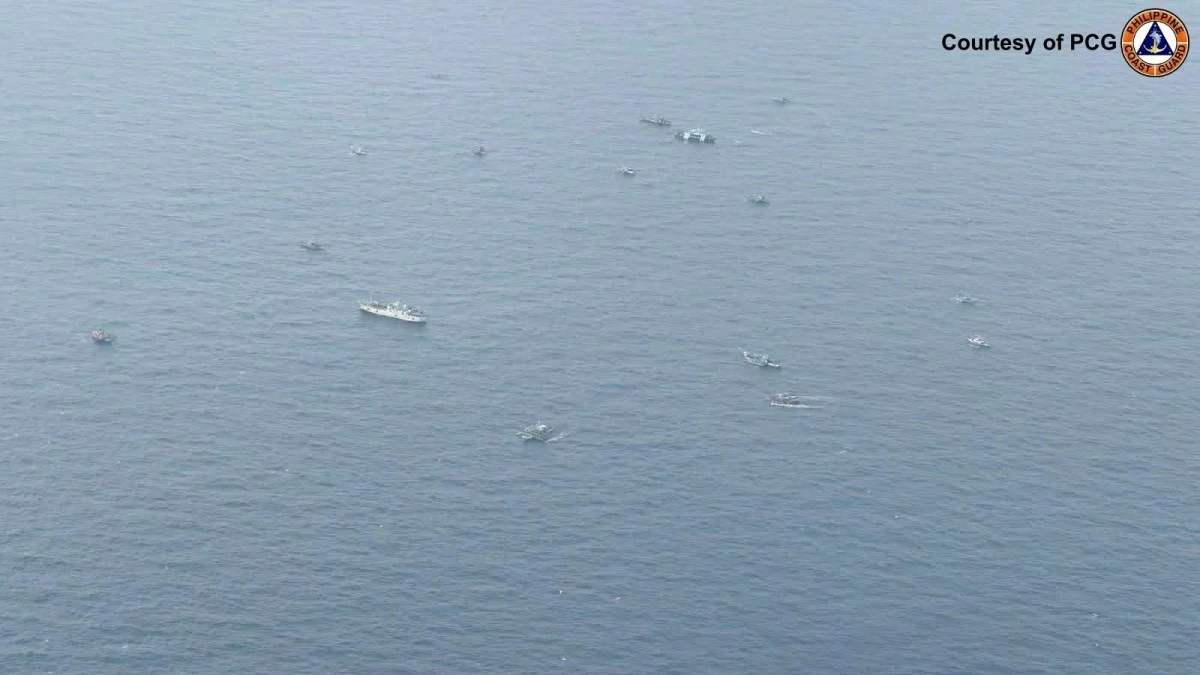
The Philippine Coast Guard (PCG) conducts an aerial patrol over Bajo de Masinloc in the West Philippine Sea (WPS) where at least 35 Filipino fishing boats are gathered to fish in their traditional fishing ground, on Feb. 23, 2026. (Photo: PCG)
The national government should continue the firm and coordinated decisive measures in addressing harassment and coercion in the West Philippine Sea, , Stratbase Institute President Victor Andres “Dindo” Manhit said.
During a forum in Makati City, Manhit cited data showing 64 cases of what the Philippine Coast Guard described as illegal, coercive and aggressive actions against Philippine missions or vessels in 2025.
He said they involved dangerous maneuvers, shadowing, water cannon attacks, collisions, radio challenges, and live-fire exercises.
“These are only the incidents that were reported and made public. Far from the cameras and the headlines, many more acts of intimidation occur at sea—often involving Filipino fishermen and frontline personnel who continue to operate under constant pressure and uncertainty,” Manhit said.
“The growing frequency and intensity of these incidents are deeply alarming. Such behavior, as we have stressed time and again, should not and cannot be normalized or tolerated. It must be met with firm, coordinated, and decisive measures to end this persistent pattern of coercion,” he added.
Fir his part, National Security Adviser Eduardo Año said such actions are designed to alter facts on the water while remaining below the threshold of armed conflict, adding that the 2016 arbitral award invalidated China’s illegal nine 10-dash line claim.
This affirmed the Philippines’ sovereign rights within its EEZ and clarifying the legal status of certain maritime features. More fundamentally, it reinforced the principle that disputes must be resolved through law rather than force,” said Año.
Manhit added that the Philippines “cannot—and should not—stand alone” in the efforts to promote a free, open, and rules-based Indo-Pacific region, through which nearly two-thirds of global trade passes.
“This is why the issue before us is not solely a Philippine concern. It is a regional and global one,” he said.
“Safeguarding the maritime domain is not simply about defending territory. It is about defending the principles that allow nations—large and small—to coexist peacefully: respect for international law, freedom of navigation, and the peaceful management of disputes.”
The key, he said, was to forge stronger and more coordinated partnerships among like-minded nations – including the United States, Australia, Japan, Canada, New Zealand, France, and India – that “believe in openness, transparency, and the peaceful resolution of disputes.”
Hosted by Stratbase Institute and the Japan Institute of International Affairs, the symposium brought together leading scholars, policymakers, and practitioners across the Indo-Pacific region to discuss how countries in the region could better cooperate within the Free and Open Indo-Pacific (FOIP) framework, which marks its 10th anniversary this year.
Introduced by former Japanese Prime Minister Shinzo Abe in 2016, the FOIP covers three pillars: the promotion and establishment of fundamental values like rule of law and freedom of navigation; pursuit of economic prosperity; and commitment for peace and stability.
Now, the framework must “evolve at this juncture...[as] the world has changed considerably” since its inception, said Japanese ambassador to the Philippines H.E. Endo Kazuya.
He stressed that Japan “places the utmost value on its collaboration with the Philippines” and that like-minded partners “must work together to uphold and reinforce a free and open international order.”
Endo noted, for example, that they anticipate “strengthened participation” of the Japan Self-Defense Forces in the upcoming Balikatan exercises.