






Manila Bulletin
 Philippines
National
DepEd NCR conducts first unified science high school admissions test for Grade 7
Philippines
National
DepEd NCR conducts first unified science high school admissions test for Grade 7
Philippines
National
DepEd NCR conducts first unified science high school admissions test for Grade 7
DepEd NCR conducts first unified science high school admissions test for Grade 7
Published Mar 7, 2026 10:55 am
|
Updated Mar 7, 2026 01:22 pm


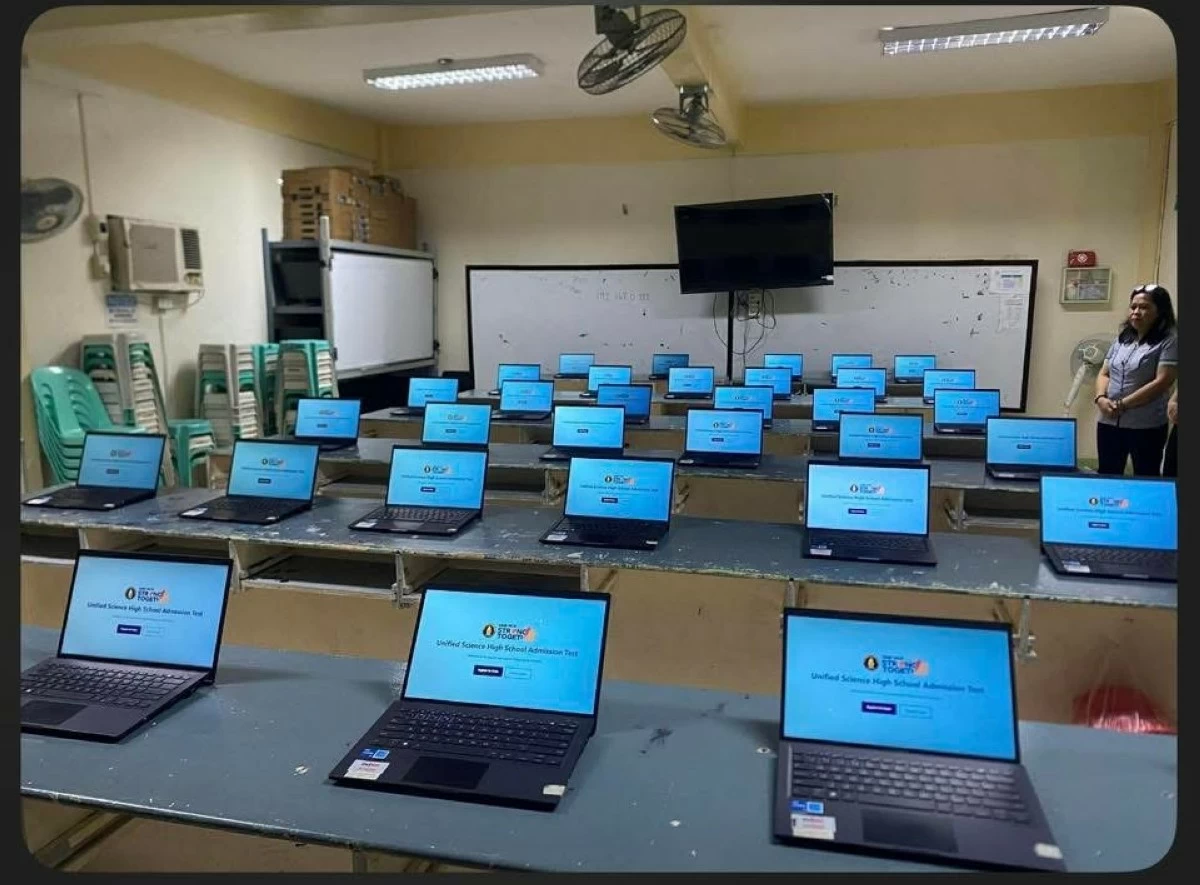
The Department of Education (DepEd)–National Capital Region (NCR) conducted the Unified Science High School Admissions Test (USHAT) 2026 on March 7, 2026, introducing a standardized, computer-based entrance exam for science high schools across Metro Manila. (DepEd photo)
The Department of Education–National Capital Region (DepEd NCR) on Saturday, March 7, conducted the first Unified Science High School Admissions Test (USHAT) 2026, a standardized entrance examination designed to streamline and modernize the admission process for science high schools across Metro Manila.
Based on the briefer sent to the Manila Bulletin, the unified test aims to ensure a fair, transparent, and merit-based selection of Grade 6 learners aspiring to enroll in Regional and Legislated Science High Schools for School Year (SY) 2026–2027.
Unified admissions system for NCR science high schools
DepEd Assistant Secretary and concurrent DepEd NCR Regional Director Jocelyn “Joyce” Andaya explained that the USHAT was introduced to address long-standing concerns about the varied entrance examinations and standards previously used by science high schools in the region.
“Over the years, admissions to Science High Schools in NCR have been characterized by varied entrance examinations, differing standards, and non-uniform testing modalities,” Andaya said.
In earlier years, DepEd NCR noted that each school administered its own admissions test, resulting in multiple exams for applicants, inconsistent standards, and an increased testing burden for families.
“While these locally developed assessments reflect contextual needs, the absence of a harmonized admissions framework has resulted in inequities among applicants, duplication of testing burdens for families, and challenges in ensuring comparability of results across schools,” Andaya said. “These conditions underscore the need for a unified, region-wide admissions assessment that upholds equity, transparency, and technical soundness,” she added.
The new system establishes one admissions test and one application process for all participating science high schools in Metro Manila.
During the examination, students will indicate their top five preferred science high schools, and their scores will be ranked within each chosen school’s applicant pool based on available slots.
Under the leadership of DepEd Secretary Sonny Angara, the move is part of DepEd NCR’s initiative to promote harmonization, data-driven governance, and learner-centered policies across special curricular programs.
Computer-based test aligned with curriculum reforms
The USHAT 2026 is administered through computer-based testing (CBT), marking a shift toward digital assessment systems in basic education.
The CBT modality does not necessarily require internet connectivity and may be conducted through local area networks or secured offline systems, allowing testing centers to operate even in environments with limited internet infrastructure.
According to DepEd NCR, the adoption of computer-based testing aims to improve test security and reliability, ensure standardized test delivery, enable efficient data capture and analysis, and support the government’s digital transformation in education.
DepEd Chief Media Relations Officer Dennis E. Legaspi, on the other hand, noted that the initiative aligns with the recommendations of the Second Congressional Commission on Education (EDCOM II), which called for assessment reform and increased use of technology in national education systems.
Test coverage focuses on higher-order thinking skills
Unlike traditional entrance exams that emphasize memorization, the USHAT is designed to measure higher-order thinking skills and competencies aligned with the Enhanced Kindergarten to Grade 10 Curriculum.
“The test also seeks to reduce inequities and multiple entrance exams, generate reliable data for evidence-based placement and school planning, support digital transformation through computer-based testing, and promote equitable access by selecting learners based on merit and potential,” Andaya explained.
The test evaluates applicants across several domains:
- Scientific Literacy and Process Skills (30 percent) – observation, data interpretation, hypothesis formulation, and experimental design
- Mathematical and Quantitative Reasoning (30 percent) – problem-solving, number sense, patterns, and logical inference
- Reading Comprehension and Critical Thinking (25 percent) – understanding texts and analyzing arguments in science-related contexts
- Abstract and Spatial Reasoning (15 percent) – pattern recognition and non-verbal logic
The exam also includes a Social and Emotional Learning (SEL) component, which gathers information on students’ motivation, perseverance, collaboration, and readiness to thrive in academically rigorous environments. The SEL section is not graded and will not affect admissions scores but will be used for learner profiling and support.
Categories determine next phase of admission
Results of the USHAT are expected to be released approximately two weeks after the exam, with applicants classified into three categories:
Category A – students with scores of 75 percent and above, automatically eligible for interview
Category B – students with scores between 60 percent and 74 percent, placed on a waiting list and considered for an interview depending on available slots
Category C – students scoring below 60 percent
For Quezon City Science High School, the region’s designated regional science high school, additional criteria apply. Applicants must obtain at least 75 percent overall and a minimum of 75 percent in each domain to qualify under Category A.
Nearly 8,000 expected examinees across NCR
The unified admissions test covers 18 public science high schools in the National Capital Region, including the regional science high school and 17 legislated science high schools.
Among the schools with the highest number of expected examinees are Quezon City Science High School (1,470 examinees), Manila Science High School (1,032 examinees), Pasig City Science High School (667 examinees), and Marikina Science High School (594 examinees).
Overall, several thousand Grade 6 students from both public and private elementary schools are expected to participate in the USHAT.
Key dates for USHAT 2026 admissions process
DepEd NCR outlined the following timeline for the admissions process this year: January 20 to February 20, 2026 for submission of applications; February 25 for the release of successful applicants; March 7 for the conduct of USHAT 2026; March 25 for the release of the list of applicants qualified for interview; the second week of April 2026 for interviews of shortlisted applicants; the third week of April 2026 for the release of the final list of passers; and the fourth week of April 2026 as the enrollment deadline.
Strict test security and data privacy measures
DepEd NCR emphasized that data privacy, test security, and assessment integrity are central to the implementation of the USHAT.
Security measures include controlled access to testing systems, strict handling of test materials, and the prohibition of recording or distributing test content.
Any violations—such as unauthorized access, coaching during the exam, or falsification of results—may lead to administrative or legal sanctions under existing DepEd and civil service regulations.
Toward a more equitable science education system
Andaya noted that the unified admissions system reflects the region’s broader initiative — “One NCR: Stronger Together” — which promotes coordinated policies and shared standards among science high schools.
By implementing the USHAT, DepEd NCR hopes to establish a more streamlined, equitable, and data-driven admissions system that identifies learners with strong potential in science, technology, engineering, and mathematics (STEM).
DepEd added that the initiative will help science high schools better nurture future Filipino scientists, engineers, and innovators who can contribute to national development.
“By working together to establish the Unified Science High School Admissions Test, the region moves toward a more streamlined, fair, and data-informed admissions system that supports the identification and development of learners with strong potential in science, technology, and innovation,” Andaya said.