






Manila Bulletin
 Philippines
National
Rockfalls, lava flows continue as Mayon Volcano eruption enters 60th day
Philippines
National
Rockfalls, lava flows continue as Mayon Volcano eruption enters 60th day
Philippines
National
Rockfalls, lava flows continue as Mayon Volcano eruption enters 60th day
Rockfalls, lava flows continue as Mayon Volcano eruption enters 60th day
Published Mar 6, 2026 11:18 am
|
Updated Mar 6, 2026 01:19 pm


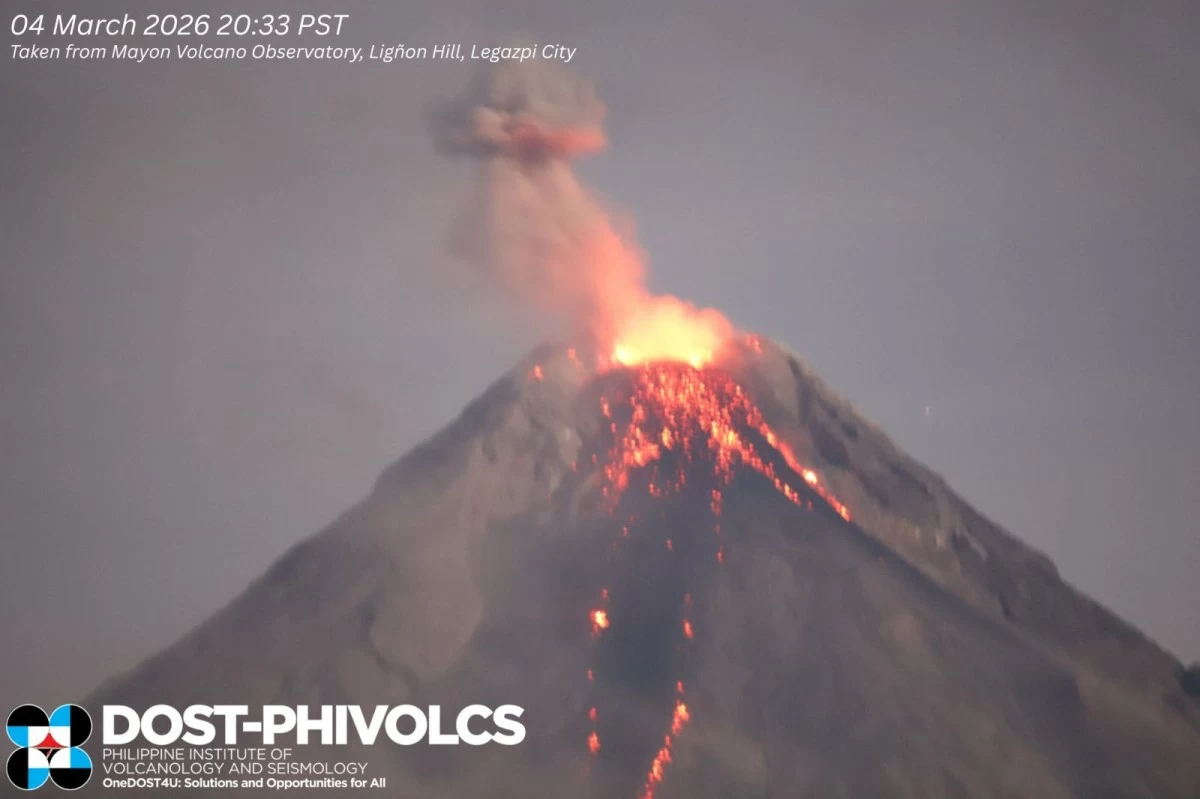
Photo shows minor strombolian activity at 8:33 p.m. on March 4, 2026 at Mayon Volcano in Albay. The effusive eruption continues to generate incandescent lava flows, pyroclastic density currents or “uson,” and rockfalls. Alert Level 3 remains in effect. Entry into the six-kilometer permanent danger zone is strictly prohibited. (Photo from the Philippine Institute of Volcanology and Seismology)
Effusive unrest at Mayon Volcano reached its 60th day on Friday, March 6, with persistent lava flows, volcanic earthquakes, and occasional explosive bursts, the Philippine Institute of Volcanology and Seismology (Phivolcs) said.
In its latest bulletin, Phivolcs said monitoring from 12 a.m. on March 5 to 12 a.m. on March 6 showed continued lava effusion feeding flows along three gullies on the volcano’s southern and eastern slopes.
Lava flows remained steady at 3.8 kilometers along the Basud gully, 2.9 kilometers along the Bonga gully, and 1.3 kilometers along the Mi-isi gully.
Occasional strombolian activity was also observed, a type of eruption that involves small but explosive bursts of lava that shoot upward, often producing short-lived glowing lava fountains.
Phivolcs also recorded 333 rockfall events, 48 volcanic earthquakes, and four pyroclastic density currents (PDCs), or fast-moving clouds of hot gas, ash, and volcanic debris locally known as “uson.”
A fair crater glow was also visible to the naked eye, indicating the presence of molten material at the summit.
Sulfur dioxide emission remained elevated at 1,139 tons on March 5.
Meanwhile, a one-kilometer plume was observed rising from the crater with moderate emission. The plume drifted southwest to north-northeast.
Mayon remains under Alert Level 3, which indicates intensified magmatic unrest and the potential for hazardous eruptions.
Phivolcs warned that ongoing activity may continue to generate lava flows, collapse-fed rockfalls, and PDCs, while possible lava fountaining or moderate explosions could affect all sectors around the volcano.
It reiterated that entry into the six-kilometer permanent danger zone is strictly prohibited.
Residents living within an eight-kilometer radius were also advised to remain prepared for possible evacuation should monitoring parameters escalate and the alert level be raised to Alert Level 4.
Mayon entered a period of magmatic eruption on Jan. 6.
Since then, its activity has been characterized by lava effusion, or the non-explosive outpouring of lava from the summit crater, generating lava flows as well as collapse-fed rockfalls and pyroclastic density currents, locally known as “uson,” which are hazardous mixtures of hot volcanic gas, ash, and fragmented rock.