






Manila Bulletin
 Philippines
National
PAGASA inaugurates Iloilo radar, breaks ground for new synoptic station
Philippines
National
PAGASA inaugurates Iloilo radar, breaks ground for new synoptic station
Philippines
National
PAGASA inaugurates Iloilo radar, breaks ground for new synoptic station
PAGASA inaugurates Iloilo radar, breaks ground for new synoptic station
Published Mar 6, 2026 01:54 pm


Screenshot
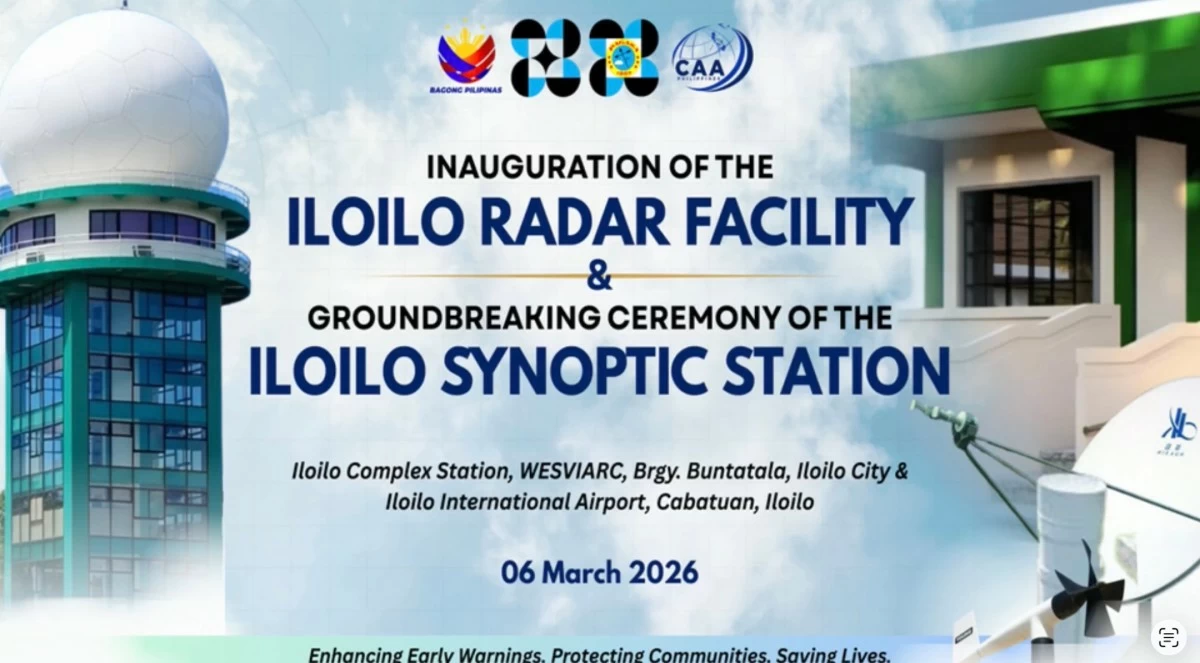
The Philippine Atmospheric, Geophysical and Astronomical Services Administration (PAGASA) marked two key milestones in the country’s weather modernization program on Friday, March 6, with the inauguration of the Iloilo Radar Facility and the groundbreaking of a new synoptic station at Iloilo International Airport.
The Iloilo S-band Radar Facility, equipped with a dual-polarimetric Doppler radar system, will enhance weather monitoring across Western Visayas and nearby provinces, providing high-resolution, near real-time data to track heavy rainfall, severe thunderstorms, and tropical cyclones.
Operating at lower frequencies with longer wavelengths, the radar remains effective even during intense rainfall, enabling large-scale, reliable weather observations.
During his keynote address, Science and Technology Secretary Renato U. Solidum Jr. stressed the need to pair advanced technology with expert personnel and community awareness.
“It is the combination of technology, skilled scientists, proactive leaders, and a well-informed public that truly builds resilience. This is why we in the Department of Science and Technology (DOST) continue to invest in modernizing PAGASA’s equipment, enhancing forecasting capabilities, and bringing science closer to communities,” he said.
The new synoptic station will continuously record essential meteorological parameters such as temperature, rainfall, wind, and air pressure, supporting daily weather forecasts, long-term climate records, and aviation operations.
Meanwhile, PAGASA Administrator Nathaniel T. Servando said the new synoptic station will play a key role in providing accurate weather data for forecasts and disaster preparedness.
“These may appear to be simple measurements, but they form the very foundation of every forecast we issue. Without accurate observations, there can be no reliable forecasts, and without reliable forecasts, effective preparedness becomes a challenge,” he said.