







PSEi retreats as Middle East war clouds rate-cut outlook
Published Mar 4, 2026 05:36 pm


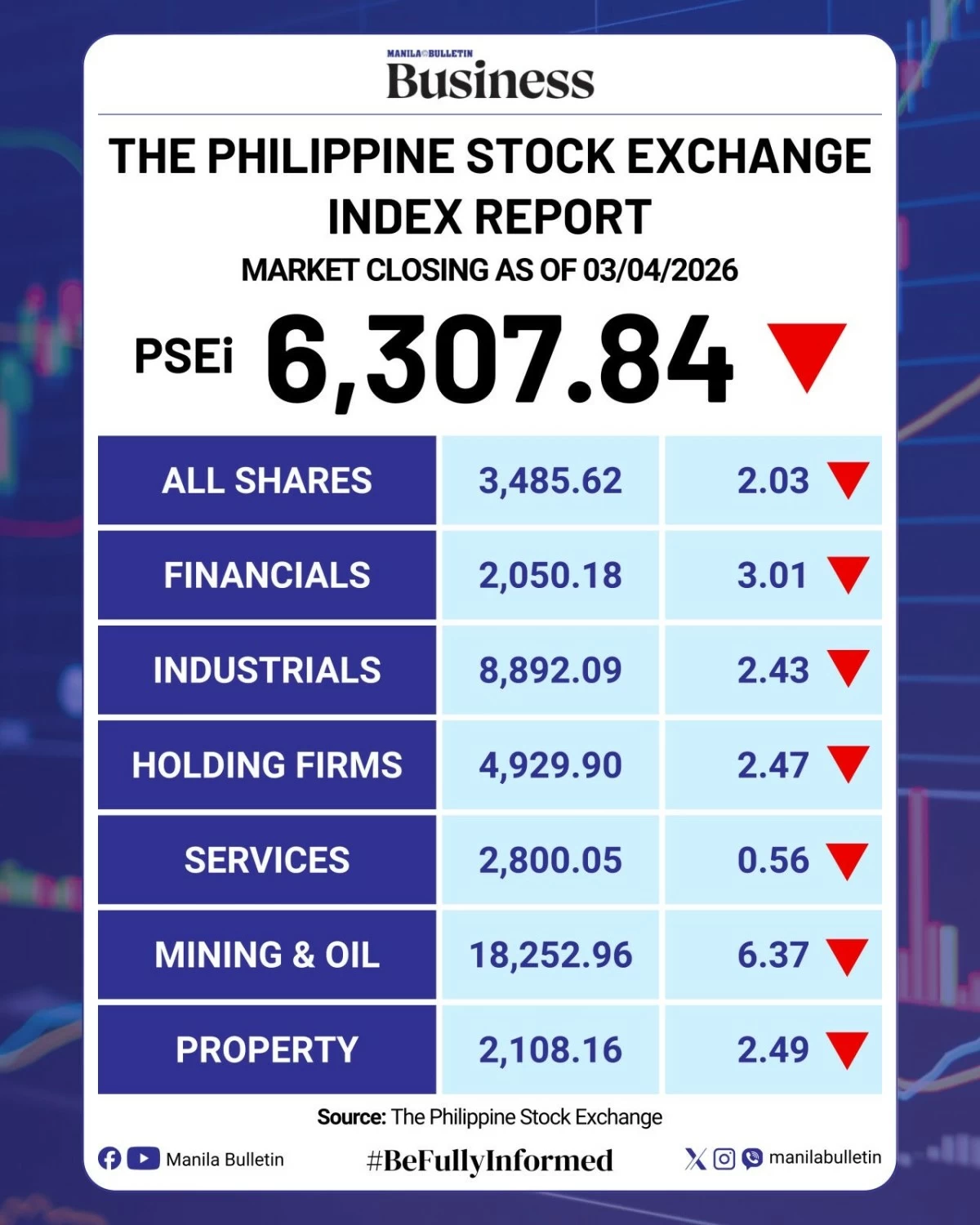
Local stocks tumbled on Wednesday, March 4, erasing the previous session’s gains as escalating conflict in the Middle East fueled fears that spike in global energy prices will reignite inflation and derail the central bank’s pivot toward monetary easing.
The Philippine Stock Exchange index (PSEi) slumped 137.54 points, or 2.13 percent, to close at 6,307.84. The decline was felt across all sub-indices, with the Mining and Oil sector leading the retreat as investors braced for volatility in the crude market.
Trading remained active, with 4.5 billion shares changing hands valued at ₱8.67 billion. Market breadth was overwhelmingly negative, as 179 stocks fell while only 35 advanced and 58 remained unchanged.
The sell-off comes amid deepening anxiety that the confrontation involving Iran could disrupt oil supplies, a particularly sensitive issue for the Philippines, which imports nearly all of its fuel requirements.
“The local bourse declined again after a day of relief as the conflict in the Middle East weighed on sentiment” said Japhet Tantiangco, research manager at Philstocks Financial.
He noted that investors are specifically pricing in the risks that higher energy costs will exert downward pressure on the peso and stifle overall economic growth.
The benchmark’s return to the 6,300 level followed a steep sell-off in global equities, as geopolitical instability prompted a flight to safety.
Luis Limlingan, managing director at Regina Capital Development Corp., said the escalating tensions are weighing heavily on regional sentiment.
He added that the continued weakening of the peso is further dampening investor confidence, as a depreciating currency raises the cost of imports and risks triggering capital outflows.
Market participants are also recalibrating their expectations for interest rate cuts both domestically and in the US.
Michael Ricafort, chief economist at Rizal Commercial Banking Corp., said the threat of a wider war in Iran has the potential to unleash a wave of global inflation. This shift in the macro environment has led Fed Fund futures markets to sharply reduce bets on aggressive easing by the US Federal Reserve.
For the Philippines, the prospect of a “higher-for-longer” rate environment is becoming more likely. The Bangko Sentral ng Pilipinas may be forced to delay its own easing measures or other monetary support to defend the peso and keep inflation within its target range.
With geopolitical risks showing no signs of abating, analysts expect the local market to remain under pressure in the near term.