ADVERTISEMENT

China to unveil priorities for coming 5 years at major annual political meeting

Published Mar 4, 2026 01:38 pm
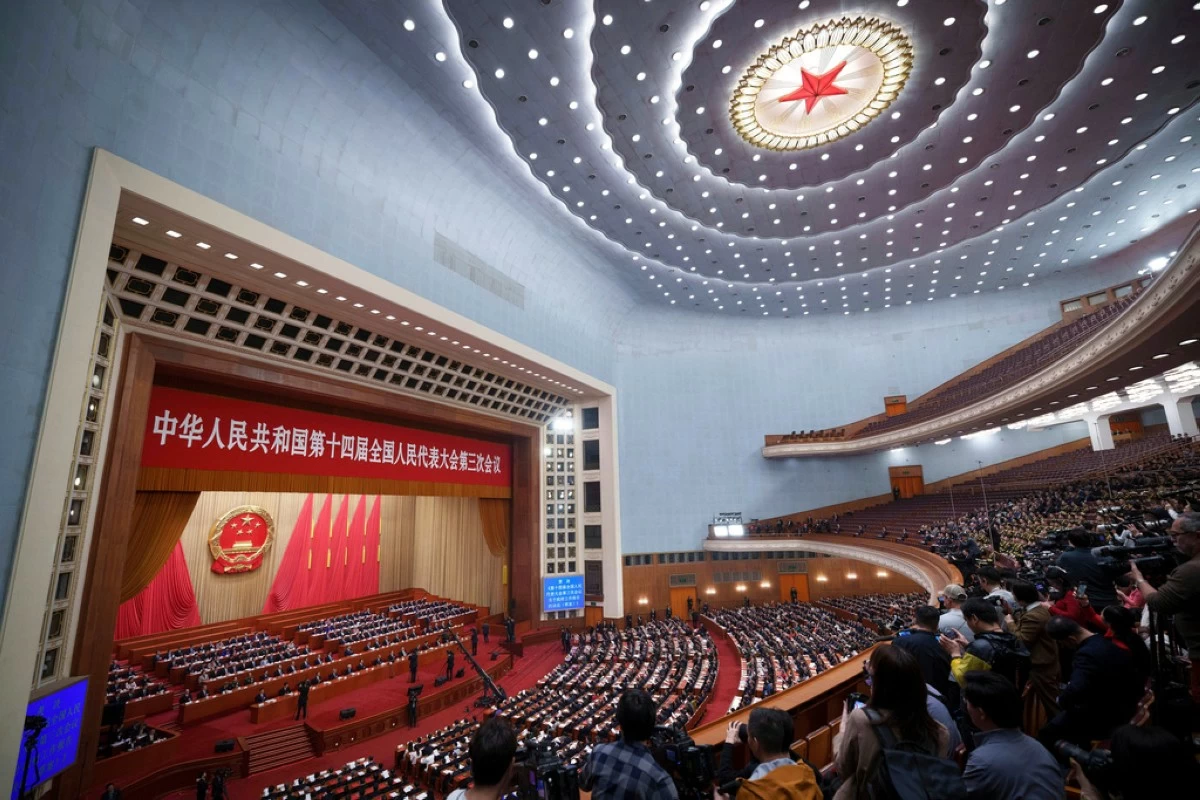
The closing session of the National People's Congress (NPC) is seen in the Great Hall of the People in Beijing on March 11, 2025. (AP Photo/Vincent Thian, File)
BEIJING (AP) — China's ceremonial legislature is set to meet Thursday, where it will unveil the country's policy direction and economic goals for the coming years.
The meeting is held in Beijing, where the National People's Congress and its advisory body gather. The National People's Congress will ratify new laws decided by China's Communist Party leadership. While the near 3,000-member body technically votes, the vote is always almost unanimous.
Also meeting is the Chinese People’s Political Consultative Conference, an advisory body composed of elite members of Chinese society, from businessmen to athletes. They also include representatives from China's minority groups, but the body has little power on issues of public policy.
The gathering of these two bodies is called the Two Sessions. The political meetings have changed under President Xi Jinping's rule, with tighter scripts and less scope for debate.
“A long, long time ago, it was a venue for policy deliberation,” and even controversial things, said Alfred Wu, a professor of public policy at the National University of Singapore. “Now it's very much become a showcase, propaganda."
Economy is front and center
The National People's Congress is when the Chinese premier announces the country's GDP targets and other economic targets for the year.
This year, observers are waiting for details for the 15th five-year plan, of which the government had revealed a draft in October. It is expected to be focused on building tech prowess and self-sufficiency.
China issues five-year plans to direct its economy, a legacy of its historical approach when it had a planned economy.
The Chinese economy remains sluggish, with high youth unemployment, weak housing prices and sagging domestic consumption. It also faces a trade war with the U.S., which has leveraged tariffs on all Chinese goods.
Experts have said China will have to strike a tough balance between its goals of boosting its tech manufacturing, such as in robotics, renewable energy and AI, and boosting domestic consumption as many ordinary people are feeling the pinch. Tech supply chains are narrow and the trickle-down effect is less pronounced.
China is likely to drop its headline growth target to a record low, predicted Neil Thomas and Lobsang Tsering, policy experts at the Asia Society. It will be significant as a step in a “shift from high-speed to high-quality growth,” they wrote.
Personnel movements are not expected
China's legislature dismissed 19 members last week, after a highly publicized removal of two of its most senior generals in January.
Now, only one member remains of the powerful Central Military Commission, which controls the military, but policy experts say they do not expect any personnel announcements in the upcoming Two Sessions. Observers like to closely watch attendance for any signs of possible purges, however.
Xi Jinping has removed possibly up to 100 senior officials in the People’s Liberation Army in the past four years, according to new research from the Center for Strategic Studies, with the most prominent being General Zhang Youxia in January.
Yet, there is likely no great rush from the leadership to find a replacement.
“I don’t think they’re particularly worried about this,” said Wu of National University Singapore. For example, he said, Wang Yi became foreign minister again after stepping down from the job initially because of the high-profile removal of Qin Gang, previously his replacement.

Related Tags

WORLDNEWS CHINA National People\'s Congress
ADVERTISEMENT
.most-popular .layout-ratio{ padding-bottom: 79.13%; } @media (min-width: 768px) and (max-width: 1024px) { .widget-title { font-size: 15px !important; } }

{{ articles_filter_1561_widget.title }}

.most-popular .layout-ratio{ padding-bottom: 79.13%; } @media (min-width: 768px) and (max-width: 1024px) { .widget-title { font-size: 15px !important; } }

{{ articles_filter_1562_widget.title }}

.most-popular .layout-ratio{ padding-bottom: 79.13%; } @media (min-width: 768px) and (max-width: 1024px) { .widget-title { font-size: 15px !important; } }

{{ articles_filter_1563_widget.title }}

{{ articles_filter_1564_widget.title }}

.mb-article-details { position: relative; } .mb-article-details .article-body-preview, .mb-article-details .article-body-summary{ font-size: 17px; line-height: 30px; font-family: "Libre Caslon Text", serif; color: #000; } .mb-article-details .article-body-preview iframe , .mb-article-details .article-body-summary iframe{ width: 100%; margin: auto; } .read-more-background { background: linear-gradient(180deg, color(display-p3 1.000 1.000 1.000 / 0) 13.75%, color(display-p3 1.000 1.000 1.000 / 0.8) 30.79%, color(display-p3 1.000 1.000 1.000) 72.5%); position: absolute; height: 200px; width: 100%; bottom: 0; display: flex; justify-content: center; align-items: center; padding: 0; } .read-more-background a{ color: #000; } .read-more-btn { padding: 17px 45px; font-family: Inter; font-weight: 700; font-size: 18px; line-height: 16px; text-align: center; vertical-align: middle; border: 1px solid black; background-color: white; } .hidden { display: none; }
function initializeAllSwipers() { // Get all hidden inputs with cms_article_id document.querySelectorAll('[id^="cms_article_id_"]').forEach(function (input) { const cmsArticleId = input.value; const articleSelector = '#article-' + cmsArticleId + ' .body_images'; const swiperElement = document.querySelector(articleSelector); if (swiperElement && !swiperElement.classList.contains('swiper-initialized')) { new Swiper(articleSelector, { loop: true, pagination: false, navigation: { nextEl: '#article-' + cmsArticleId + ' .swiper-button-next', prevEl: '#article-' + cmsArticleId + ' .swiper-button-prev', }, }); } }); } setTimeout(initializeAllSwipers, 3000); const intersectionObserver = new IntersectionObserver( (entries) => { entries.forEach((entry) => { if (entry.isIntersecting) { const newUrl = entry.target.getAttribute("data-url"); if (newUrl) { history.pushState(null, null, newUrl); let article = entry.target; // Extract metadata const author = article.querySelector('.author-section').textContent.replace('By', '').trim(); const section = article.querySelector('.section-info ').textContent.replace(' ', ' '); const title = article.querySelector('.article-title h1').textContent; // Parse URL for Chartbeat path format const parsedUrl = new URL(newUrl, window.location.origin); const cleanUrl = parsedUrl.host + parsedUrl.pathname; // Update Chartbeat configuration if (typeof window._sf_async_config !== 'undefined') { window._sf_async_config.path = cleanUrl; window._sf_async_config.sections = section; window._sf_async_config.authors = author; } // Track virtual page view with Chartbeat if (typeof pSUPERFLY !== 'undefined' && typeof pSUPERFLY.virtualPage === 'function') { try { pSUPERFLY.virtualPage({ path: cleanUrl, title: title, sections: section, authors: author }); } catch (error) { console.error('ping error', error); } } // Optional: Update document title if (title && title !== document.title) { document.title = title; } } } }); }, { threshold: 0.1 } ); function showArticleBody(button) { const article = button.closest("article"); const summary = article.querySelector(".article-body-summary"); const body = article.querySelector(".article-body-preview"); const readMoreSection = article.querySelector(".read-more-background"); // Hide summary and read-more section summary.style.display = "none"; readMoreSection.style.display = "none"; // Show the full article body body.classList.remove("hidden"); } document.addEventListener("DOMContentLoaded", () => { let loadCount = 0; // Track how many times articles are loaded const offset = [1, 2, 3, 4, 5, 6, 7, 8, 9, 10]; // Offset values const currentUrl = window.location.pathname.substring(1); let isLoading = false; // Prevent multiple calls if (!currentUrl) { console.log("Current URL is invalid."); return; } const sentinel = document.getElementById("load-more-sentinel"); if (!sentinel) { console.log("Sentinel element not found."); return; } function isSentinelVisible() { const rect = sentinel.getBoundingClientRect(); return ( rect.top < window.innerHeight && rect.bottom >= 0 ); } function onScroll() { if (isLoading) return; if (isSentinelVisible()) { if (loadCount >= offset.length) { console.log("Maximum load attempts reached."); window.removeEventListener("scroll", onScroll); return; } isLoading = true; const currentOffset = offset[loadCount]; window.loadMoreItems().then(() => { let article = document.querySelector('#widget_1690 > div:nth-last-of-type(2) article'); intersectionObserver.observe(article) loadCount++; }).catch(error => { console.error("Error loading more items:", error); }).finally(() => { isLoading = false; }); } } window.addEventListener("scroll", onScroll); });

Sign up by email to receive news.