







Bohol enacts EO to ease impact of Mideast conflict
Published Mar 4, 2026 06:10 pm


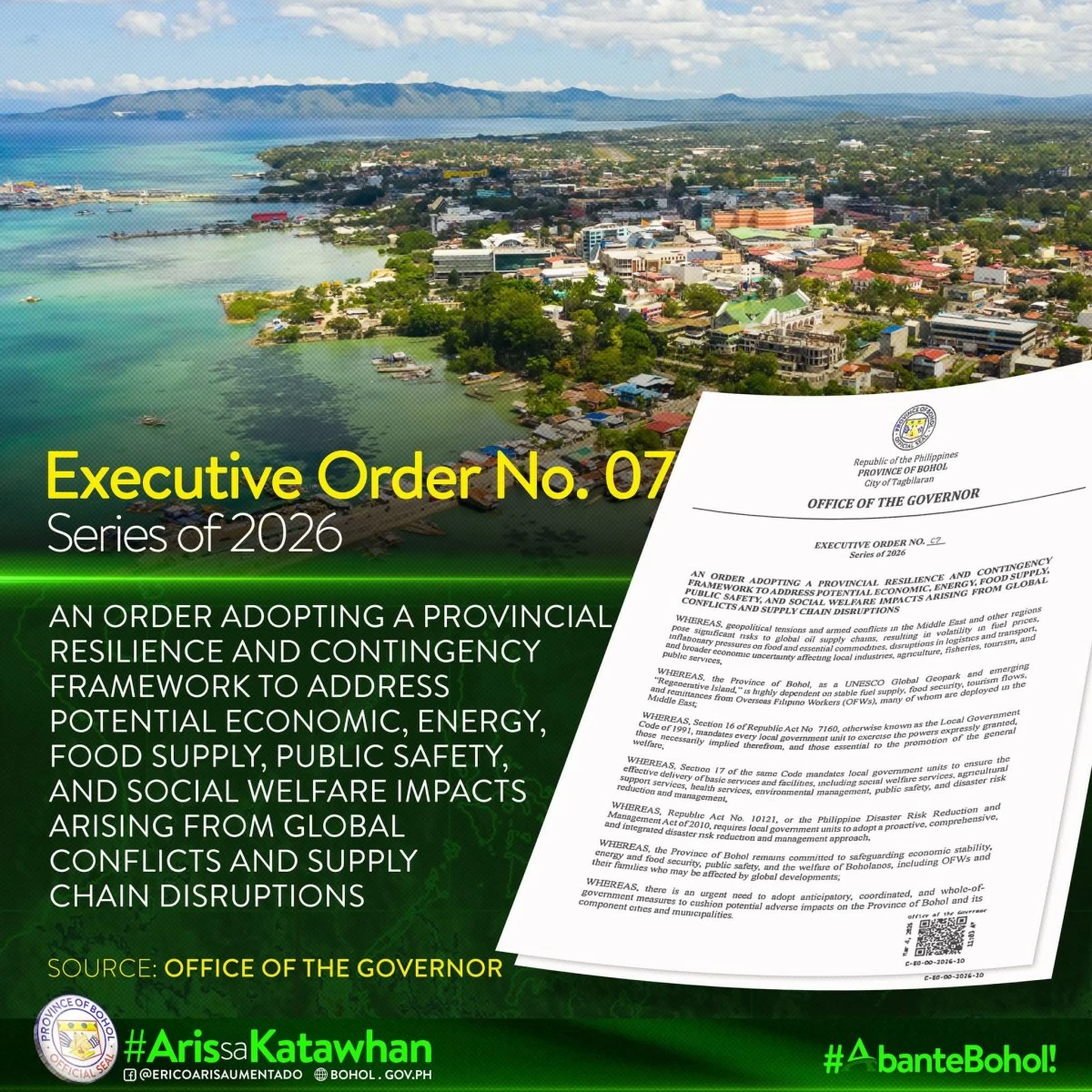
The provincial government of Bohol has taken proactive steps to cushion the possible impact of the raging conflict in the Middle East on the province’s economy, fuel supply, food security, and prices of basic goods.
Gov. Erico Aristotle Aumentado on March 2 signed Executive Order (EO) No. 7 titled “An Order Adopting a Provincial Resilience and Contingency Framework to Address Potential Economic, Energy, Food Supply, Public Safety, and Social Welfare Impacts Arising from Global Conflicts and Supply Chain Disruptions.”
The EO establishes a comprehensive, whole-of-government approach to prepare the province for potential ripple effects of global oil supply disruptions, inflationary pressures, logistics constraints, and economic uncertainty.
The Provincial Inter-Agency Task Force on Economic and Energy Resilience (PIATF-EER), chaired by the governor, with the provincial administrator as vice chairperson, was created to monitor fuel supply levels and price movements, assess food security risks, coordinate updates concerning overseas Filipino workers (OFWs), and recommend fiscal or regulatory interventions to stabilize local markets.
It is also tasked to develop contingency plans, including possible fuel prioritization measures if necessary.
The body brings together key provincial offices, national government agencies such as the Department of Trade and Industry (DTI) and Department of Energy (DOE), law enforcement, and representatives from the fuel, transport, agriculture, and business sectors.
Aumentado emphasized that Bohol, as a United Nations Educational, Scientific, and Cultural Organization Global Geopark and emerging regenerative island, remains highly dependent on stable fuel supply, tourism flows, agriculture, fisheries, and remittances from OFWs, especially those deployed in the Middle East.
Provincial Administrator Asteria Caberte said that the Provincial Price Coordinating Council (PPCC) convened an emergency meeting on March 3.
Present during the meeting were representatives from the DTI, the Department of Agriculture, Bureau of Fisheries and Aquatic Resources, Department of Environment and Natural Resources, petroleum depot managers in Tagbilaran City, and representatives from major fuel companies.
According to Caberte, fuel industry representatives assured the province of a steady petroleum supply, with no immediate concerns on availability.
“As of now, we are assured of a stable supply of petroleum products in the province,” she said.
Major suppliers of prime and basic commodities, including BQ Mall, Alturas Group of Companies, and Shoppers Mart, also reported that their current inventories are sufficient to last up to three months.
Under Republic Act No. 7581 or the Price Act, the council is mandated to monitor prices and supply, especially during emergencies or impending crises, and establish mechanisms that protect consumers from unreasonable price increases and supply shortages.