







PH, South Korea ink 10 agreements in key sectors
Lee: PH, SK will become optimal partners for nuclear power
Published Mar 3, 2026 08:14 pm


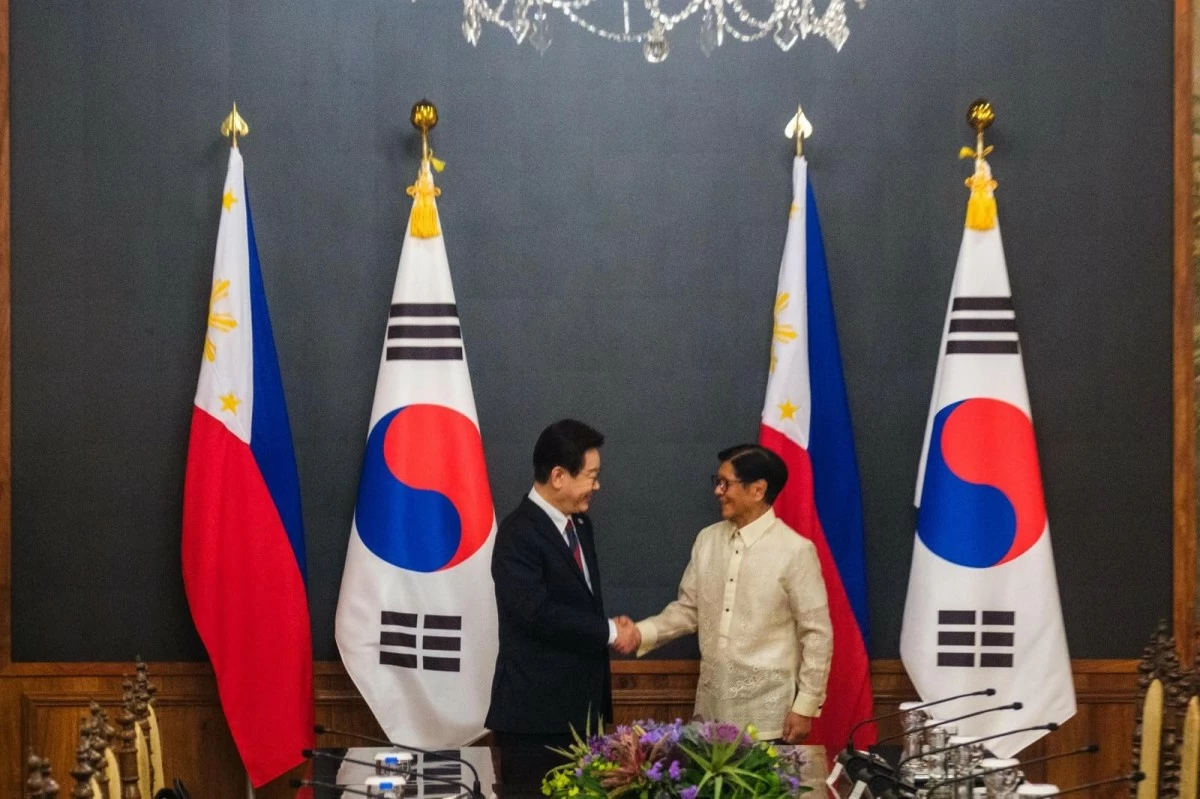
President Ferdinand R. Marcos Jr. and South Korean President Lee Jae Myung hold a bilateral meeting at the Malacañan Palace on March 3, 2026. (Photo courtesy of PPA)
The Philippines and South Korea have signed 10 agreements covering various areas such as defense, agriculture, law enforcement, tourism, education, and technology.
President Marcos and South Korean President Lee Jae Myung witnessed the signing and presentation of the 10 memorandums of understanding (MOU) during their meeting at the Malacañan Palace on Tuesday, March 3.
"And as we just had witnessed, we concluded a number of agreements in the field of defense materials procurement, veterans affairs, agriculture, trade, investment, and economic cooperation, intellectual property, digital cooperation, digitalization and innovation, Korean language training in schools, cultural cooperation, and police cooperation which will sustain the momentum of the Philippines-Republic of Korea's strategic partnership for the future.
The 10 MOUs, including an amendment to an implementing arrangement with the Department of National Defense, were presented to the public after their bilateral meeting.
The MOUs were:
1. Memorandum of Understanding (MOU) between the Department of Information and Communications Technology (DICT) of the Republic of the Philippines and the Ministry of Science and ICT of the Republic of Korea (ROK) on Digital Cooperation
2. MOU between the Department of Economy, Planning, and Development (DEPDev) of the Republic of the Philippines and the Ministry of Foreign Affairs of the ROK on Technology, Digitalization, and Innovation Program
3. Amendment Number 2 to the Implementing Arrangement (IA) between the Department of National Defense (DND) of the Republic of the Philippines and the Defense Acquisition Program Administration of the ROK Concerning the Procurement of Certain Defense Materials
4. MOU on Cooperation in the Field of Patriots and Veterans Affairs between the DND of the Republic of the Philippines and the Ministry of Patriots and Veterans Affairs of the ROK
5. MOU between the Department of Agriculture (DA) of the Republic of the Philippines and the Ministry of Agriculture, Food, and Rural Affairs of the ROK on Cooperation in the Field of Agriculture
6. MOU between the Department of Trade and Industry (DTI) of the Republic of the Philippines and the Ministry of Trade, Industry, and Resources of the ROK on Trade, Investment, and Economic Cooperation
7. MOU between the DTI of the Republic of the Philippines and the Ministry of Intellectual Property of the ROK for Reinforced Cooperation in the Field of Intellectual Property
8. MOU on Cooperation on the Special Program in Foreign Language in Philippine Schools between the Department of Education (DepEd) of the Republic of the Philippines and the Ministry of Education of the ROK
9. MOU on Cultural Cooperation between the National Commission for Culture and the Arts (NCCA) of the Republic of the Philippines and the Ministry of Culture, Sports, and Tourism of the ROK
10. MOU between the Philippine National Police (PNP) of the Republic of the Philippines and the Korean National Police Agency of the ROK on Police Cooperation
In signing the agreements, Marcos said the "decades of cordial and productive relations" between the two countries, which were elevated to a strategic partnership in 2024, expand various areas of mutual interest.
"During our comprehensive meetings, President Lee and I covered a wide-range of areas in our bilateral partnership, including defense and security, maritime cooperation, economic and development cooperation, and of course, people to people exchanges," Marcos said.
"We agreed that we have made significant strides in advancing and deepening our bilateral cooperation towards the attainment of our mutually beneficial goals," Marcos added.
In signing the MOUs on intellectual property rights and on the agricultural sector, Lee said the deals "will facilitate the entry of new firms in their respective fields, stimulate regional trade and investment, and increase the utility of our existing Free Trade Agreement."
According to the South Korean President, Marcos said that "he will make proactive efforts to support Korean firms to enter the Philippine market and to alleviate the difficulties they face."
Lee also committed to continue supporting Korean defense industry firms "so they may actively participate in modernization projects of the Philippine military on the basis of the implementation agreement for the defense industry procurement."
Marcos' counterpart said that the expanded cooperation in shipbuilding would "create synergistic effects that will enhance the competitiveness of both our industries."
In signing the MOU in digital cooperation, Lee hopes that it will help Korea to realize its vision of becoming a "top 3 artificial intelligence (AI) power.
"On the basis of our MOU on digital cooperation, we have expanded our bilateral science and technology cooperation to include AI and next generation communication infrastructure. We hope that this will serve as a steadfast cornerstone in accelerating the digital transformation of the Philippines and help to realize Korea's vision of becoming a top three AI power," Lee said.
'Optimal partners for nuclear power'
In his statement, Lee disclosed that he and Marcos agreed to strengthen substantial cooperation in the field of nuclear power.
This, as he stressed that the Philippines and South Korea will become "optimal partners for nuclear power."
"Building on the results of the feasibility study for the Bataan Nuclear Power Plant resumption and the MOU for cooperation on new nuclear power projects, we will become optimal partners for nuclear power cooperation," Lee said.
The Korean President also emphasized that the two countries are "ideal partners" in the field of critical minerals as Korea has advanced technology while the Philippines has abundant mineral resources.
"By utilizing the MOU for cooperation in critical minerals signed during this visit, we will further expand substantial cooperation on critical minerals and relevant supply chains," he said.
During their meeting, the two leaders expressed hopes that "peace and stability in the Middle East may be restored at an early date."
Lee's visit to Manila coincided with the 77th anniversary of the Philippines' and South Korea's diplomatic ties.