ADVERTISEMENT

Time to enact anti-dynasty law that institutes good governance

Published Mar 2, 2026 12:05 am  |  Updated Mar 2, 2026 10:52 am
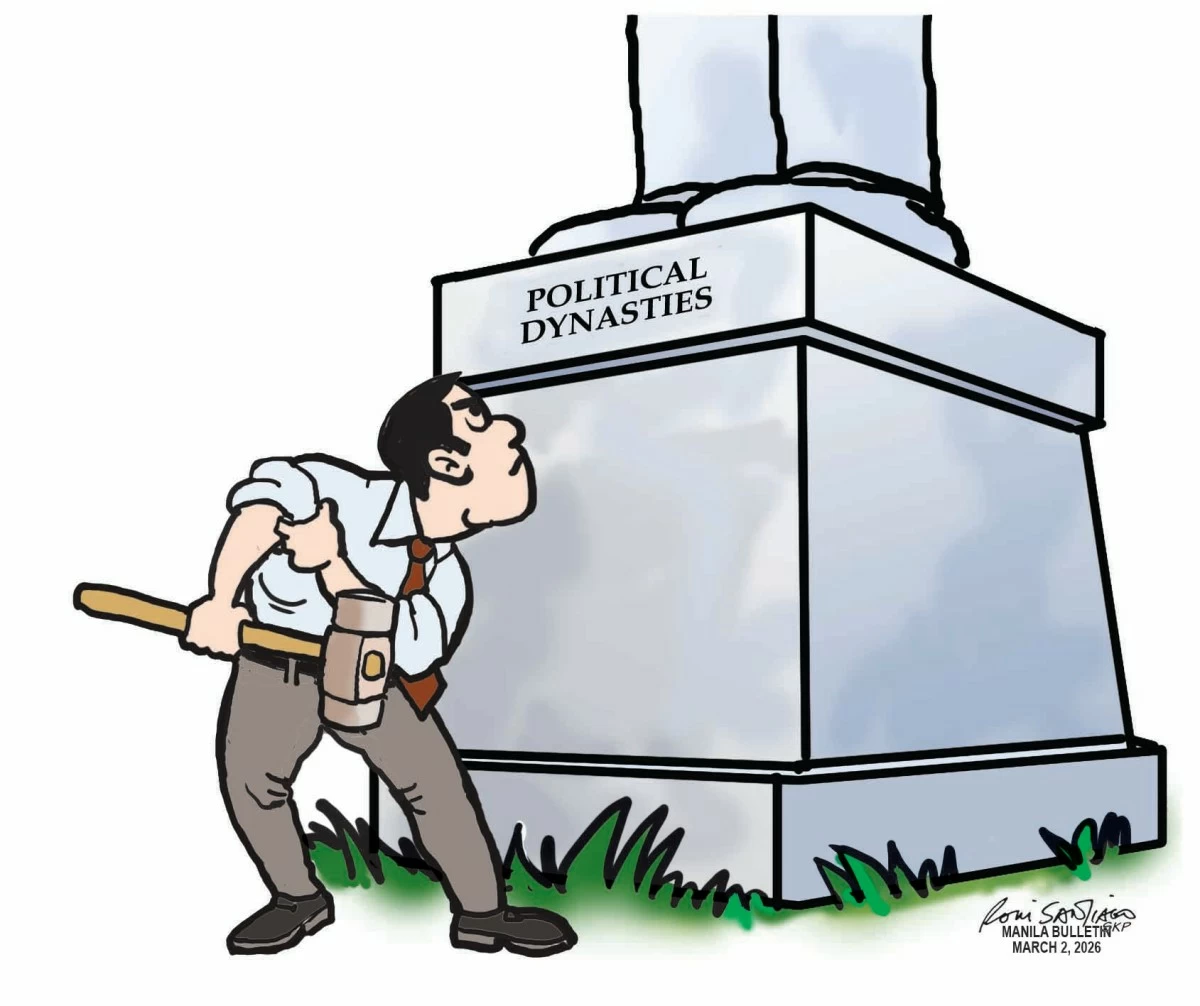
In a welcome convergence of civic conscience and business leadership, 31 of the country’s leading business and civic organizations have publicly called for the enactment of an anti-political dynasty law. Their advocacy breathes life into a long-dormant constitutional mandate and reaffirms a simple yet powerful principle: public office must not be treated as a family heirloom.
Coming as it did on the eve of the celebration of the 40th anniversary of the EDSA People Power Revolution, it is a clear manifestation that a robust civic spirit permeates our society even amid widespread cynicism spawned by endemic graft and corruption.
The 1987 Constitution is unequivocal. Article II, Section 26 provides that “The State shall guarantee equal access to opportunities for public service and prohibit political dynasties as may be defined by law.” Nearly four decades later, however, Congress has yet to pass the enabling measure that would give this provision teeth. The result is a paradox. While the Constitution speaks clearly, the political system has allowed entrenched family dominance to persist across provinces, cities, and municipalities.
The renewed push for reform is therefore both timely and necessary.
Various bills have already been filed in the House of Representatives of the Philippines seeking to define and prohibit political dynasties. These proposals differ in scope—some ban relatives up to the second degree of consanguinity or affinity from running simultaneously or in succession within the same locality, while others adopt broader prohibitions covering national and local posts. Though nuanced in approach, they share a common goal: to level the political playing field and open public service to qualified Filipinos beyond the orbit of established clans.
The intervention of respected business chambers and civic groups reframes the anti-dynasty debate. This is no longer merely an academic or partisan issue. It is a matter of governance, economic competitiveness, and institutional integrity.
Political dynasties often flourish where accountability is weakest. When power circulates within a narrow familial circle, the checks and balances essential to democracy can erode. Clearly, this has been the sorry state of governance in the post-EDSA era. Public resources have been captured and political competition has been stifled by their dominance Hence, this has discouraged many capable leaders—especially young professionals, women, and reform-minded citizens—from entering public life, perceiving it as inaccessible or predetermined.
From an economic standpoint, the implications are equally serious. Investors and entrepreneurs thrive in environments governed by transparent rules, predictable policies, and merit-based leadership. When political succession appears prearranged within families, it undermines perceptions of fairness and stability. By contrast, a rules-based system that widens access to leadership enhances public trust and strengthens institutions.
While an anti-dynasty law is not a cure-all that will totally eliminate corruption, it is a vital element in good governance. Competence and integrity should not be determined by bloodline alone. The core issue is structural, not personal.
Democracy thrives on competition, rotation of leadership, and genuine choice. An enabling law that clearly defines and reasonably limits dynastic concentration would operationalize the Constitution’s intent and signal that no family, however influential, stands above the principle of equal opportunity.
The advocacy of 31 business and civic groups should serve as a catalyst for serious deliberation in Congress. Lawmakers must rise above self-interest and consider the long-term health of the Republic. Public hearings should be transparent and inclusive, allowing constitutional scholars, local officials, civil society, and ordinary citizens to weigh in on the most balanced and enforceable framework.
It is time for legislation to respond to the imperative of concretizing the principle that public office is a public trust.
ADVERTISEMENT
.most-popular .layout-ratio{ padding-bottom: 79.13%; } @media (min-width: 768px) and (max-width: 1024px) { .widget-title { font-size: 15px !important; } }

{{ articles_filter_1561_widget.title }}

.most-popular .layout-ratio{ padding-bottom: 79.13%; } @media (min-width: 768px) and (max-width: 1024px) { .widget-title { font-size: 15px !important; } }

{{ articles_filter_1562_widget.title }}

.most-popular .layout-ratio{ padding-bottom: 79.13%; } @media (min-width: 768px) and (max-width: 1024px) { .widget-title { font-size: 15px !important; } }

{{ articles_filter_1563_widget.title }}

{{ articles_filter_1564_widget.title }}

.mb-article-details { position: relative; } .mb-article-details .article-body-preview, .mb-article-details .article-body-summary{ font-size: 17px; line-height: 30px; font-family: "Libre Caslon Text", serif; color: #000; } .mb-article-details .article-body-preview iframe , .mb-article-details .article-body-summary iframe{ width: 100%; margin: auto; } .read-more-background { background: linear-gradient(180deg, color(display-p3 1.000 1.000 1.000 / 0) 13.75%, color(display-p3 1.000 1.000 1.000 / 0.8) 30.79%, color(display-p3 1.000 1.000 1.000) 72.5%); position: absolute; height: 200px; width: 100%; bottom: 0; display: flex; justify-content: center; align-items: center; padding: 0; } .read-more-background a{ color: #000; } .read-more-btn { padding: 17px 45px; font-family: Inter; font-weight: 700; font-size: 18px; line-height: 16px; text-align: center; vertical-align: middle; border: 1px solid black; background-color: white; } .hidden { display: none; }
function initializeAllSwipers() { // Get all hidden inputs with cms_article_id document.querySelectorAll('[id^="cms_article_id_"]').forEach(function (input) { const cmsArticleId = input.value; const articleSelector = '#article-' + cmsArticleId + ' .body_images'; const swiperElement = document.querySelector(articleSelector); if (swiperElement && !swiperElement.classList.contains('swiper-initialized')) { new Swiper(articleSelector, { loop: true, pagination: false, navigation: { nextEl: '#article-' + cmsArticleId + ' .swiper-button-next', prevEl: '#article-' + cmsArticleId + ' .swiper-button-prev', }, }); } }); } setTimeout(initializeAllSwipers, 3000); const intersectionObserver = new IntersectionObserver( (entries) => { entries.forEach((entry) => { if (entry.isIntersecting) { const newUrl = entry.target.getAttribute("data-url"); if (newUrl) { history.pushState(null, null, newUrl); let article = entry.target; // Extract metadata const author = article.querySelector('.author-section').textContent.replace('By', '').trim(); const section = article.querySelector('.section-info ').textContent.replace(' ', ' '); const title = article.querySelector('.article-title h1').textContent; // Parse URL for Chartbeat path format const parsedUrl = new URL(newUrl, window.location.origin); const cleanUrl = parsedUrl.host + parsedUrl.pathname; // Update Chartbeat configuration if (typeof window._sf_async_config !== 'undefined') { window._sf_async_config.path = cleanUrl; window._sf_async_config.sections = section; window._sf_async_config.authors = author; } // Track virtual page view with Chartbeat if (typeof pSUPERFLY !== 'undefined' && typeof pSUPERFLY.virtualPage === 'function') { try { pSUPERFLY.virtualPage({ path: cleanUrl, title: title, sections: section, authors: author }); } catch (error) { console.error('ping error', error); } } // Optional: Update document title if (title && title !== document.title) { document.title = title; } } } }); }, { threshold: 0.1 } ); function showArticleBody(button) { const article = button.closest("article"); const summary = article.querySelector(".article-body-summary"); const body = article.querySelector(".article-body-preview"); const readMoreSection = article.querySelector(".read-more-background"); // Hide summary and read-more section summary.style.display = "none"; readMoreSection.style.display = "none"; // Show the full article body body.classList.remove("hidden"); } document.addEventListener("DOMContentLoaded", () => { let loadCount = 0; // Track how many times articles are loaded const offset = [1, 2, 3, 4, 5, 6, 7, 8, 9, 10]; // Offset values const currentUrl = window.location.pathname.substring(1); let isLoading = false; // Prevent multiple calls if (!currentUrl) { console.log("Current URL is invalid."); return; } const sentinel = document.getElementById("load-more-sentinel"); if (!sentinel) { console.log("Sentinel element not found."); return; } function isSentinelVisible() { const rect = sentinel.getBoundingClientRect(); return ( rect.top < window.innerHeight && rect.bottom >= 0 ); } function onScroll() { if (isLoading) return; if (isSentinelVisible()) { if (loadCount >= offset.length) { console.log("Maximum load attempts reached."); window.removeEventListener("scroll", onScroll); return; } isLoading = true; const currentOffset = offset[loadCount]; window.loadMoreItems().then(() => { let article = document.querySelector('#widget_1690 > div:nth-last-of-type(2) article'); intersectionObserver.observe(article) loadCount++; }).catch(error => { console.error("Error loading more items:", error); }).finally(() => { isLoading = false; }); } } window.addEventListener("scroll", onScroll); });

Sign up by email to receive news.