






Manila Bulletin
 Philippines
National
No direct threat to EDCA sites amid Middle East tensions, say PH security officials
Philippines
National
No direct threat to EDCA sites amid Middle East tensions, say PH security officials
Philippines
National
No direct threat to EDCA sites amid Middle East tensions, say PH security officials
No direct threat to EDCA sites amid Middle East tensions, say PH security officials
Published Mar 2, 2026 02:48 pm


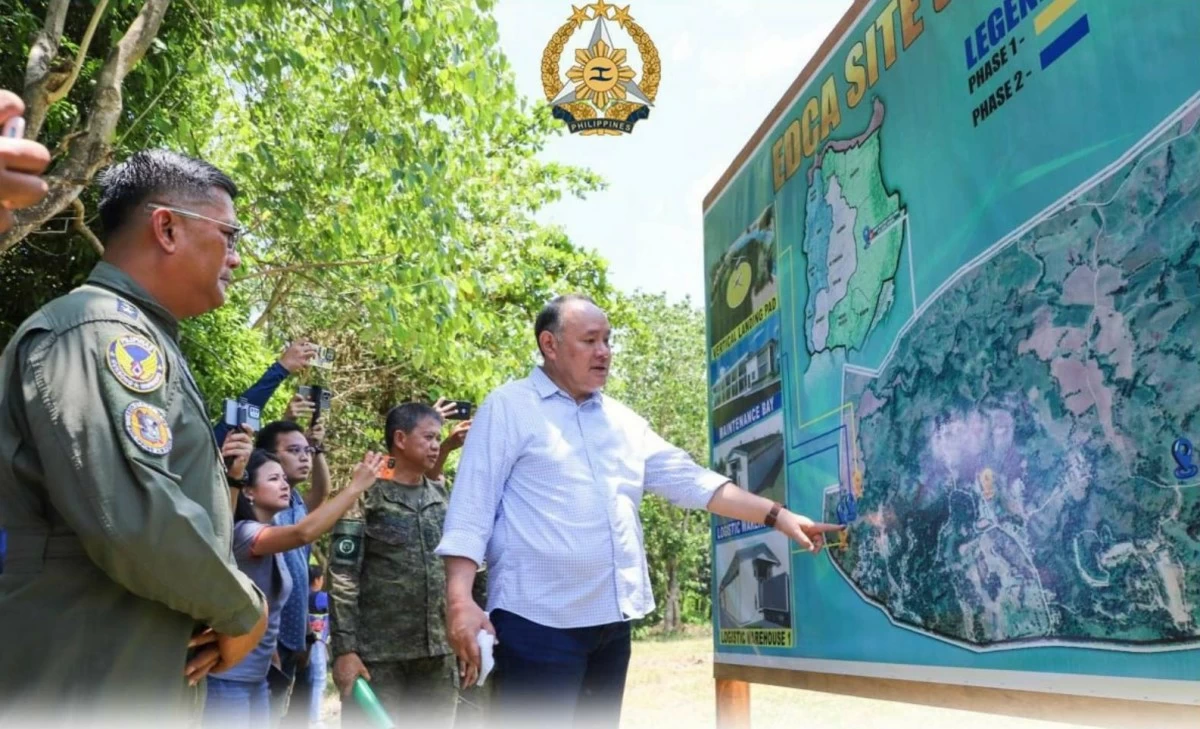
Department of National Defense (DND) Sec. Gilberto Teodoro Jr. at an Enhanced Defense Cooperation Agreement (EDCA) site. (File photo: Armed Forces of the Philippines)
Top defense and security officials on Monday, March 2, dismissed fears that the nine Enhanced Defense Cooperation Agreement (EDCA) sites in the country could become targets following the escalating conflict in the Middle East.
The Department of National Defense (DND), the Armed Forces of the Philippines (AFP), and the National Security Council (NSC) made the assurance after Sen. Erwin Tulfo called for a review of the EDCA, warning that the sites could become potential targets following recent hostilities involving the United States, Israel, and Iran.
DND spokesperson Assistant Secretary Arsenio Andolong said the Philippines is not part of the conflict among the three countries, hence there is no reason to fear that the EDCA sites could be targeted by Iran.
“The DND respects the oversight role of the Philippine Senate and we will always cooperate with them. It must be stated, however, that the hostilities are confined to the Middle East. The Philippines is not a participant in the theater of conflict,” Andolong said.
“As such, there is no credible direct threat to the Philippines or facilities therein. Iran launched attacks on US facilities in countries that it shares maritime or land borders with. The Philippines poses no threat to Iran,” he explained.
Narratives have circulated online claiming that the EDCA sites in the Philippines could be targeted after Iran launched attacks on US facilities in countries near its borders. The claims, echoed by certain vloggers, surfaced following strikes involving the US and Israel against Iranian targets, which raised fears of a wider regional war.
There are currently nine EDCA locations in the country where the US military may operate on a rotational basis: Antonio Bautista Air Base (Palawan), Basa Air Base (Pampanga), Benito Ebuen Air Base (Cebu), Fort Magsaysay (Nueva Ecija), Lumbia Airport (Cagayan de Oro), Balabac Island (Palawan), Camp Melchor Dela Cruz (Gamu, Isabela), Lal-lo Airport (Lal-lo, Cagayan), and Naval Base Camilo Osias (Santa Ana, Cagayan).
The first five sites were established when the agreement was signed in 2014 while the last four locations were approved by President Marcos Jr. in 2023 to strengthen the country’s defense and improve capability for humanitarian assistance and disaster response (HADR) logistics and coordination.
The EDCA is a readiness agreement between the Philippines and US that supports the AFP under Philippine sovereignty by allowing approved activities, training or exercises, HADR, and logistical support at designated locations within AFP bases.
The AFP said EDCA sites are not a permanent foreign base, and the Philippines owns and controls all sites under the Philippine law, through a 10-year term that is renewable by mutual consent.
The military noted that the Supreme Court upheld EDCA’s constitutionality in a decision issued in January 2016 and reaffirmed in July of the same year. The EDCA implements the 1951 Mutual Defense Treaty (MDT) and the 1999 Visiting Forces Agreement (VFA).
“Our EDCA sites are Philippine facilities. They do not belong to the US nor are they being used to launch or stage assaults against another country. They are for joint training, HADR, and the defense and security of our country. They fulfill an important role in the capacity and capability building of the AFP,” Andolong stressed.
He also cited Marcos’ previous remarks that the EDCA sites “will not be used for offensive action.”
‘EDCA are not US bases’
Meanwhile, AFP spokesperson Col. Francel Margareth Padilla clarified that the EDCA sites do not convert local camps into US bases.
“With regard to EDCA, it is essential to clarify that EDCA sites remain Philippine sovereign AFP installations. They are not US bases,” she noted.
“Access granted to US forces is rotational and primarily geared toward interoperability, logistics prepositioning, disaster response, and humanitarian assistance. These arrangements enhance our defensive readiness and our capacity for humanitarian assistance and disaster response, rather than diminish our security,” Padilla added, echoing the position of the DND.
Further, the AFP spokesperson stressed that the country’s strategic position has long shaped its security environment.
“It is also worth noting that the Philippines’ strategic relevance in the region is shaped by geography — particularly in the context of developments in the South China Sea and the Taiwan Strait — regardless of EDCA. Strengthening alliances and improving our defense posture does not create vulnerability; it contributes to deterrence, preparedness, and stability,” she said.
She then urged the public to be cautious in consuming information online as some of the information being spread there is only being used to cause fear or confusion.
“We encourage the public to remain discerning and to rely on verified information. Security matters require calm assessment, not speculation. The AFP remains focused on its mandate: defending our sovereignty, ensuring territorial integrity, and contributing to regional peace and stability,” Padilla said.
Coordination
NSC Assistant Director General and spokesperson Cornelio Valencia echoed the statements of the DND and AFP, saying the EDCA sites are “Philippine military bases.”
He said the sites “remain under the full ownership, control, and management of the Armed Forces of the Philippines.”
Valencia said the NSC was monitoring the developments in the Middle East and coordinating with the AFP, DND, and other concerned agencies.
“At this time, tensions remain confined to the region, and there is no verified direct threat to Philippine territory, including our military facilities. We urge the public to remain calm, exercise discernment, and be vigilant against disinformation,” he added.