






Manila Bulletin
 Business
The Stock Market
Local markets reeling as Middle East conflict fuels oil anxiety
Business
The Stock Market
Local markets reeling as Middle East conflict fuels oil anxiety
Business
The Stock Market
Local markets reeling as Middle East conflict fuels oil anxiety
Local markets reeling as Middle East conflict fuels oil anxiety
Published Mar 2, 2026 06:09 pm


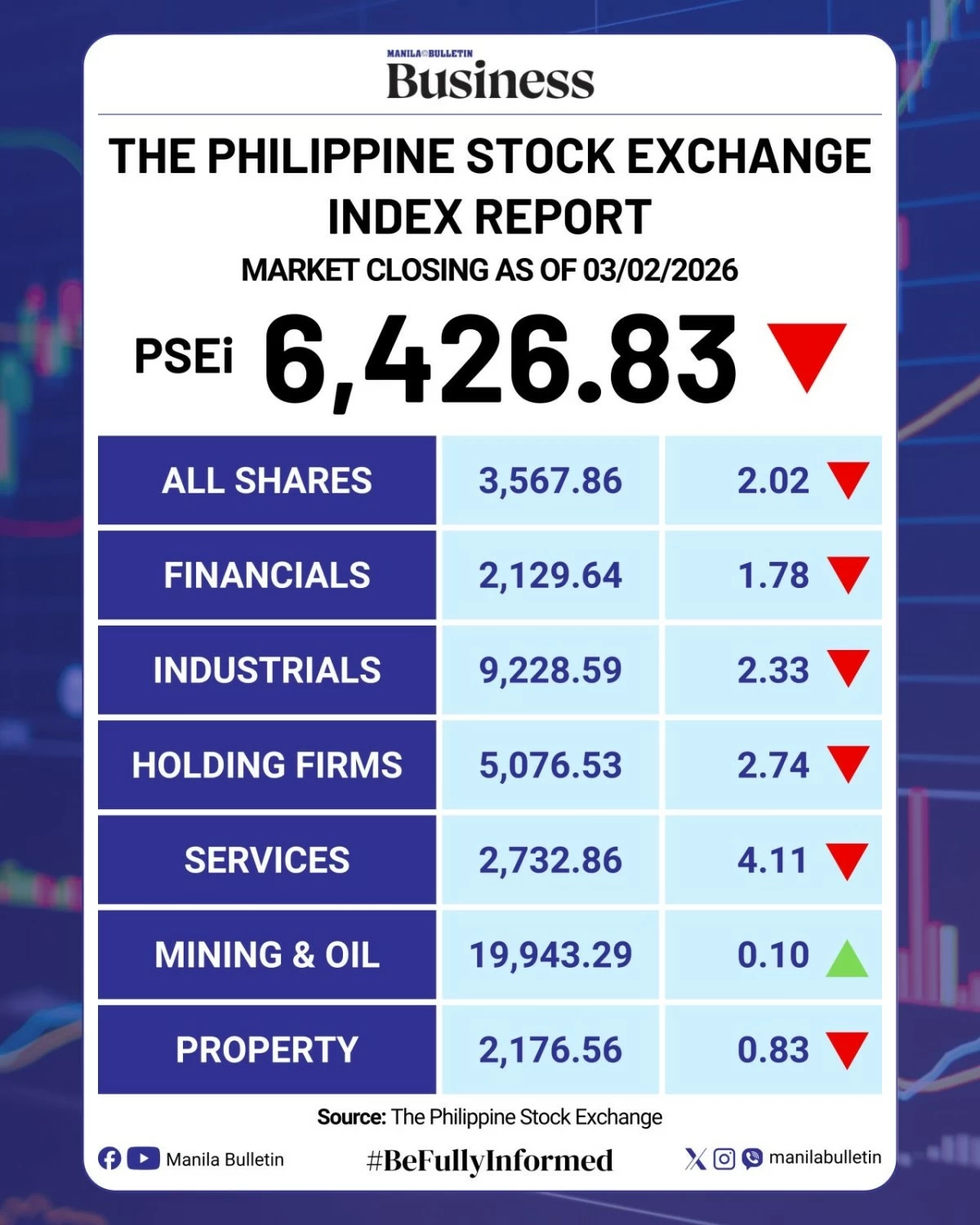
Philippine stocks and the peso tumbled on Monday, March 2, as the threat of an escalating war in the Middle East rattled regional markets, fueling concerns that surging energy costs will derail efforts to tame domestic inflation.
The Philippine Stock Exchange index (PSEi) slumped 2.79 percent, or 184.41 points, to close at 6,426.83. The retreat marked the sharp reversal for the benchmark, which just a day earlier had reached its highest level in over a year.
Trading was heavy, with 1.19 billion shares valued at ₱9.12 billion changing hands. Decliners overwhelmed advancers 159 to 53, while 52 issues remained unchanged.
The sell-off was mirrored in the foreign exchange market, where the peso plunged to ₱58.20 against the United States (US) dollar, hitting its intraday low for the session.
The local currency opened at ₱57.85 and failed to regain ground from Friday’s close of ₱57.665, according to data from the Bankers Association of the Philippines.
Volatility prompted a surge in activity, with total trading volume jumping to $2.245 billion from $1.504 billion in the previous session.
Rising oil prices typically weigh heavily on the Philippines, a net oil importer, putting immediate pressure on the current account and domestic price stability.
“The local index closed sharply lower as escalating global conflict triggered a broad-based sell-off across sectors, dampening overall market sentiment,” said Luis Limlingan, managing director at Regina Capital Development Corp.
He noted that risk-off sentiment dominated the session as investors rotated into commodity-backed assets like gold and oil, which serve as defensive hedges during periods of geopolitical upheaval.
Market analysts warned that the benchmark may face further volatility if the friction involving Iran persists. Japhet Tantiangco, research manager at Philstocks Financial, said the market is currently pricing in the negative impact of high energy costs on domestic consumption.
He noted that unless countermeasures are established to mitigate the spike in fuel prices, sentiment is likely to remain skewed to the downside.
Despite the intensity of the drop, Michael Ricafort, chief economist at Rizal Commercial Banking Corp., said the decline was healthy profit-taking following a seven-day rally.
However, he cautioned that the spike in global crude to new eight-month highs remains the primary headwind, as it risks stoking local inflation and complicating the interest rate environment.