







The home you suddenly don't know
Published Mar 1, 2026 11:52 am


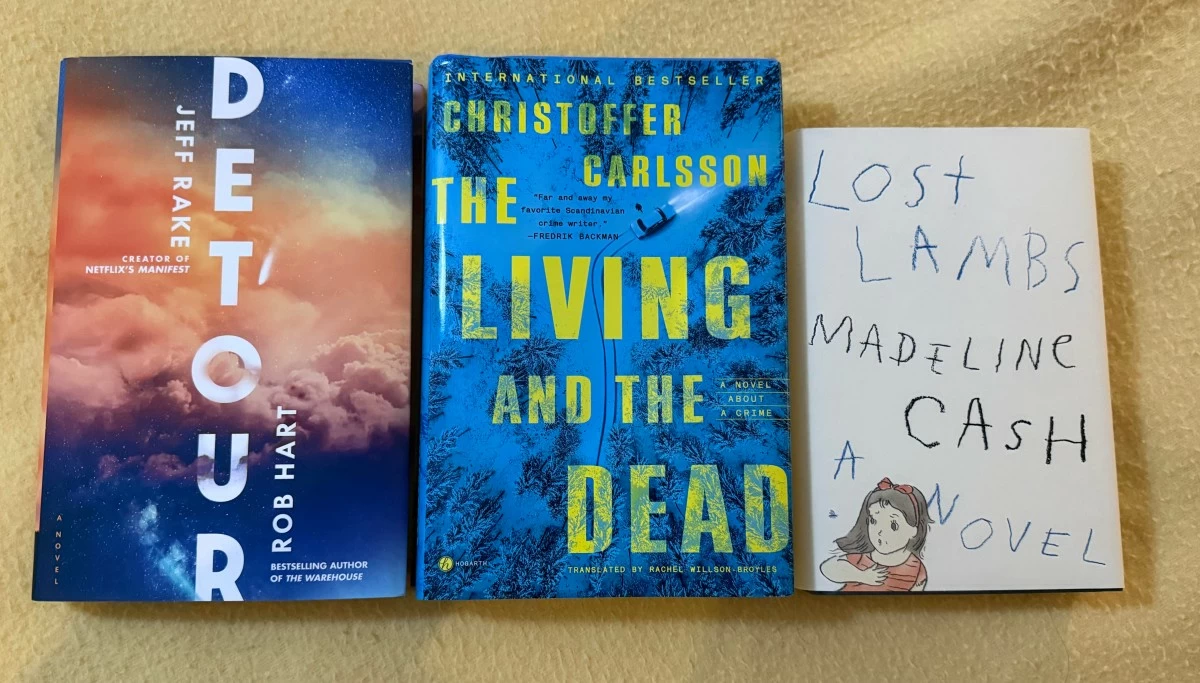
Whether a planet, a rural community, or a small coastal town, what if the location you called ‘home’ suddenly became something very different, unfamiliar, and strange? These three novels explore that theme.
"Detour" by Jeff Rake and Rob Hart
Rake is the creator of the Manifest series on Netflix, while Hart is the author of The Warehouse. This is their first collaboration, and it’s been described as the "offspring of 'The Martian' and 'The Twilight Zone.'" It’s a near-future thriller that nimbly mixes SciFi and space travel, with suspense and subtle strangeness. When we first meet Ryan Crane, he’s a cop who just happens to be in the right place at the right time while off-duty. Thanks to his actions, billionaire and wannabe-politician John Ward is saved from a possible assassination attempt. Working with NASA, Ward is bankrolling the first manned mission to Titan, one of Saturn’s 146 moons. It’s a six-man mission of three veteran astronauts and three chosen civilians. Ward offers a spot to Crane, with a substantial financial incentive attached.
It’s a two-year mission, and the big paycheck could go a long way in helping Crane and his wife care for their disabled son. A near-fatal accident occurs when they approach Titan, and it’s the resourcefulness of the other crew members that saves the day for everyone. It’s when they return to Earth that the real weirdness begins. All the crew members return to a family, situation, and Earth that is slightly different from the one they departed from. Crane, for example, has a son who is into football and was never disabled from the accident he suffered in the other version of Earth. The theories behind why this would be happening, plus the growing suspicion that Ward was expecting all this to occur, are what propel the compelling narrative. Emotional and mind-bending, it’s easy to see this also being optioned into a limited series. I’d look forward to that.
"The Living and the Dead" by Christoffer Carlsson
With a PhD in Criminology from Stockholm University, Carlsson has twice been named the youngest winner of Best Swedish Crime Novel of the Year. He has been a recipient of the Glass Key Award and the Palle Rosenkrantz Prize for Best Translated Crime Novel. Blending Nordic noir with psychological mystery, this latest from Carlsson examines a crime that rocks a small rural community in the southwest of Sweden. It opens in 1999, as two good friends, 17-year-olds Sander and Killian, leave a house party together, only to awaken to their world turned upside-down. In the course of the night, their friend, the eldest son of the richest family in the town, has been bludgeoned, and his corpse left in the trunk of a car, parked by the house of a widow and her daughter, Felicia. The murdered boy, Mikael, had an argument with Jakob, another young boy, during the party, and the car does belong to the widow.
We read as both Sander and Killian become suspects, but circumstances lead to it being left an open case, with no person charged for the murder. A lead detective of Indonesian descent named Siri becomes part of the compelling narrative, and we watch as she’s frustrated by the case, eventually resigning from the force. What’s interesting in this narrative is how twenty years later, a second body turns up, murdered in exactly the same way. The impact of violence on those left behind, an insular community that closes on itself in the face of said violence, and how people cope with the trauma, all form part of Carlsson’s story, making this so much more than just a mystery, crime-solving novel. We watch how Siri is treated like an outsider, and we agonize with Sander when he dreams of moving to the city to carve out a new life and have that dream snatched away when it was so close. That all this is happening, while the unknown murderer is moving undetected within the village, adds a high degree of suspense.
"Lost Lambs" by Madeline Cash
Forget your run-of-the-mill dysfunctional American nuclear family. In this debut novel, Cash sets a new, crazy-hilarious standard with the Flynn family. Both tender and entertaining, the storyline has Catherine and Bud, with their open marriage at the center. It’s an open marriage that’s more one-sided, as Bud isn’t that happy with the arrangement. Meanwhile, how it impacts their three daughters is another matter altogether. The eldest, Abigail, is dating a man in his twenties who’s nicknamed War Crimes Wes. Louise, the middle child, is corresponding with and being inspired by an online terrorist. The youngest, Harper, is brilliant but has a hard time adjusting and is being sent to a wilderness reform camp. And lurking in the shadows of the coastal town that the Flynns call home is billionaire shipping magnate, Paul Alabaster.
Harper has the paranoid fantasy that Alabaster has the whole town under his watch and control. A family saga for this century and time, the novel works as a spectator sport of a different nature, and we watch with fascination as this dysfunctional family spirals towards chaos. It’s interesting to note that the film rights for this first novel of Cash have already been optioned by A24, with the name of Director Lena Dunham attached to the purchase. Cash's first published novel is that rare find of a comedy novel that’s genuinely funny and works in a sustained manner. We care for the sisters and their parents; we genuinely are interested to know what happens next, and while some of the plot developments go off on a tangent that veers on the ludicrous, we’re gently brought back to the richly drawn characters and how they interact with each other. A fun read, filled with warmth.