






Manila Bulletin
 Philippines
National
AFP, US, Japan validate combat readiness in West Philippine Sea through joint drills
Philippines
National
AFP, US, Japan validate combat readiness in West Philippine Sea through joint drills
Philippines
National
AFP, US, Japan validate combat readiness in West Philippine Sea through joint drills
AFP, US, Japan validate combat readiness in West Philippine Sea through joint drills
Aerial patrols reach Bashi Channel, a critical waterway separating Northern Luzon from Taiwan
Published Feb 27, 2026 01:26 pm


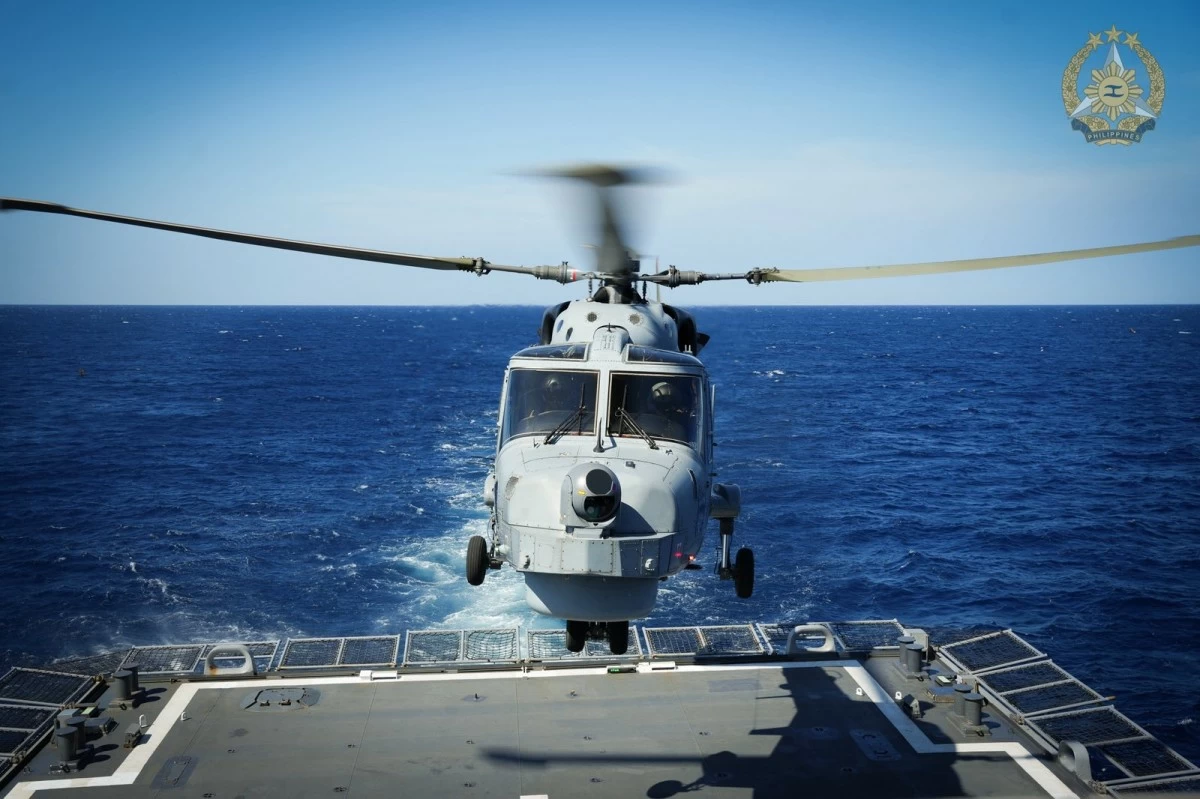
The Philippine Navy’s AW159 helicopter executes a cross-deck landing during the 15th Multilateral Maritime Cooperative Activity (MMCA) in the West Philippine Sea, held from February 20 to 26, 2026. (Photo: Armed Forces of the Philippines)
The Armed Forces of the Philippines (AFP) announced on Friday, Feb. 27, that it has tested its combat readiness in a high-stakes demonstration of trilateral interoperability in the West Philippine Sea (WPS) with counterparts from the United States and Japan.
The AFP concluded its 15th Multilateral Maritime Cooperative Activity (MMCA) with the US Indo-Pacific Command (INDOPACOM) and Japan Maritime Self-Defense Force (JMSDF) on Thursday, Feb. 26, after a week of intensive naval and air exercises.
The designated operational box covered areas within Philippine jurisdiction which extended up to the northern tip of Luzon, particularly Mavulis Island, and toward the maritime boundary in the area, said AFP public affairs office chief, Col. Xerxes Trinidad.
The AFP said naval assets operated up to waters west of Basco, Batanes while air operations were conducted within airspace over Philippine territory and its territorial sea north of Luzon, including Bashi Channel, another military official confirmed.
The Bashi Channel lies between northern Luzon and Taiwan, and connects the WPS to the western Pacific Ocean. The waterway is a key transit route for military and commercial vessels moving between the South China Sea and the Pacific.
The channel has drawn attention from Beijing, Washington, and Tokyo due to its proximity to Taiwan and major sea lines of communication. For Manila, the area north of Luzon forms part of its northern maritime approaches.
In fact, it sits near Mavulis Island, the country’s northernmost island, where AFP Chief of Staff Gen. Romeo Brawner Jr. previously expressed his intention to strengthen the military’s presence in preparation for a possible Taiwan invasion contingency.
Because of its proximity to both Taiwan and China, the Bashi Channel is frequently monitored by regional powers as a key chokepoint that could influence the outcome of a potential conflict.
Assets deployed
During the MMCA, the AFP said it deployed the Philippine Navy’s guided missile frigate BRP Antonio Luna (FF151) with an embarked AW159 helicopter, along with the Philippine Air Force's (PAF) FA-50 fighter jets, C-208B utility aircraft, A-29 Super Tucano light attack aircraft, and a Sokol search and rescue helicopter.
The Philippine Coast Guard (PCG) also joined with offshore patrol vessel BRP Gabriela Silang (OPV 8301), and the AFP said its participation reflected a “whole-of-nation” approach to maritime security.
Meanwhile, Japan contributed a P-3 Orion maritime patrol aircraft while the US deployed the guided missile destroyer USS Dewey (DDG 105) and a P-8A Poseidon maritime patrol and reconnaissance aircraft.
Exercises
Prior to the sailing phase, preparatory engagements were undertaken under the overall MMCA framework, including the troops’ operational synchronization on Feb. 20, a subject matter expert exchange aboard USS Dewey (DDG 105) in Subic on Feb. 21, and final preparations and movement to the operational area on Feb. 22.
The four-day at-sea activities were officially conducted from Feb. 23 to 26, including a communications check exercise, maritime domain awareness drills, replenishment at sea, and joint air patrols.
Participating forces also carried out fly-bys, division tactics and officer of the watch maneuvers, a photo exercise, and an anti-submarine warfare exercise.
A live-fire gunnery exercise was also conducted by BRP Antonio Luna (FF-151) to validate its targeting accuracy and combat readiness under realistic maritime conditions.
The AFP said the activity ended with a hotwash and finish exercise to assess performance and capture lessons for future operations.
“This second MMCA of the year underscores the sustained commitment of partner forces to enhance interoperability, reinforce maritime security, and improve maritime domain awareness in the region,” Trinidad said.
The first MMCA in the WPS this year, which was also the 14th iteration overall since the series began in 2024, was conducted by the AFP along with partners from the US and Australia from Feb. 15 to 16.