ADVERTISEMENT

US, South Korean joint drills set in March

Published Feb 25, 2026 03:24 pm
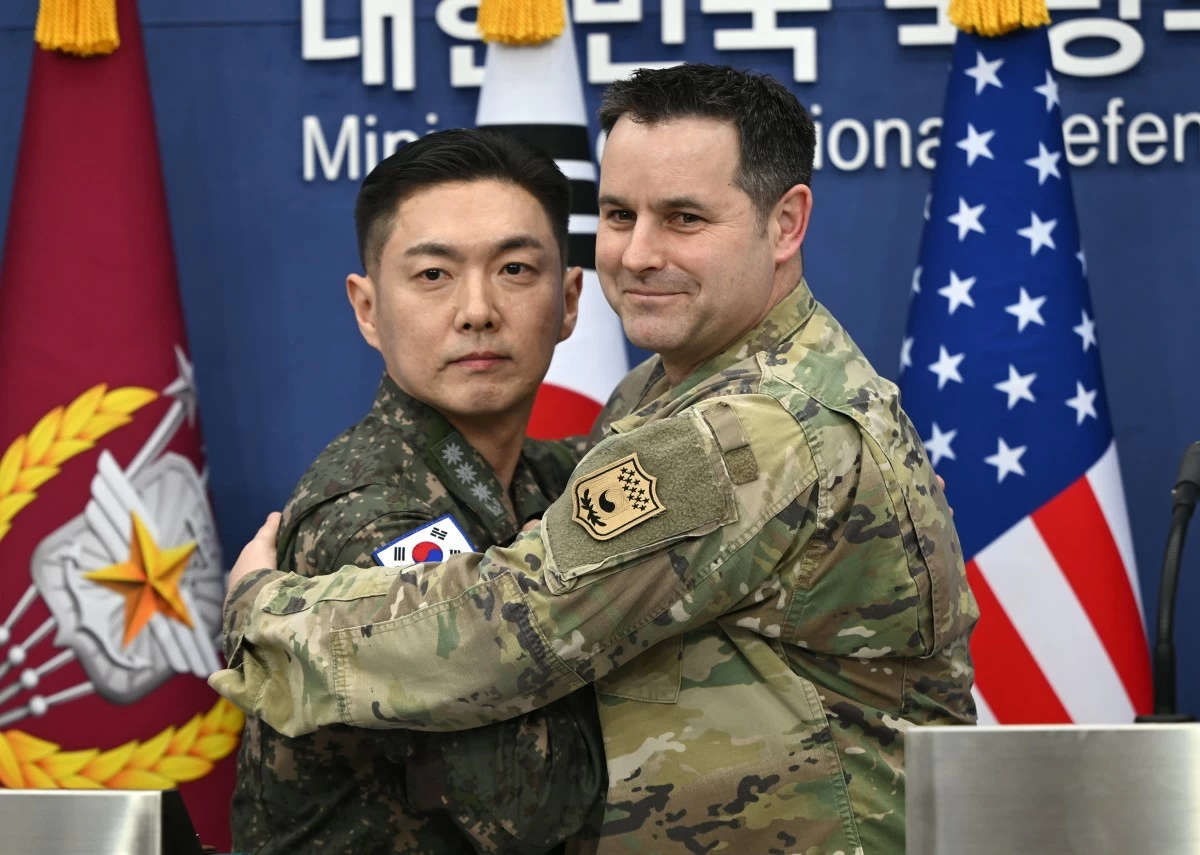
COL. Jang Do-young (left), public affairs director of South Korea's Joint Chiefs of Staff, and US Army Col. Ryan Donald, public affairs director of the United Nations Command, Combined Forces Command, and United States Forces Korea, pose for a photo during a media briefing on the 2026 ROK-US Freedom Shield Military Exercise at the Defense Ministry in Seoul, South Korea, Wednesday, Feb. 25, 2026. (AP)
SEOUL, South Korea (AP) – The US and South Korean militaries said on Wednesday they will conduct their annual springtime exercises next month to bolster their countries' combined defense capabilities against a backdrop of a deepening diplomatic freeze with nuclear-armed North Korea.
The Freedom Shield drills is set for March 9-19, according to the announcement.
North Korea has long described the allies’ joint exercises as invasion rehearsals and used them as a pretext to dial up its own military demonstrations and weapons testing activity. The allies say the drills are defensive in nature.
The announcement came as North Korea is holding a major political conference where authoritarian leader Kim Jong Un is expected to outline his key domestic, foreign policy, and military goals for the next five years. North Korean state media have not so far reported any direct comments by Kim on relations with Washington and Seoul at the ruling Workers’ Party congress, which began last week.
Based on recent public comments, experts say Kim could use the congress to further entrench his hardline stance toward South Korea, reiterate calls for Washington to drop its demand for denuclearization as a precondition for renewed talks, and announce steps to simultaneously strengthen and integrate his nuclear and conventional forces.
Freedom Shield is one of two “command post” exercises that the allies conduct each year; the other is Ulchi Freedom Shield, held in August. The drills are largely computer-simulated and designed to test the allies’ joint operational capabilities while incorporating evolving war scenarios and security challenges.
As usual, the March drill will be accompanied by a field training program called Warrior Shield to enhance “training realism and combat readiness,” Col. Ryan Donald, public affairs director of US Forces Korea, told a news conference.
South Korean and US officials have not said how many troops will participate. The exercises typically involve thousands.
There has been speculation that the allies are seeking to tone down the drills to create conditions for dialogue with North Korea.
Liberal South Korean President Lee Jae Myung has expressed a desire for inter-Korean engagement, and some of his top officials have voiced hope that President Donald Trump’s expected visit to China in late March or April could open the door to renewed talks between Washington and Pyongyang.
Col. Jang Do-young, public affairs director of South Korea’s Joint Chiefs of Staff, said the March exercises will not involve scenarios of a possible response to a North Korean nuclear attack but will include training aimed at “deterring nuclear threats.” He said the allies were still discussing the specifics of the field training program.
The rapid expansion in recent years of Kim’s nuclear weapons program – now featuring systems capable of threatening US allies in Asia, as well as long-range missiles that could potentially reach the American homeland – has heightened South Korea’s security concerns while its diplomacy with Pyongyang remains stalled.
South Korea is also grappling with intensifying US-China competition in the region, which has prompted Washington to press its ally to assume a greater share of the defense burden against North Korea as it focuses more on China.
North Korea has repeatedly rejected Washington and Seoul’s calls to resume diplomacy aimed at winding down its nuclear program, which derailed in 2019 following the collapse of Kim’s second summit with Trump during the American president’s first term.
Kim has now made Russia the priority of his foreign policy, sending thousands of troops and large amounts of military equipment to support Moscow’s war in Ukraine, possibly in exchange for aid and military technology.

Related Tags

World news
ADVERTISEMENT
.most-popular .layout-ratio{ padding-bottom: 79.13%; } @media (min-width: 768px) and (max-width: 1024px) { .widget-title { font-size: 15px !important; } }

{{ articles_filter_1561_widget.title }}

.most-popular .layout-ratio{ padding-bottom: 79.13%; } @media (min-width: 768px) and (max-width: 1024px) { .widget-title { font-size: 15px !important; } }

{{ articles_filter_1562_widget.title }}

.most-popular .layout-ratio{ padding-bottom: 79.13%; } @media (min-width: 768px) and (max-width: 1024px) { .widget-title { font-size: 15px !important; } }

{{ articles_filter_1563_widget.title }}

{{ articles_filter_1564_widget.title }}

.mb-article-details { position: relative; } .mb-article-details .article-body-preview, .mb-article-details .article-body-summary{ font-size: 17px; line-height: 30px; font-family: "Libre Caslon Text", serif; color: #000; } .mb-article-details .article-body-preview iframe , .mb-article-details .article-body-summary iframe{ width: 100%; margin: auto; } .read-more-background { background: linear-gradient(180deg, color(display-p3 1.000 1.000 1.000 / 0) 13.75%, color(display-p3 1.000 1.000 1.000 / 0.8) 30.79%, color(display-p3 1.000 1.000 1.000) 72.5%); position: absolute; height: 200px; width: 100%; bottom: 0; display: flex; justify-content: center; align-items: center; padding: 0; } .read-more-background a{ color: #000; } .read-more-btn { padding: 17px 45px; font-family: Inter; font-weight: 700; font-size: 18px; line-height: 16px; text-align: center; vertical-align: middle; border: 1px solid black; background-color: white; } .hidden { display: none; }
function initializeAllSwipers() { // Get all hidden inputs with cms_article_id document.querySelectorAll('[id^="cms_article_id_"]').forEach(function (input) { const cmsArticleId = input.value; const articleSelector = '#article-' + cmsArticleId + ' .body_images'; const swiperElement = document.querySelector(articleSelector); if (swiperElement && !swiperElement.classList.contains('swiper-initialized')) { new Swiper(articleSelector, { loop: true, pagination: false, navigation: { nextEl: '#article-' + cmsArticleId + ' .swiper-button-next', prevEl: '#article-' + cmsArticleId + ' .swiper-button-prev', }, }); } }); } setTimeout(initializeAllSwipers, 3000); const intersectionObserver = new IntersectionObserver( (entries) => { entries.forEach((entry) => { if (entry.isIntersecting) { const newUrl = entry.target.getAttribute("data-url"); if (newUrl) { history.pushState(null, null, newUrl); let article = entry.target; // Extract metadata const author = article.querySelector('.author-section').textContent.replace('By', '').trim(); const section = article.querySelector('.section-info ').textContent.replace(' ', ' '); const title = article.querySelector('.article-title h1').textContent; // Parse URL for Chartbeat path format const parsedUrl = new URL(newUrl, window.location.origin); const cleanUrl = parsedUrl.host + parsedUrl.pathname; // Update Chartbeat configuration if (typeof window._sf_async_config !== 'undefined') { window._sf_async_config.path = cleanUrl; window._sf_async_config.sections = section; window._sf_async_config.authors = author; } // Track virtual page view with Chartbeat if (typeof pSUPERFLY !== 'undefined' && typeof pSUPERFLY.virtualPage === 'function') { try { pSUPERFLY.virtualPage({ path: cleanUrl, title: title, sections: section, authors: author }); } catch (error) { console.error('ping error', error); } } // Optional: Update document title if (title && title !== document.title) { document.title = title; } } } }); }, { threshold: 0.1 } ); function showArticleBody(button) { const article = button.closest("article"); const summary = article.querySelector(".article-body-summary"); const body = article.querySelector(".article-body-preview"); const readMoreSection = article.querySelector(".read-more-background"); // Hide summary and read-more section summary.style.display = "none"; readMoreSection.style.display = "none"; // Show the full article body body.classList.remove("hidden"); } document.addEventListener("DOMContentLoaded", () => { let loadCount = 0; // Track how many times articles are loaded const offset = [1, 2, 3, 4, 5, 6, 7, 8, 9, 10]; // Offset values const currentUrl = window.location.pathname.substring(1); let isLoading = false; // Prevent multiple calls if (!currentUrl) { console.log("Current URL is invalid."); return; } const sentinel = document.getElementById("load-more-sentinel"); if (!sentinel) { console.log("Sentinel element not found."); return; } function isSentinelVisible() { const rect = sentinel.getBoundingClientRect(); return ( rect.top < window.innerHeight && rect.bottom >= 0 ); } function onScroll() { if (isLoading) return; if (isSentinelVisible()) { if (loadCount >= offset.length) { console.log("Maximum load attempts reached."); window.removeEventListener("scroll", onScroll); return; } isLoading = true; const currentOffset = offset[loadCount]; window.loadMoreItems().then(() => { let article = document.querySelector('#widget_1690 > div:nth-last-of-type(2) article'); intersectionObserver.observe(article) loadCount++; }).catch(error => { console.error("Error loading more items:", error); }).finally(() => { isLoading = false; }); } } window.addEventListener("scroll", onScroll); });

Sign up by email to receive news.