






Manila Bulletin
 Philippines
National
PH Army kicks off CATEX 'Katihan' to prime troops for expanded drills with US, Japan
Philippines
National
PH Army kicks off CATEX 'Katihan' to prime troops for expanded drills with US, Japan
Philippines
National
PH Army kicks off CATEX 'Katihan' to prime troops for expanded drills with US, Japan
PH Army kicks off CATEX 'Katihan' to prime troops for expanded drills with US, Japan
Published Feb 25, 2026 05:33 pm


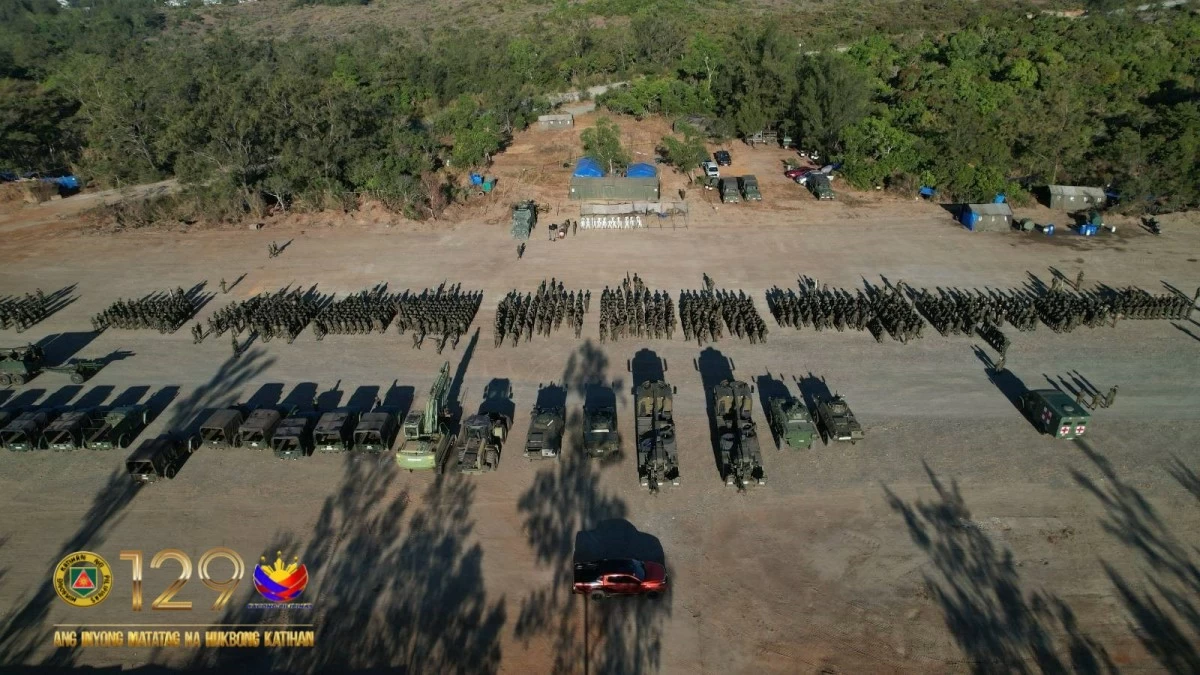
Training units gather for the opening ceremony of the third iteration of the large-scale Combined Arms Training Exercise (CATEX) “Katihan” 2026 at the Paredes Air Station in Pasuquin, Ilocos Norte on February 23, 2026. (Photo: Philippine Army)
The Philippine Army (PA) announced Wednesday, Feb. 25, that it has launched the third iteration of its large-scale Combined Arms Training Exercise (CATEX) “Katihan” 2026 at Paredes Air Station in Pasuquin, Ilocos Norte.
The exercise is designed to test the Army’s ability to quickly move troops and equipment to wherever they are needed, whether in combat, disaster response, or community protection, according to PA Commanding General Lt. Gen. Antonio G. Nafarrete.
It includes a range of drills covering displaced civilian operations, where soldiers practice helping civilians forced to flee from danger, littoral defense drills which focus on securing coastal areas and ports, mobile defense and retrograde operations which train troops to fight strategically by moving or pulling back as needed to protect key areas, and area defense exercises which focus on holding and protecting specific locations.
The exercise also puts into practice the Army’s Land Defense Concept (LDC) and its role in the Comprehensive Archipelagic Defense Operations (CADC). The frameworks guide how the Army, Philippine Navy (PN), and Philippine Air Force (PAF) coordinate to defend the country’s islands.
In his keynote remarks, Brig. Gen. Rhenante M. Salvador, commander of the 503rd Infantry Brigade, said the training exercise, which began on Feb. 23, would be conducted in controlled areas to ensure the safety and security of the training audience and the community.
Upcoming major drills
CATEX “Katihan” is seen as a preparatory step for the Army’s participation in upcoming multinational exercises including the Salaknib (Ilocano term for shield) Exercise, Exercise Balikatan (which translates to shoulder-to-shoulder), and the Joint Pacific Multinational Readiness Center-Exportable (JPMRC-X) Exercise with allied forces from the United States and Japan, among others.
For Salaknib, around 5,000 military personnel from the PA, US Army Pacific (USARPAC), and Japan Ground Self-Defense Force (JGSDF) will be involved in the exercise, tentatively scheduled in April.
Nafarrete said this will be the first time Japanese troops will participate in an active capacity in the PH-US-led Salaknib, coinciding with the entry into force of the Reciprocal Access Agreement (RAA) between Manila and Tokyo on September 11, 2025.
Around 300 JGSDF personnel are expected to participate in the drills. He said the Japanese participation in Salaknib will be primarily staff-level, although a mechanized company will also take part in maneuvers.
“Their mechanized unit will be coming here, a company size,” he said. He did not confirm whether these units will be used in a live fire exercise.
The exercises will mostly take place in Northern Luzon, with Fort Magsaysay in Nueva Ecija serving as the main venue. Nafarrete said some iterations may extend to Isabela.
“It is more on infantry, combined arms operations, combined arms, and more of well HADR operations,” he said, referring to humanitarian assistance and disaster response, a key area of military cooperation since the Philippines is frequently hit by typhoons.
On the other hand, the JPMRC-X is a flexible and multinational military training program between the PA and USARPAC where allied forces practice coordinating and responding together in realistic combat or disaster scenarios.
Meanwhile, Exercise Balikatan, the largest annual military exercise between the Philippines and United States, will include eight major drills, and will be conducted sometime in the second quarter of the year.
The exercises will feature live fire drills for allied forces, Nafarrete confirmed.
“There will be a live fire on the part of our counterparts, on MLRS (medium and long-range systems) and the purpose of this is also to train our personnel on using these capabilities because later on, the Army will also be acquiring these assets,” he added.
For Balikatan, additional operations will be held in Aparri, and the focus of the drills will be on interoperability of Filipino troops with American counterparts, Nafarrete said.
“Actually, it’s more on conducting joint combined training exercises. It is to become interoperable with them. And then expertise exchanges, and capacity building programs including HADR operations because they know that we are always being visited by typhoons,” the Army chief shared.