






Manila Bulletin
 Philippines
National
Philippines links global UN pledges to local job creation, social protection
Philippines
National
Philippines links global UN pledges to local job creation, social protection
Philippines
National
Philippines links global UN pledges to local job creation, social protection
Philippines links global UN pledges to local job creation, social protection
By Trixee Rosel
Published Feb 24, 2026 01:12 pm


At A Glance
- DOLE showcased how the Philippines is turning UN development commitments into local jobs and social protection programs.
- The strategy was presented at the 3rd UN Directors Group Retreat of the Local2030 Coalition in Bilbao, Spain.
- Key frameworks driving this initiative are the Trabaho Para sa Bayan (TPB) Plan, LEP 2023–2028, and the Global Accelerator.
- Implementation focuses on local government integration, UN collaboration, and participatory governance.
- The Philippines, as a Global Accelerator pathfinder, is developing a roadmap for construction and transportation sectors.
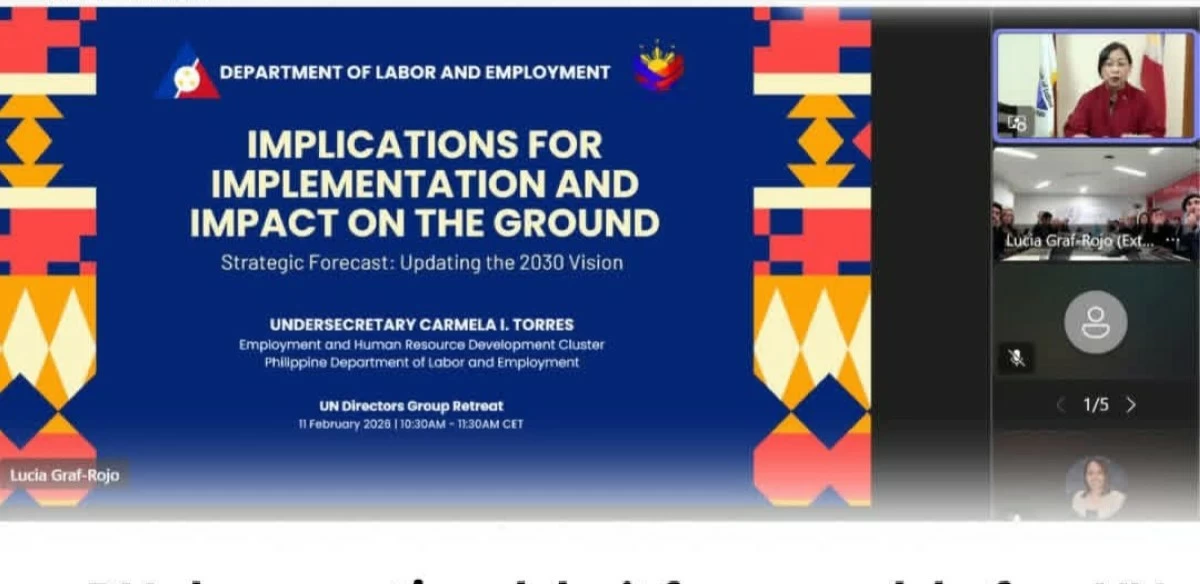
DOLE Undersecretary Carmela Torres delivers a virtual presentation to the United Nations Directors Group Retreat of the Local2030 Coalition. (Photo: DOLE)
The Philippines, through the Department of Labor and Employment (DOLE), showcased to United Nations development leaders how it is translating international commitments into tangible jobs and social protection programs nationwide.
The presentation took place during the 3rd Directors Group Retreat of the Local2030 Coalition in Spain, where government and UN officials discussed aligning global development goals with local implementation.
DOLE Undersecretary Carmela Torres said the Sustainable Development Goals (SDGs) are fully integrated into the Philippine Development Plan and Ambisyon Natin 2040.
She added that this ensures national commitments on decent work, social protection, and inclusion reach regional and local governments.
Central to this approach are three frameworks: the Trabaho Para sa Bayan (TPB) Plan, the Labor and Employment Plan (LEP) 2023–2028, and the Global Accelerator, which together drive measurable SDG outcomes at the grassroots level.
Implementation relies on three mechanisms: integrating employment and SDG priorities into local government plans, collaborating with the UN system and development partners, and sustaining participatory governance through tripartite mechanisms.
Aligned with the SDGs, the TPB serves as the national roadmap for job creation and recovery.
It focuses on enterprise support, improving employability, reducing informal work, strengthening employment services, and expanding social protection.
The TPB also provides the platform for engagement with the Global Accelerator, ensuring reforms are nationally owned and globally aligned.
“Through the UN joint programme under the Global Accelerator, the Philippines is supporting job-rich, SDG-aligned interventions in priority sectors, generating lessons that can be scaled nationwide,” Torres said.
The LEP 2023–2028 operationalizes these commitments by setting targets to create more and better-quality jobs, strengthen labor rights, and expand social protection coverage.
Torres emphasized the country’s commitment to deepen collaboration with international partners to make the 2030 development agenda tangible in communities nationwide.
Since March 2024, the Philippines has been a pathfinder country under the Global Accelerator, developing a national roadmap for the construction and transportation sectors to turn global commitments into concrete employment opportunities.