







Marcos: Let's not fail our farmers
Published Feb 24, 2026 12:15 pm
|
Updated Feb 24, 2026 01:16 pm


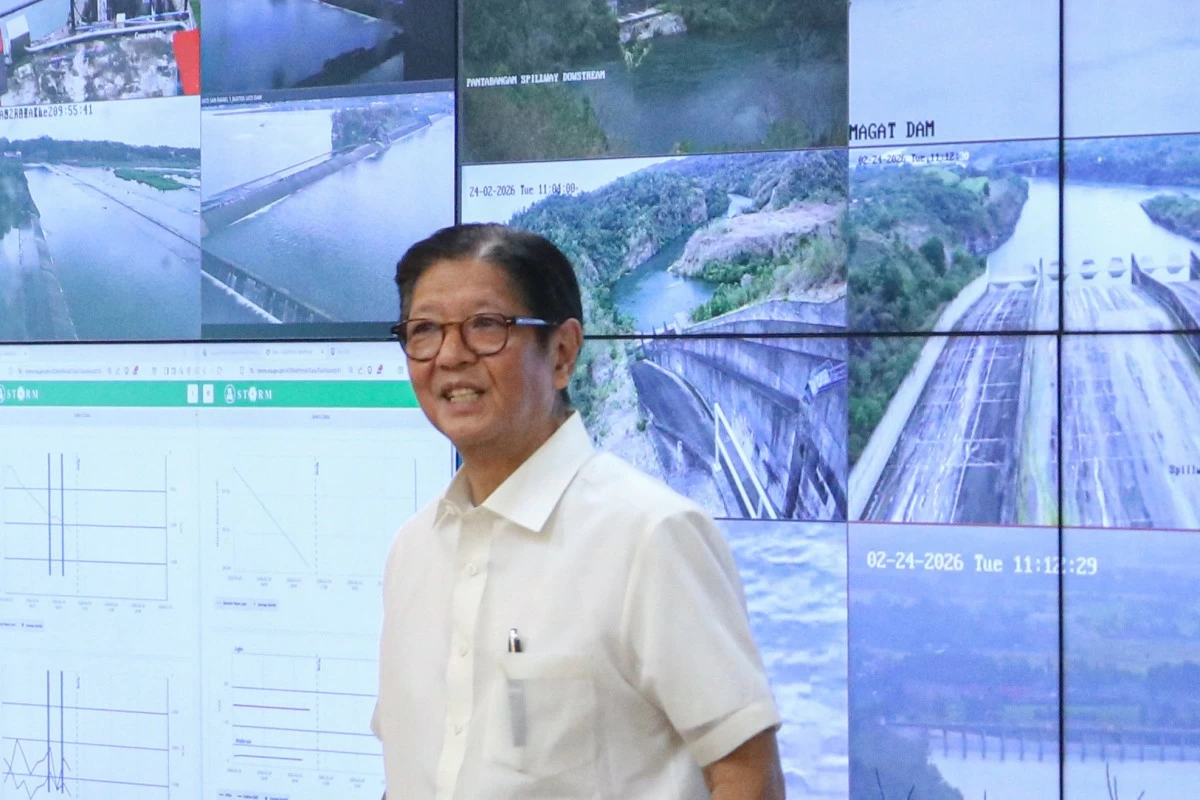
President Ferdinand Marcos Jr., inspects the National Irrigation Authority Command Center that serves as the central hub for monitoring, managing, and controlling national irrigation systems, including AI-driven weather forecasting and dam operations in the country at NIA Headquarters in Quezon City on Feb. 24, 2026. (Santi San Juan)
Emphasizing that farmers remain as the strength of agriculture despite the emergence of modern technology, President Marcos reminded the government to not fail the country's farmers.
In his remarks at the 2026 National Irrigation Administration (NIA) – National Confederation of Irrigators Associations (NCIA) general assembly on Tuesday, Feb. 24, Marcos stressed that "each of us carries a responsibility" in strengthening the country's agriculture.
Thus, he called on the agency to help assist farmers in improving their livelihood.
"Sa mga kawani ng NIA at mga katuwang sa NCIA, huwag nating bibiguin ang ating mga magsasaka (To the personnel of the NIA and our partners in the NCIA, let us not fail our farmers)," Marcos said.
The President also underscored that farmers are the government's partners in strengthening the agriculture sector, telling that whatever technology emerges, they remain to hold a key role in the sector.
"Anumang makabagong teknolohiya ang ating ilunsad, nananatiling nakasalalay ang lakas ng sektor ng agrikultura sa ating mga magsasaka (Whatever modern technology we introduce, the strength of the agricultural sector still depends on our farmers)," Marcos said.
"Kayo po ang katuwang ng pamahalaan. Kayo ang nakakaalam ng pangangailangan sa lupa. At kayo ang kasama namin sa pagbuo ng mga solusyon (You are the government’s partners. You are the ones who understand the needs of the land. And you are with us in developing solutions)," Marcos added.
Marcos also acknowledged that while Filipino farmers are diligent, resourceful, and skilled, it must be matched with a clear plan and sustained support from the government.
The Chief Executive cited the role of NIA's command center where everything is monitored in real time such as the condition of the dams, the water levels, and weather movements.
He said that through telemetry, information is transmitted directly to the command center because of satellite-fed monitoring, including satellite-fed weather monitoring.
"[N]agpalipad po tayo ng satellite at nasa taas natin at yun ay ating ginagamit upang tingnan kung ano yung kalagayan ng mga taniman natin (We launched a satellite that is now above us, and we use it to observe the condition of our farmlands)," Marcos said.
"Mas maaga ngayon nating natutukoy kung kailan magpapakawala ng tubig, kailan dapat maging handa sa pagbaha, at kailan dapat magbigay ng babala sa ating mga komunidad na magiging apektado (We can now determine much earlier when to release water, when to prepare for flooding, and when to issue warnings to communities that may be affected)," he added.
The President stressed that modern technologies such as AI-based crop monitoring and smart weather forecasting systems ensure that agricultural and irrigation projects are guided by accurate data.
In his speech, the President expressed his gratitude to experts and specialists from the academe and the private sector for their continued research and support for the agricultural sector.
"Mas uunlad ang sektor ng agrikultura kung magkakaisa tayong kikilos nang may dedikasyon at may disiplina (The agricultural sector will progress further if we act together with dedication and discipline)," Marcos said.
"Sama-sama natin itaguyod ang mas masagana at mas likas-kayang sakahan sa buong bansa upang masabi natin lahat ng ating mga kababayan ay may food supply (Let us work hand in hand to promote more productive and more sustainable farms across the country, so that we can truly say that all our fellow citizens have a secure food supply), Marcos added.
This year’s NCIA general assembly aims to strengthen collaboration with national and international organizations to promote the interests and welfare of irrigators associations (IA), build partnerships with government and non-government organizations (NGOs) to support agriculture and other services for increased farm productivity, and act as a channel for technical and financial assistance to further growth and development among IAs, among other goals.