







1-kilometer-high ash plume rises from Mayon Volcano
Published Feb 24, 2026 03:07 pm


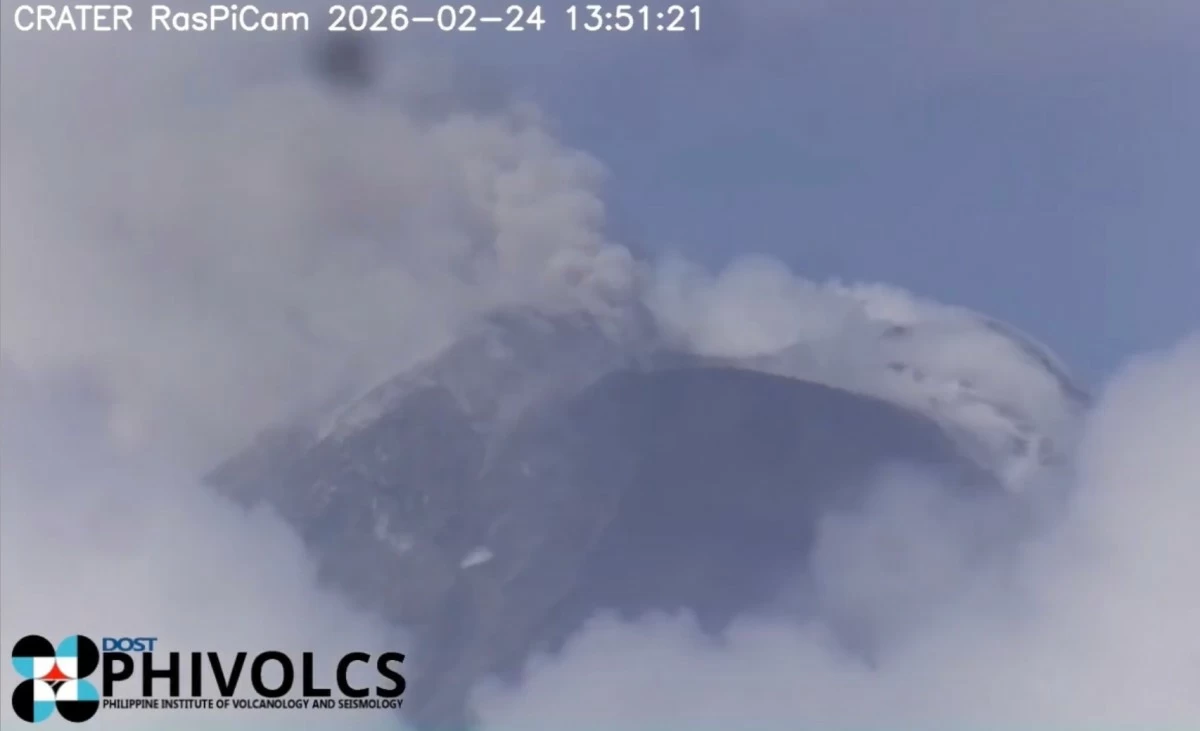
A grayish to brownish ash plume rises about one kilometer above the summit crater of Mayon Volcano on Feb. 24, 2026, drifting west-southwest as captured by the Mayon Volcano Observatory Crater RasPi Camera. The volcano remains under Alert Level 3 amid continuing effusive eruption and volcanic unrest. (Screenshot from Phivolcs Facebook page)
An ash plume rose anew from Mayon Volcano on Tuesday afternoon, Feb. 24, reaching about one kilometer above the summit crater as the volcano remained under Alert Level 3, the Philippine Institute of Volcanology and Seismology (Phivolcs) said.
Time-lapse footage recorded at 1:50 p.m. showed a grayish to brownish plume drifting west-southwest, based on images captured by the Mayon Volcano Observatory Crater RasPi Camera.
In its 24-hour monitoring from 12 a.m. Feb. 23 to 12 a.m. Feb. 24, Phivolcs recorded 305 rockfall events, 20 pyroclastic density currents (PDCs), and four volcanic earthquakes.
Lava effusion continues at the summit, with lava flows extending up to 3.8 kilometers along the Basud Gully, 2.2 kilometers along the Bonga Gully, and 1.3 kilometers along the Mi-isi Gully.
Sulfur dioxide emission remained high at 3,891 tons per day.
Phivolcs said Mayon remains under Alert Level 3, indicating intensified magmatic unrest and the potential for hazardous eruptions.
Under this alert level, ongoing activity may continue to generate lava flows, collapse-fed rockfalls, and PDCs on the southern and eastern upper slopes, while possible lava fountaining or moderate explosions could affect all sectors of the volcano.
Phivolcs reiterated that the public must stay out of the six-kilometer radius permanent danger zone due to hazards posed by lava flows, rockfalls, and PDCs.
Residents within the eight-kilometer radius were also advised to be prepared for possible evacuation should monitoring parameters escalate and the alert level be raised to Alert Level 4.