






Manila Bulletin
 Philippines
National
Tarriela accuses China of jamming PH ships' Starlink internet connection during patrol in Bajo de Masinloc
Philippines
National
Tarriela accuses China of jamming PH ships' Starlink internet connection during patrol in Bajo de Masinloc
Philippines
National
Tarriela accuses China of jamming PH ships' Starlink internet connection during patrol in Bajo de Masinloc
Tarriela accuses China of jamming PH ships' Starlink internet connection during patrol in Bajo de Masinloc
Published Feb 23, 2026 02:20 pm


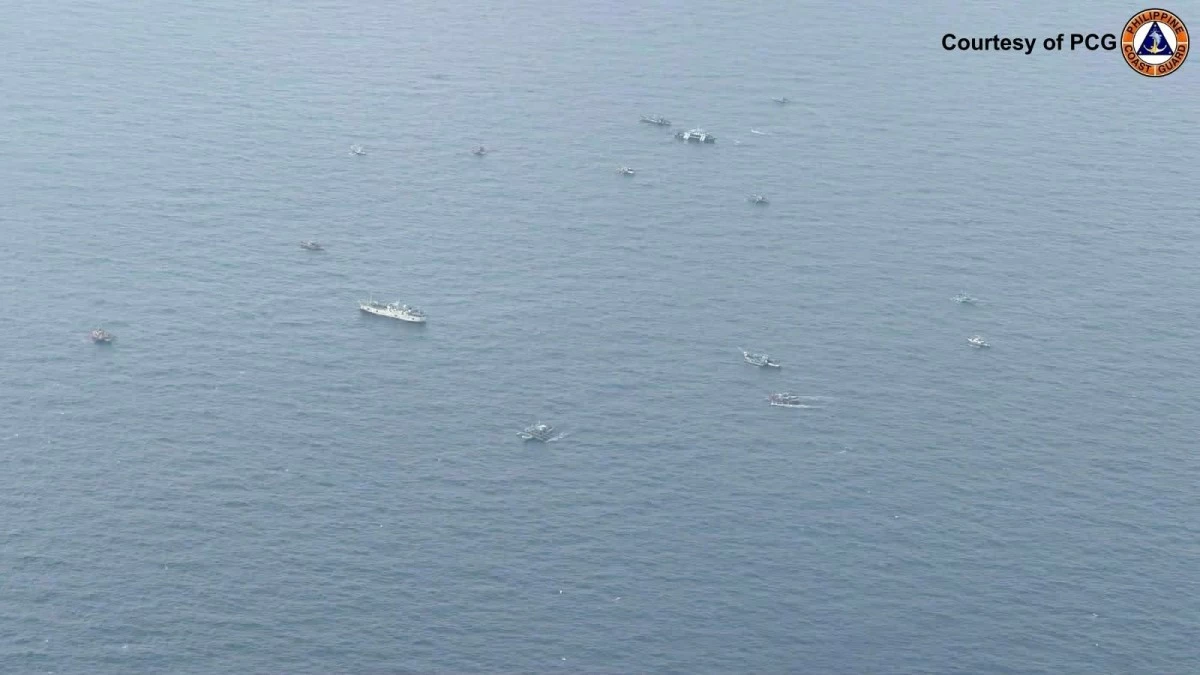
The Philippine Coast Guard (PCG) conducts an aerial patrol over Bajo de Masinloc in the West Philippine Sea (WPS) where at least 35 Filipino fishing boats are gathered to fish in their traditional fishing ground, on Feb. 23, 2026. (Photo: PCG)
The Philippine Coast Guard (PCG) accused China of jamming the Starlink internet connection of its vessels and Bureau of Fisheries and Aquatic Resources (BFAR) ships during a maritime domain awareness (MDA) flight near Bajo de Masinloc (Scarborough or Panatag Shoal) in the West Philippine Sea (WPS) on Monday morning, Feb. 23.
Commodore Jay Tarriela, PCG spokesperson for WPS, said the disruption happened while PCG and BFAR vessels and patrol aircraft were supporting Filipino fishermen operating in the area.
“We deployed our Coast Guard Islander this morning. They departed Manila at 7 a.m. this morning. The reason why we did an MDA flight is because we monitored a large number of Filipino fishing boats fishing in the vicinity of Bajo de Masinloc,” Tarriela told reporters.
He said BFAR deployed four vessels to provide safety and security to Filipino fishermen and to distribute fuel subsidy and ice so they could extend their fishing operations.
“When we conducted the MDA flight, we were able to monitor three China Coast Guard vessels at a distance of 33.6 nautical miles from Bajo de Masinloc,” he added.
Aside from the aircraft, the PCG deployed BRP Cabra (MRRV-4409) and BRP Gabriela Silang (OPV 8301) to support the Kadiwa Para sa Bagong Bayaning Mangingisda program of the national government.
A total of 35 Filipino fishing boats were monitored receiving fuel subsidies and ice packs from the vessels.
However, a People’s Liberation Army-Navy (PLA-N) warship with bow number “554” challenged the PCG aircraft during the flight.
He disclosed that the Starlink connection of BFAR and PCG vessels was lost while operating near Bajo de Masinloc.
“I would like to believe that the People’s Republic of China is conducting signal jamming because we monitor that for our vessels every time we go near or within a radius of 24 nautical miles and closer to Bajo de Masinloc. These are the instances when our Starlink signal disappears,” Tarriela said.
Asked if it was a new incident, he said this was the first time that the PCG experienced signal jamming of its Starlink internet connection.
"As I said, it’s not just something that the Philippine Coast Guard monitored, it was also experienced by four BFAR vessels during this particular mission,” he said.
Tarriela said the disruption affects real-time coordination between vessels at sea and monitoring units on shore. He said stable internet connectivity is critical during patrols and support missions, especially in areas such as Bajo de Masinloc where multiple government ships and Filipino fishing boats are operating.
“Well, obviously, when our Starlink internet connectivity is jammed, it delays the transmission of information and also compromises the communication of the vessels with the Coast Guard units monitoring them,” he explained.
Tarriela said the PCG will “definitely come up with necessary contingencies” to adjust and make sure that such signal jamming will be prevented. He, however, declined to give details on the specific adjustments that will be made as these are part of “operational details.”
When asked if the jamming indeed came from China, Tarriela responded in the affirmative.
“Well, there is no other country we can think of that would jam our internet connectivity every time we move closer to Bajo de Masinloc. Definitely, it would be the People’s Republic of China,” he said.