







ICC prosecutor: DDS killings needed Duterte's clearance
Published Feb 23, 2026 10:59 pm


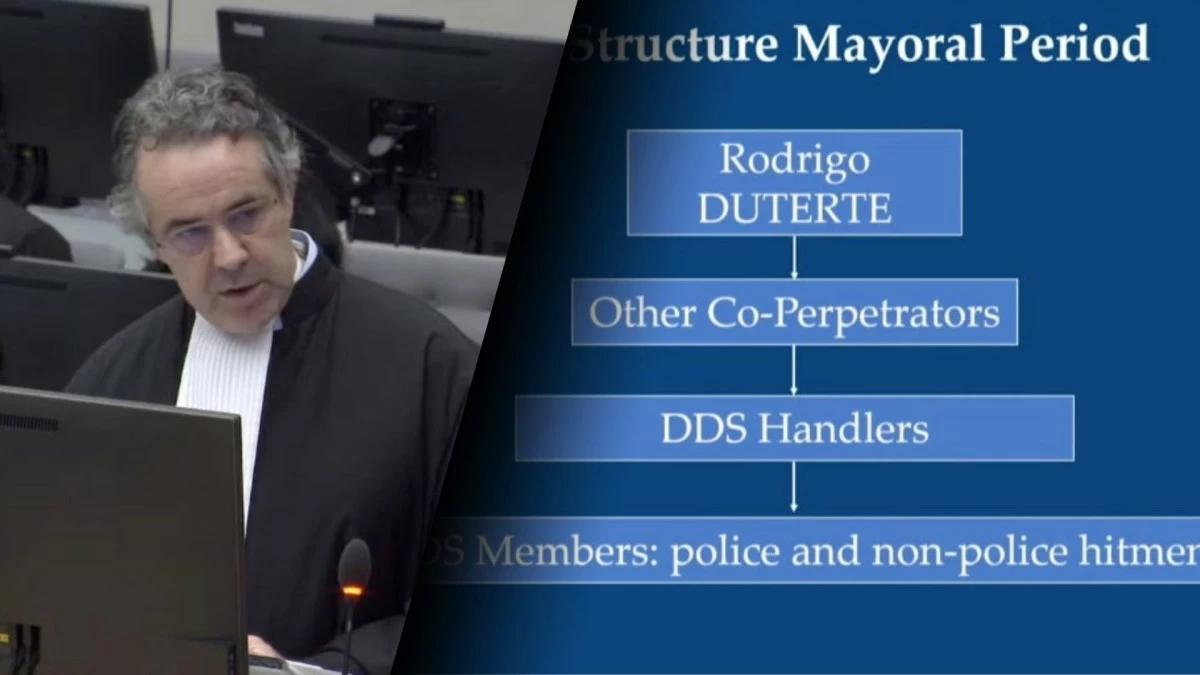
CONFIRMATION OF CHARGES HEARING DAY 1 — International Criminal Court prosecutor Julian Nicholls presents a diagram supposedly explaining how the Davao Death Squad (DDS) model of killing took place in Davao City during former president Rodrigo Duterte's mayoral tenure. (ICC photos)
Prosecutors at the International Criminal Court (ICC) alleged that killings carried out by the so-called Davao Death Squad (DDS) during former president Rodrigo Duterte’s mayoral tenure required his personal approval before they could proceed.
During the third and final session of the first day of the confirmation of charges hearing, ICC Senior Trial Lawyer Julian Nicholls told Pre-Trial Chamber I that multiple witnesses testified that Duterte’s “clearance” was necessary before any killing operation was conducted.
“His clearance, his approval, was required — his permission was required — for DDS members to conduct these murders,” Nicholls said Monday evening, Feb. 23 (Manila time).
“Several witnesses confirm that,” he added.
‘Only one person was making the decisions’
Nicholls cited statements attributed to alleged DDS members describing how they supposedly sought authorization from Duterte before carrying out operations.
“Only one person was making the decisions. [...] you had to ask Duterte because if we didn't make that request, if we didn't ask for [...] authorization, we would be chased or we would be pursued,” one witness statement read.
Another statement quoted in court said: “We cannot conduct a clearing ... or killing operations without his clearance. We called it clearance.”
A separate account presented by the prosecution stated: “[Y]ou cannot just kill anyone in Davao City without Duterte's approval, otherwise you will be charged.”
Nicholls also cited a claim that alleged perpetrators received financial rewards.
“[E]very kill, the first reward money, to my recall, it was P10,000 per kill,” a witness statement read.
Alleged DDS structure
The prosecution displayed in court a diagram labeled “DDS Structure – Mayoral Period,” placing Duterte at the top, followed by “Other Co-Perpetrators,” “DDS Handlers,” and at the bottom, “DDS Members: police and non-police hitmen.”
Nicholls argued that Duterte exercised control over the group and that some alleged members were recruited because they were indebted to him or to police officials, and were threatened with torture or death if they attempted to leave.
The prosecutor also presented video clips of Duterte’s past speeches and interviews, in which he appeared to admit to killings and warned of more bloodshed should he assume higher office.
Alleged ‘necessary evil’
Nicholls further cited testimony claiming that Duterte, as a former prosecutor and mayor, taught police trainees that planting evidence could be justified as a “necessary evil.”
“Our teacher then in the police basic training [...] in law and law and evidence, procedure, investigation, was then Prosecutor Rodrigo Duterte,” a witness statement read.
“He's like planting of evidence. It is necessary, he called it ‘necessary evil.’ [...] So, they said that there are times in police work that you have to do the necessary evil for the sake of the common good [...],” it continued.
Nicholls also referred to Duterte’s response during a House hearing when asked if he had planted evidence: “That was part of the strategy as a mayor and as the leader of the law enforcement agency in the city.”
Named co-perpetrators
In presenting the alleged “common plan,” Nicholls named five individuals as Duterte’s alleged co-perpetrators during his mayoral period: Senator Ronald dela Rosa, former chief of the Davao City Police Office; Senator Bong Go, Duterte’s longtime aide; former Justice Secretary Vitaliano Aguirre II; Vicente Danao, former Davao City police chief; and former National Bureau of Investigation director Dante Gierran.
The confirmation of charges hearing will determine whether there are substantial grounds to believe that Duterte committed the crimes against humanity of murder and attempted murder in connection with the anti-drug campaign.
Duterte, arrested in March 2025, has denied wrongdoing and has challenged the ICC’s jurisdiction over the Philippines.