






Manila Bulletin
 Philippines
National
ICC opens Duterte hearing; Prosecutor: No one is above the law; Victims fear Duterte's 'return'
Philippines
National
ICC opens Duterte hearing; Prosecutor: No one is above the law; Victims fear Duterte's 'return'
Philippines
National
ICC opens Duterte hearing; Prosecutor: No one is above the law; Victims fear Duterte's 'return'
ICC opens Duterte hearing; Prosecutor: No one is above the law; Victims fear Duterte's 'return'
Published Feb 23, 2026 07:01 pm


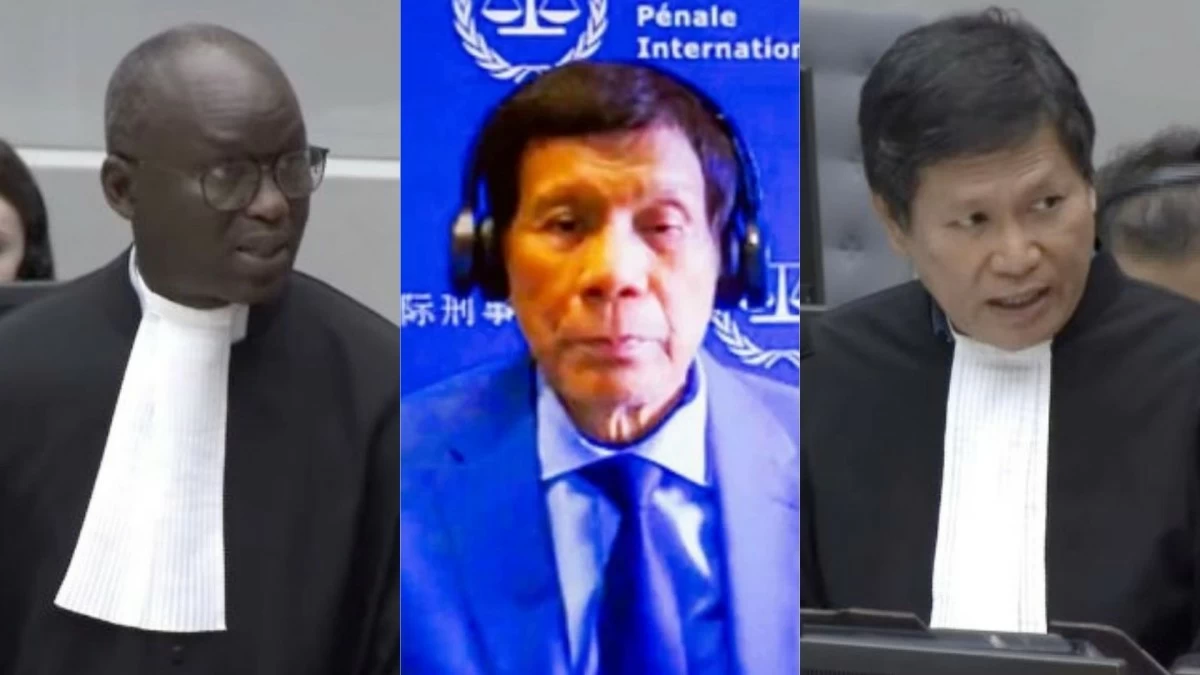
International Criminal Court Deputy Prosecutor Mame Mandiaye Niang, former president Rodrigo Duterte, and the victims' external legal representative Joel Butuyan (ICC photos)
The International Criminal Court (ICC) has officially opened the confirmation of charges hearing against former president Rodrigo Duterte, with prosecutors stressing accountability, while victims warned he would continue preaching a “gospel of immunity” if the case collapses.
In his opening statement before Pre-Trial Chamber I on Monday evening, Feb. 23 (Manila time), Deputy Prosecutor Mame Mandiaye Niang said the start of the hearing marked “an important day for international justice for the people of the Philippines.”
“For the victims and for this court, the commencement of the confirmation hearing against Mr. Rodrigo Roa Duterte is a reminder of the court's unwavering commitment to its mission to investigate and prosecute individuals for the most serious crimes of concern to the international community, and to bring justice to the victims of the atrocities committed in the Philippines,” Niang said.
“It is also a reminder that those in power are not above the law,” he added.
Duterte, arrested in March last year, is suspected of crimes against humanity of murder and attempted murder, allegedly committed between Nov. 1, 2011, and March 16, 2019, in the context of his government’s drug war.
‘Substantial grounds’ for murder, attempted murder
Niang told the chamber there are “substantial grounds” to believe that Duterte is criminally responsible for the charges against him.
He added that these were “merely a fraction of the overall criminality” that resulted in thousands of deaths.
The crimes were first allegedly committed in and around Davao City when Duterte was mayor, and later expanded nationwide when he became president.
Niang said the 78 murders and attempted murders “are not random crimes, nor spontaneous, or happened in isolation,” but were part of “a widespread and systematic attack directed against the civilian population of the Philippines.”
‘Pivotal role’ and ‘common plan’
The deputy prosecutor argued that Duterte played a “pivotal role” and that his contribution to the crimes was “essential.”
He said Duterte personally instructed members of what prosecutors described as the Davao Death Squad (DDS) that their mission was to “kill criminals and suspected criminals,” including alleged drug dealers and users.
“The plan was no secret; clear to the general public in the numerous public statements he made time and again,” Niang said.
He cited Duterte’s own admissions that he rode around Davao on a motorcycle “looking for trouble” so he could kill, and described him as the creator of the DDS who exercised de facto control over its members.
When he became president, prosecutors said, Duterte’s authority expanded nationwide, allowing him to control those implementing the alleged “common plan.”
Niang noted that killings dropped significantly when the drug war was suspended twice, which he said demonstrated Duterte’s authority over the perpetrators.
Witnesses, he added, testified that police killed because of directives from the president, motivated by promises of money, promotions, rewards, and immunity.
Meanwhile, Niang also cited “insiders” who claimed that the crimes were committed because of the promise of immunity.
Niang also accused Duterte of mocking deaths and making fun of an “iconic photograph” linked to the killings. This particular case, however, was not included in the charges against the former president.
“Mr. Duterte intended and knew that the charged crimes were occurring,” he said, pointing to public statements and written orders acknowledging extrajudicial killings (EJKs) by subordinates.
Victims fear ‘conquering hero’ narrative
Appearing before the chamber on behalf of 497 authorized victims, lawyer Joel Butuyan expressed disappointment over the decision allowing Duterte to waive his appearance at the hearing.
Butuyan relayed the “views and concerns” of victims, many of whom, he said, continue to suffer harassment and fear.
“If the charges are not confirmed in this case, Mr. Duterte will return to the Philippines as a conquering hero. He will continue preaching his gospel of immunity,” Butuyan told the judges.
He urged the chamber to “imagine the kind of threats against the victim if the suspect walks free.”
According to Butuyan, Duterte would be portrayed in history as the leader who “vanquished the ICC,” emboldening supporters and further intimidating victims.
He also claimed that Duterte “created clones of himself,” referring to individuals who allegedly continue similar practices, with victims still afraid to come forward.
Butuyan also warned judges that they could be subjected to online harassment by the "Duterte clones."
"There is only one solution to stop the impunity propagated by Mr. Duterte from continuing to bring harm and suffering to the victims, and that is for this honorable Chamber to confirm the charges so that the witnesses can testify and evidence can be presented on the horrible crimes committed by Mr. Duterte," he said.
"The testimonies and evidence presented will inoculate these mini-Dutertes from this virus of impunity that infected them. [...] It will rekindle the embers of humanity that still remain in their heart," he added.
Hearing to determine if case goes to trial
The confirmation of charges hearing is not a trial but a pre-trial proceeding to determine whether there is sufficient evidence to establish substantial grounds to believe Duterte committed the crimes charged.
If the charges are confirmed, the case will proceed to trial before a different ICC chamber.
Duterte has denied wrongdoing and previously questioned the ICC’s jurisdiction over the Philippines, which withdrew from the Rome Statute in 2019.