ADVERTISEMENT

PCG completes 75 percent of underwater search at MV Trisha Kerstin 3; death toll hits 64

Published Feb 21, 2026 02:21 pm
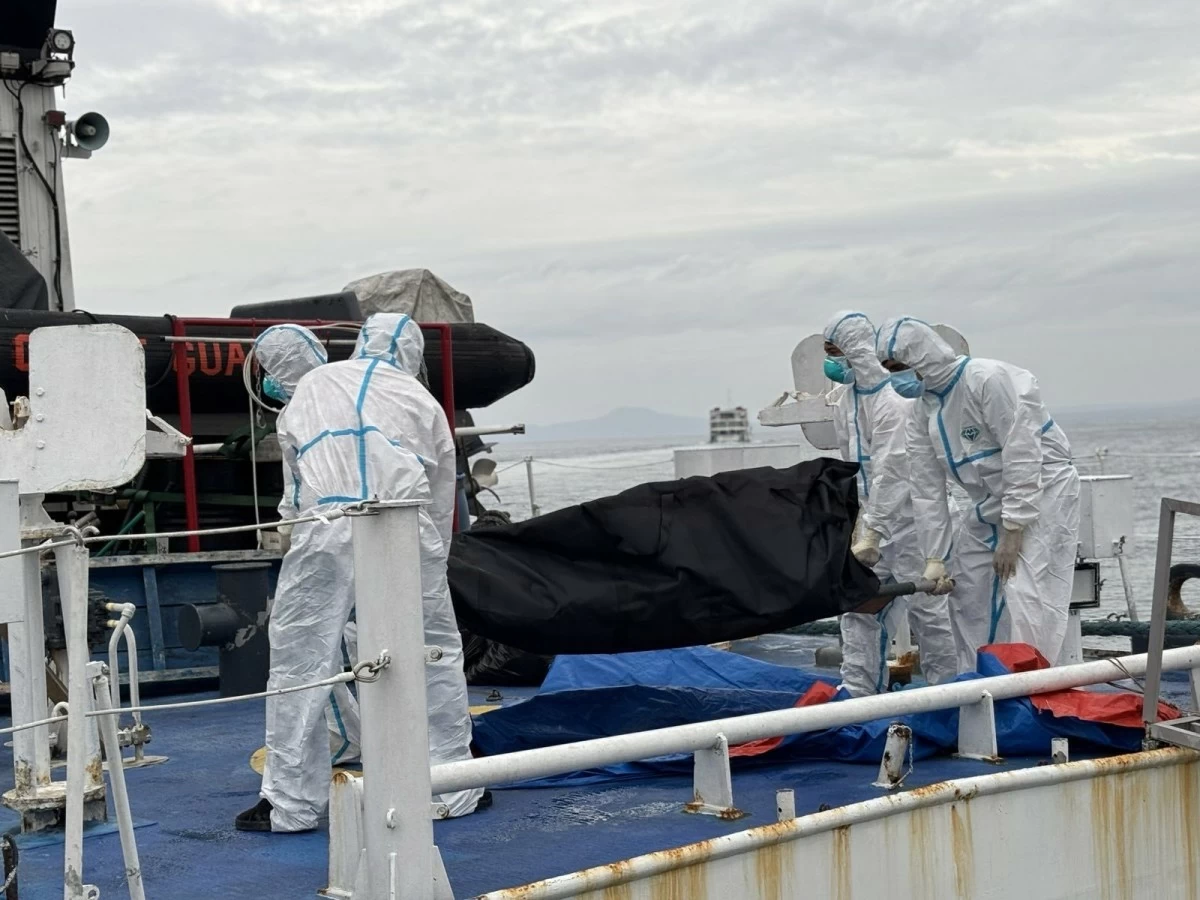
Authorities carry one of the two cadavers recovered by Philippine Coast Guard (PCG) technical wreck divers at the site where MV Trisha Kerstin 3 sank off Baluk-Baluk Island in Basilan on Feb. 18, 2026. The recovery pushes the death toll to 64. (Photo: PCG)
The Philippine Coast Guard (PCG) has completed 75 percent of its underwater search inside the sunken ferry MV Trisha Kerstin 3, a ranking official said on Saturday, Feb. 21.
PCG spokesperson Capt. Noemie Cayabyab said two bodies were recovered during underwater operations on Feb. 18, pushing the confirmed fatalities to 64.
Meanwhile, 293 passengers survived while 15 others remain missing.
“As for the recovered bodies, we have 64, and 15 are still missing. These 15 are live data so the dive operations are ongoing. The numbers may change, and we have 293 survivors,” Cayabyab said.
The vessel sank near Baluk-Baluk Island in Basilan on Jan. 26 and the PCG Technical Diving Group has been conducting sustained underwater operations since the incident.
“Based on our technical wreck divers, they have scoured almost 75 percent of the entire vessel. The intention of the PCG is to search the whole ship, first to check if there are still individuals trapped inside, and second because any information and evidence we find would form part of the investigation,” she said.
The PCG said the figures were validated through joint efforts of the Philippine National Police-Scene of the Crime Operatives (PNP-SOCO), the City Disaster Risk Reduction and Management Office, Coast Guard District Southwestern Mindanao, and the affected families.
The PCG was coordinating with the families of the passengers to confirm the identities of the recovered bodies.
“Usually, the process is that if the recovered body has an identification card, we immediately inform the family. But if there is none, we turn it over to PNP-SOCO for proper identification because the relatives have already provided DNA samples,” she said.
Search and rescue
The PCG has not set a timetable for the completion of the search and rescue operations because Cayabyab said the diving operations depend on the weather.
She added that there remains a possibility of finding survivors even though it has already been one month since the ferry sank.
“Until we have searched the entire vessel, there is still a possibility [of finding survivors]. In the past few days, the bodies recovered were mostly from the accommodation area. We will check the crew cabins next, and now we are at the cargo deck,” Cayabyab said.
“We divided our search area into Deck A and Deck B. Deck A has been almost fully scoured by our technical wreck divers so they are now in Deck B. We are hoping that as long as the weather remains good, we will be able to fully maximize the favorable conditions in the area,” she added.
Strong underwater current
The PCG has deployed 19 technical wreck experts at the site where MV Trisha Kerstin 3 sank.
Cayabayab said that one of the primary challenges that the divers continue to face is the strong underwater current beneath the surface.
“The current underwater is still strong so they are really maximizing what they call ‘flat time.’ This means they conduct diving operations only when the water below is calm. When the current strengthens, searching the ship becomes dangerous. They want to be able to penetrate the innermost parts of the cabins and even the areas where individuals might be trapped,” she stated.
The PCG said it has sufficient number of technical divers but Cayabyab welcomed any support from other able agencies, including the Philippine Navy (PN).

Related Tags

PCG MV Trisha Kerstin 3 Baluk-Baluk Island Basilan
ADVERTISEMENT
.most-popular .layout-ratio{ padding-bottom: 79.13%; } @media (min-width: 768px) and (max-width: 1024px) { .widget-title { font-size: 15px !important; } }

{{ articles_filter_1561_widget.title }}

.most-popular .layout-ratio{ padding-bottom: 79.13%; } @media (min-width: 768px) and (max-width: 1024px) { .widget-title { font-size: 15px !important; } }

{{ articles_filter_1562_widget.title }}

.most-popular .layout-ratio{ padding-bottom: 79.13%; } @media (min-width: 768px) and (max-width: 1024px) { .widget-title { font-size: 15px !important; } }

{{ articles_filter_1563_widget.title }}

{{ articles_filter_1564_widget.title }}

.mb-article-details { position: relative; } .mb-article-details .article-body-preview, .mb-article-details .article-body-summary{ font-size: 17px; line-height: 30px; font-family: "Libre Caslon Text", serif; color: #000; } .mb-article-details .article-body-preview iframe , .mb-article-details .article-body-summary iframe{ width: 100%; margin: auto; } .read-more-background { background: linear-gradient(180deg, color(display-p3 1.000 1.000 1.000 / 0) 13.75%, color(display-p3 1.000 1.000 1.000 / 0.8) 30.79%, color(display-p3 1.000 1.000 1.000) 72.5%); position: absolute; height: 200px; width: 100%; bottom: 0; display: flex; justify-content: center; align-items: center; padding: 0; } .read-more-background a{ color: #000; } .read-more-btn { padding: 17px 45px; font-family: Inter; font-weight: 700; font-size: 18px; line-height: 16px; text-align: center; vertical-align: middle; border: 1px solid black; background-color: white; } .hidden { display: none; }
function initializeAllSwipers() { // Get all hidden inputs with cms_article_id document.querySelectorAll('[id^="cms_article_id_"]').forEach(function (input) { const cmsArticleId = input.value; const articleSelector = '#article-' + cmsArticleId + ' .body_images'; const swiperElement = document.querySelector(articleSelector); if (swiperElement && !swiperElement.classList.contains('swiper-initialized')) { new Swiper(articleSelector, { loop: true, pagination: false, navigation: { nextEl: '#article-' + cmsArticleId + ' .swiper-button-next', prevEl: '#article-' + cmsArticleId + ' .swiper-button-prev', }, }); } }); } setTimeout(initializeAllSwipers, 3000); const intersectionObserver = new IntersectionObserver( (entries) => { entries.forEach((entry) => { if (entry.isIntersecting) { const newUrl = entry.target.getAttribute("data-url"); if (newUrl) { history.pushState(null, null, newUrl); let article = entry.target; // Extract metadata const author = article.querySelector('.author-section').textContent.replace('By', '').trim(); const section = article.querySelector('.section-info ').textContent.replace(' ', ' '); const title = article.querySelector('.article-title h1').textContent; // Parse URL for Chartbeat path format const parsedUrl = new URL(newUrl, window.location.origin); const cleanUrl = parsedUrl.host + parsedUrl.pathname; // Update Chartbeat configuration if (typeof window._sf_async_config !== 'undefined') { window._sf_async_config.path = cleanUrl; window._sf_async_config.sections = section; window._sf_async_config.authors = author; } // Track virtual page view with Chartbeat if (typeof pSUPERFLY !== 'undefined' && typeof pSUPERFLY.virtualPage === 'function') { try { pSUPERFLY.virtualPage({ path: cleanUrl, title: title, sections: section, authors: author }); } catch (error) { console.error('ping error', error); } } // Optional: Update document title if (title && title !== document.title) { document.title = title; } } } }); }, { threshold: 0.1 } ); function showArticleBody(button) { const article = button.closest("article"); const summary = article.querySelector(".article-body-summary"); const body = article.querySelector(".article-body-preview"); const readMoreSection = article.querySelector(".read-more-background"); // Hide summary and read-more section summary.style.display = "none"; readMoreSection.style.display = "none"; // Show the full article body body.classList.remove("hidden"); } document.addEventListener("DOMContentLoaded", () => { let loadCount = 0; // Track how many times articles are loaded const offset = [1, 2, 3, 4, 5, 6, 7, 8, 9, 10]; // Offset values const currentUrl = window.location.pathname.substring(1); let isLoading = false; // Prevent multiple calls if (!currentUrl) { console.log("Current URL is invalid."); return; } const sentinel = document.getElementById("load-more-sentinel"); if (!sentinel) { console.log("Sentinel element not found."); return; } function isSentinelVisible() { const rect = sentinel.getBoundingClientRect(); return ( rect.top < window.innerHeight && rect.bottom >= 0 ); } function onScroll() { if (isLoading) return; if (isSentinelVisible()) { if (loadCount >= offset.length) { console.log("Maximum load attempts reached."); window.removeEventListener("scroll", onScroll); return; } isLoading = true; const currentOffset = offset[loadCount]; window.loadMoreItems().then(() => { let article = document.querySelector('#widget_1690 > div:nth-last-of-type(2) article'); intersectionObserver.observe(article) loadCount++; }).catch(error => { console.error("Error loading more items:", error); }).finally(() => { isLoading = false; }); } } window.addEventListener("scroll", onScroll); });

Sign up by email to receive news.