






Manila Bulletin
 Philippines
Mindanao
An inside look at the Philippine Eagles' yearly health examination
Philippines
Mindanao
An inside look at the Philippine Eagles' yearly health examination
Philippines
Mindanao
An inside look at the Philippine Eagles' yearly health examination
An inside look at the Philippine Eagles' yearly health examination
Published Feb 21, 2026 02:35 pm


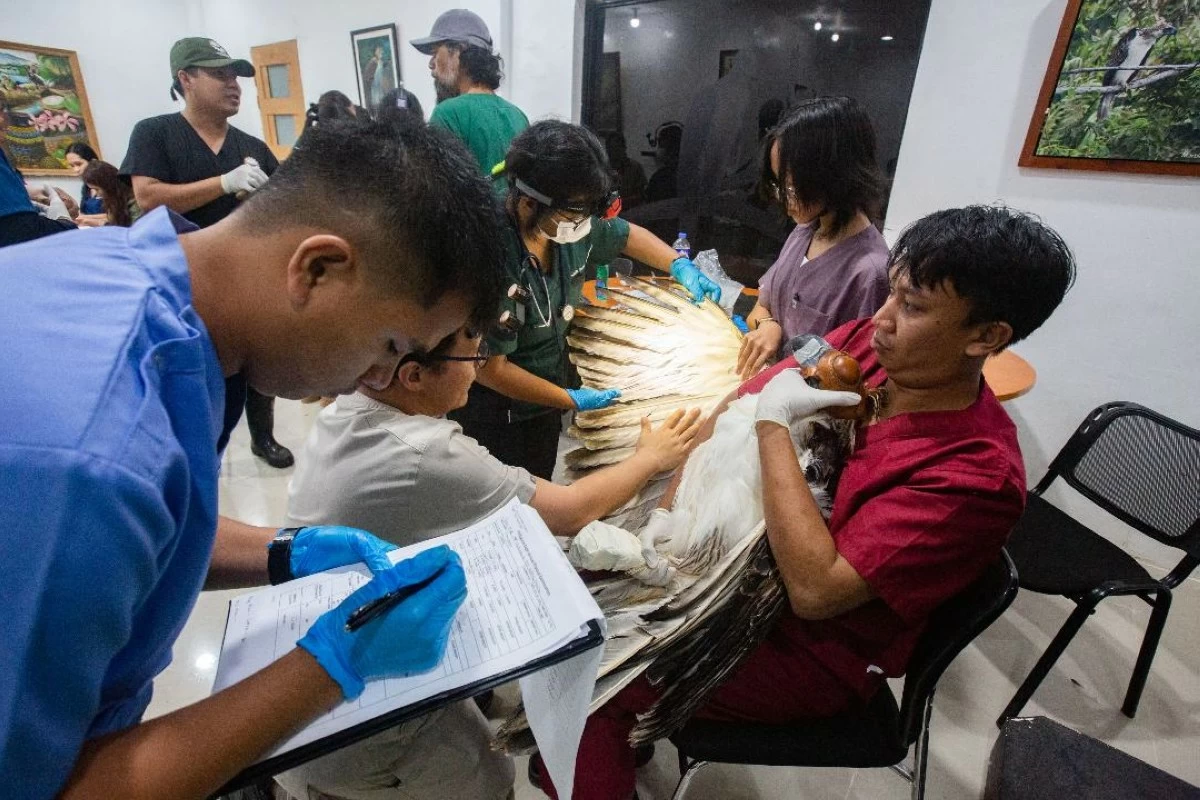
VETERINARIANS check the wings of a Philippine Eagle. (Keith Bacongco)
DAVAO CITY – Just like humans, the critically-endangered Philippine Eagles also undergo an extensive annual health check-up to ensure them a clean bill of health.
The annual health check-up is a routine effort of the Philippine Eagle Foundation to monitor the wellness of the country’s national bird as well as to identify some measures should some health issues arise.
On Feb. 18 to 19, four on-call veterinarians of Doc Bayani’s Animal Wellness clinic, PEF’s in-house veterinarian, a volunteer veterinarian, personnel, and some volunteers gathered at the PEC for the annual check-up of 18 Philippine Eagles in two batches at the Philippine Eagle Center in Barangay Malagos here.
Of the 18 birds in captivity, seven of them were rescued from the wild due to injuries. The rest were captive-bred.
Prior to the check up at the PEC, 12 other breeding eagles had check-up in an isolated facility at the National Bird Breeding Sanctuary in the hinterlands of Toril District here.
Unlike ordinary birds, handling the Philippine Eagles requires strict biosafety protocols – handlers must take a bath at the PEC and all scrub suits undergo ultraviolet sterilization.
It also requires guts, strength, alertness, and meticulousness given their status.
“We have to be very extra careful in handling the Eagles,” Dr. Bayani Vandenbroeck said a few minutes before PEF animal keepers began capturing the raptors.
Vandenbroeck, who has been helping the foundation for nearly 20 years now, was reiterating how valuable the lives of these critically-endangered birds are.
The most challenging part of the routine is how to catch them inside their cages with bare hands because there is always a probability of getting attacked.
Thus, senior animal keeper Dominic Tadena told fellow keepers to be alert and make sure that they would be able to immediately grab both legs of the Eagles at the same time.
“You have to be quick. Otherwise, the bird will have a chance to thwart you. Worst, they might grab your hands with their sharp talons,” said Tadena, who has been taking care of the Eagles for almost a decade. “It will be very difficult to remove their talons from your arms.”
Each member of the capture team was equipped with headlamps and flashlights.
“We have to wait for the bird to perch on the branch before we will grab it. Make sure that both legs are closer together," an animal keeper whispered to his colleague while standing outside the cage.
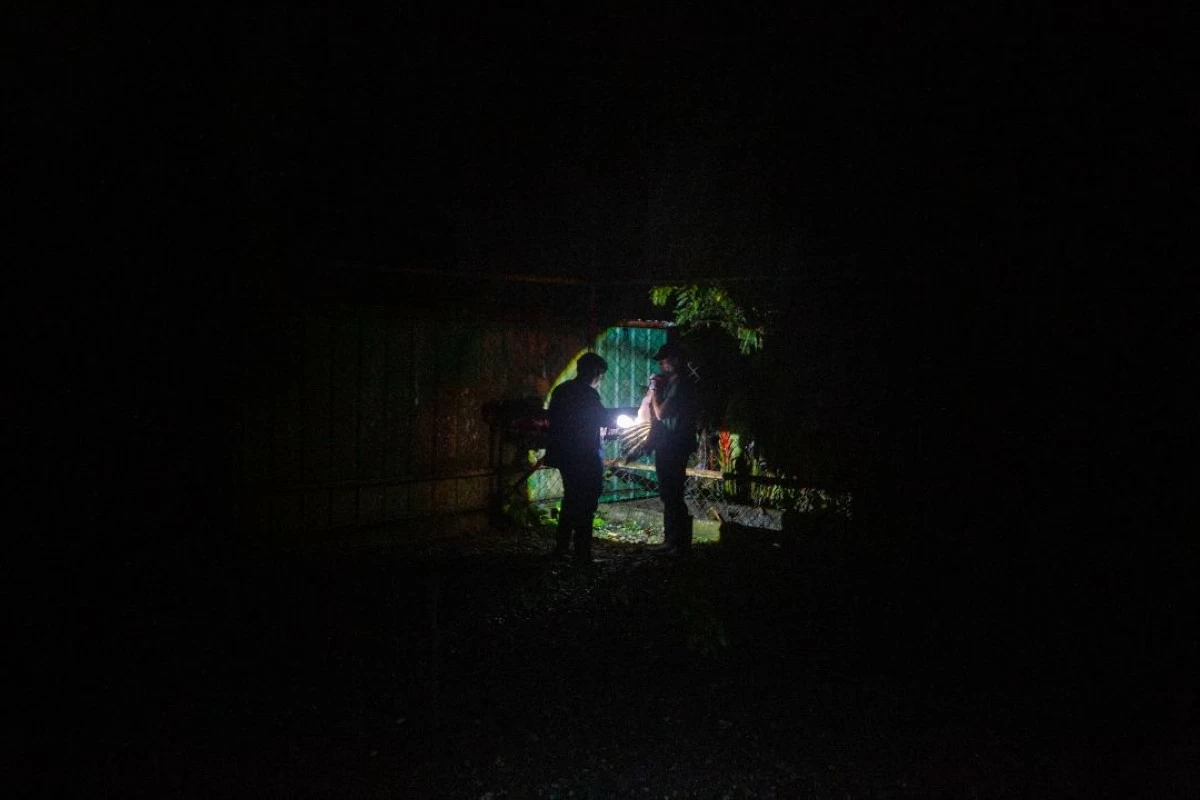
PEF staff prepare to release a Philippine Eagle inside a cage. (Keith Bacongco)
While entering the cage, the keeper turned his headlamp’s light color from white to red to minimize the light inside the cage.
“How I wish we have night vision goggles here so that we can capture them under the cover of darkness,” said Tadena, adding that Philippine Eagles are active during the day and rest at night.
Another member of the team had to distract the Eagle on the other side before the assigned personnel grabbed both legs.
Two animal keepers rushed inside and quickly covered the raptor’s head with a hood and wrapped both legs down to the talons with masking tapes.
The Eagle’s beak was taped to keep it closed during the entire duration of the examination.
After securing the Eagle, it was taken to the designated check-up area where veterinarians and PEF staff were waiting.
If the Eagle will not perch on the branch and remain on the ground for extended periods, keepers will trap the raptor using a net.
In the case of one Eagle, a keeper attempted to get inside the cage but the raptor spread its wings and faced him, a sign that it was ready to defend itself in case somebody would get closer, a PEF personnel said.
“As much as possible, we would really grab them by hand because it’s less stressful for the birds than using the net,” a keeper explained.
As short as possible
During the check-up, veterinarians look at the birds’ vitals, collecting blood samples, checking the body for parasites, weight, as well as the forms of their beaks.
Oxygen tanks are on standby as there are rare instances that some Eagles need supplemental oxygen while undergoing a check-up.
Vandenbroeck said that this is the only time that veterinarians and PEF personnel can hold and check the raptors’ physical condition up close.
“We get blood samples and swabs to screen for certain diseases like Avian influenza, Newcastle disease, and fungal infections,” he added.
But since the Eagles are in captivity, veterinarians expect that they are always in good shape.
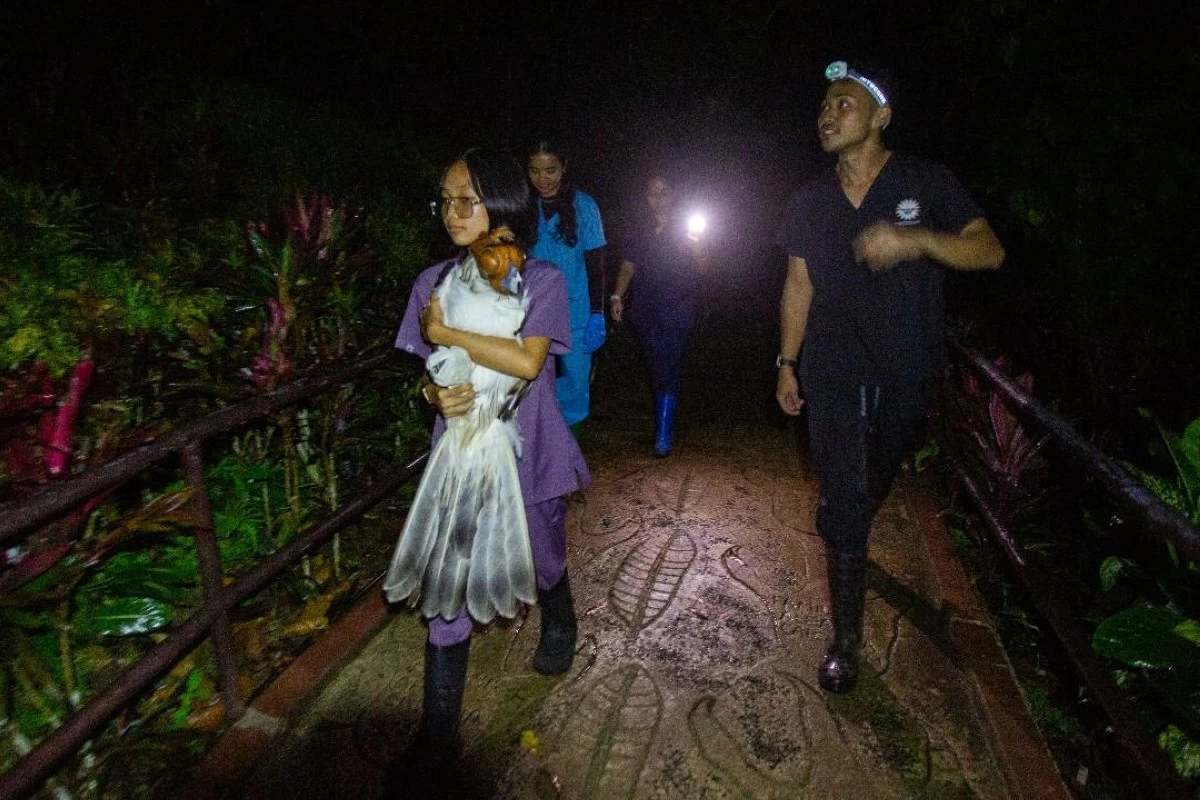
A YOUNG PEF volunteer carries Kalatungan 2 to its cage. (Keith Bacongco)
Veterinarians also monitor the weight of the Eagles to determine if they need more or reduce their diet. An adult Philippine Eagle generally weighs from four to eight kilograms.
Vandenbroeck said that the entire process should take less than 30 minutes for every bird to avoid stress.
While veterinarians are checking the birds, hoods remain in place as well and its talons remain wrapped with masking tapes.
Hoods are only opened for a quick peek on their eyes and talons are unwrapped for a quick physical check. The tape on the beak is also removed to allow veterinarians to perform swabbing procedures.
As both wings are unrestrained, the Eagle is held between both arms a little bit tight as if hugging a baby.
But in some instances when an Eagle would try to open its wings, two to three people are needed to restrain it.
Except for the Eagle Kalatungan 2, whose left wing was amputated two years ago due to a bullet injury, they were relatively easy to handle that even an 11-year-old volunteer could manage to handle the four-year old male raptor.
“When their eyes are covered with hoods, the Eagles are relaxed because they cannot see,” Tadena said.
They are immediately returned to their cages and keepers keep the light as minimal as possible to prevent them from getting aggressive and attacking.
When Eagle Pagkakaisa was returned to its cage, Tadena made sure that it was able to perch, stand, or fly inside its cages before closing the door. "This is part of our standard procedure to ensure that the Eagles are doing well after being restrained even for a short period."
Learning opportunity
Veterinarian Keil Chavez, who came all the way from Valencia City, Bukidnon to volunteer in the activity, said that it was his first time performing a check-up on the country’s national bird.
Chavez was one of the four veterinarians who assisted Vandenbroeck in the checkup of nine Eagles that took about four hours per night to complete.
He took turns with fellow veterinarians in collecting blood samples and physical examination of the Eagles.
“This is a good learning opportunity since Bukidnon is also home to many Philippine Eagles. So, whenever there are some rescues in the future, I can assist or perform first aid before the PEF staff arrives,” said Chavez, who is also a veterinarian at the Central Mindanao University in Maramag, Bukidnon.
What made the experience unique, he added, is his first-hand experience of learning how to conduct physical check-up of the Eagles.
“We don’t have this kind of system or methods yet in our books. But the PEF has already developed its own system based on their years of experience in handling the Eagles.”
Of the 30 Philippine Eagles under the care of the PEF, the youngest was four-years-old while the oldest was estimated to be about 47-years-old.
The PEF, about 400 Eagles are still left in the wild. Thus, the PEF underscored the importance of the annual check-up to monitor their health and breeding capability as part of the foundation’s conservation program.