







Powering justice through free electricity
Published Feb 20, 2026 12:05 am
|
Updated Feb 19, 2026 06:04 pm


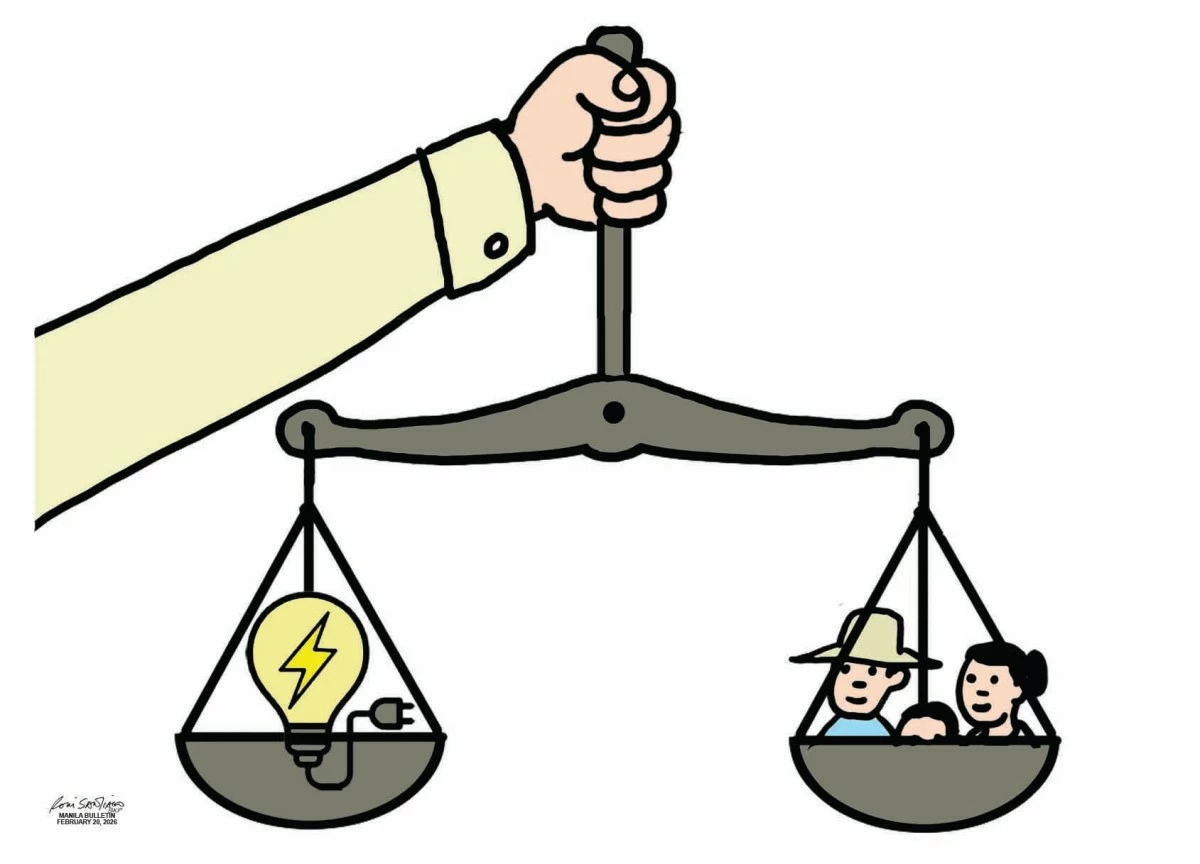
On this World Day of Social Justice, the call to make electricity more equitable in the country demands more than pure rhetoric. It demands reform.
And the proposal of House Majority Leader Sandro Marcos, representative of Ilocos Norte’s 1st District, offers precisely that—a structural correction to reform a flawed subsidy system that has long burdened the very people it seeks to protect.
House Bill No. 2700, or the proposed “Free Electricity for Low-Consumption Households Act,” seeks to grant free electricity to households consuming no more than 135 kilowatt-hours (kWh) on average over three months, or with monthly bills not exceeding ₱2,000, whichever is lower. At its core is a simple but transformative principle. Social protection should be funded transparently and fairly by the state—not quietly extracted from other consumers through cross-subsidies.
But the sad reality is for years, the lifeline rate for indigent consumers and the senior citizen discount have been implemented through a cross-subsidy mechanism. In theory, it sounds compassionate. In practice, it has meant that ordinary consumers—many of whom are themselves financially vulnerable—end up shouldering the cost. Subsidies embedded in electricity bills blur accountability and distort fairness. They create a shell game where relief for one struggling family may be paid for by another family teetering on the same economic edge.
A December 2024 study by the Philippine Institute for Development Studies, led by Dr. Kris A. Francisco, underscores the problem. It found that lifeline discounts vary widely by distribution utility and may even result in poor households subsidizing other poor households. Worse still, subsidized electricity remains subject to the 12-percent value-added tax. This is the sad irony. The state offers assistance with one hand while reclaiming a portion with the other.
HB 2700 confronts this inequity head-on by dismantling the cross-subsidy regime and replacing it with a direct government subsidy. By shifting the burden to the national budget, the measure restores clarity and accountability. Social welfare becomes an explicit policy choice debated in Congress, rather than a hidden surcharge embedded in monthly bills.
Critically, the bill provides measurable and verifiable standards for eligibility, subject to certification by the Energy Regulatory Commission and the Department of Energy. This ensures that assistance is targeted, data-driven, and insulated from arbitrariness. It also strengthens institutional coordination—an essential ingredient for sustainable reform in a sector as complex as power distribution.
Electricity today is not a luxury. It is a prerequisite for education, livelihood, health, and digital participation. Children cannot study without light. Small entrepreneurs cannot operate without power. Families cannot escape the heat or access information without it. When energy costs consume a disproportionate share of household income, the cycle of poverty tightens.
Supporting this bill is not merely about lowering bills; it is about redefining how we understand social justice in economic policy. A fair society does not hide the cost of compassion in the fine print of utility charges. It confronts inequality openly and funds remedies responsibly. By replacing opaque cross-subsidies with transparent appropriations, Congress affirms that uplifting the poor is a collective national duty.
The House of Representatives has taken the first step. The Senate must now match that resolve. If enacted, HB 2700 would mark a decisive shift toward a more rational and humane energy policy—one aligned with the constitutional promise of social justice.
On a day dedicated to justice in all its forms, the message is clear. True equity requires more than good intentions. It requires the courage to redesign systems so that fairness is not accidental, but deliberate. Congress should seize this moment and turn principle into power—for the people who need it most.