






Manila Bulletin
 Philippines
National
Kanlaon Volcano remains under Alert Level 2 after explosive eruption — Phivolcs
Philippines
National
Kanlaon Volcano remains under Alert Level 2 after explosive eruption — Phivolcs
Philippines
National
Kanlaon Volcano remains under Alert Level 2 after explosive eruption — Phivolcs
Kanlaon Volcano remains under Alert Level 2 after explosive eruption — Phivolcs
Published Feb 20, 2026 10:59 am


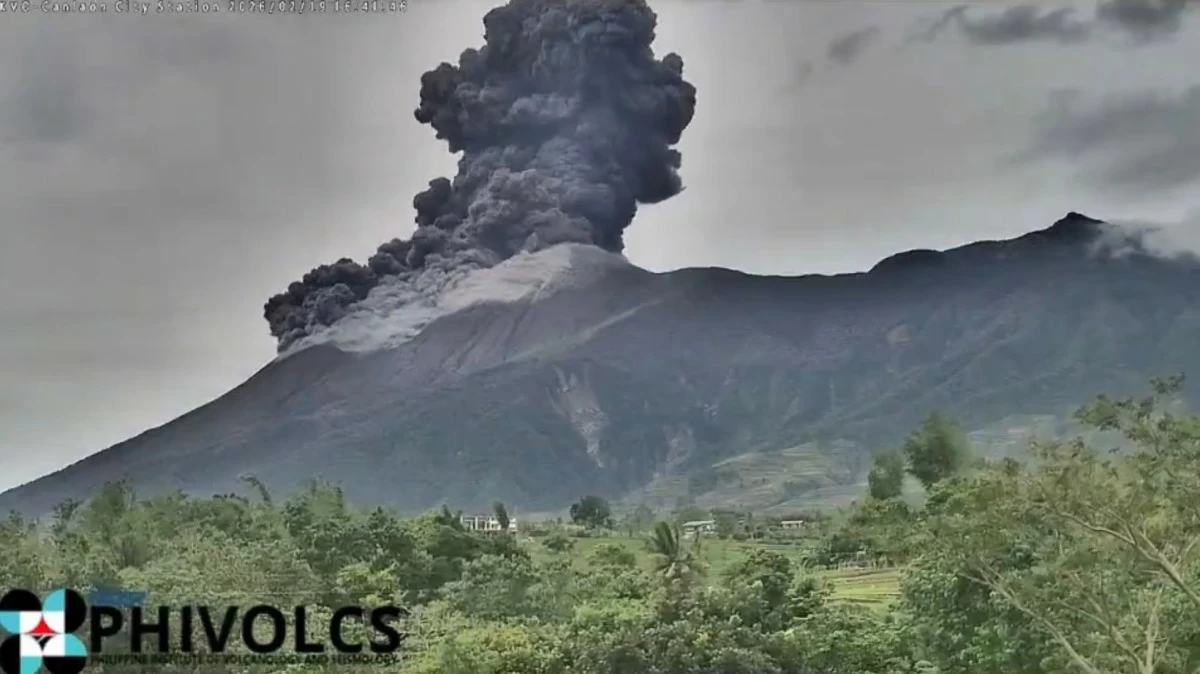
Kanlaon Volcano (Phivolcs)
The Philippine Institute of Volcanology and Seismology (Phivolcs) said Kanlaon Volcano remains under Alert Level 2 following a “moderately explosive eruption” on Thursday afternoon, Feb. 19, adding that current monitoring data do not indicate the need to raise the alert status.
The eruption, which occurred at 4:39 p.m. and lasted two minutes, generated a dense dark gray plume that rose 2,000 meters above the summit crater before drifting southwest due to strong winds.
Phivolcs said blockage of volcanic gas pathways and resulting pressurization likely triggered the moderately explosive event, a mechanism similar to previous eruptions since June 2024.
The explosion on Thursday was immediately followed by 40 minutes of continuous ash emission.
Light to moderate ashfall was reported in 41 barangays across six cities and municipalities in Negros Occidental.
Sulfurous fumes were also reported in parts of La Carlota and Bago cities and in Moises Padilla.
Phivolcs also said pyroclastic density currents (PDCs), which are hazardous mixtures of hot volcanic gas, ash and rock fragments, descended the upper slopes within one kilometer of the crater.
On the southwest flank, PDCs traveled at least two kilometers downslope.
Moreover, the eruption generated a shock wave heard as a booming sound and felt more than 30 kilometers from the crater.
Phivolcs said the eruption was preceded by 10 volcanic earthquakes, including seven low-frequency events associated with volcanic gas activity.
Sulfur dioxide emissions had decreased to an average of 174 tons per day immediately prior to the eruption, compared to a weekly short-term average of 752 tons per day.
Since eruptive unrest began in June 2024, sulfur dioxide has been degassed at an average rate of 2,823 tons per day, Phivolcs noted.
Ground deformation data show that the volcano has been inflating at very low and fluctuating rates since 2022 due to magma intrusion at depth, with short-term inflation observed in late January 2026 prior to Thursday’s eruption, it added.
Despite the explosive activity, Phivolcs said no pronounced increases in volcanic earthquakes or ground deformation have been observed after the eruption.
Alert Level 2, or moderate unrest, remains in effect, meaning further ash emissions or short-lived explosive eruptions are possible.
Entry into the four-kilometer-radius permanent danger zone remains strictly prohibited.
Local government units are advised to prepare communities within the PDC hazard zone for possible evacuation should unrest escalate.
Residents in areas affected by ashfall and recent lahars are urged to remain vigilant during heavy rainfall, which may remobilize loose volcanic material.
Civil aviation authorities have also been advised to avoid flying close to the volcano’s summit, as ash and ballistic fragments from sudden explosive eruptions pose hazards to aircraft.