






Manila Bulletin
 Environment and Sustainability
GEOP amendments help hospitals power 'care' with renewable energy
Environment and Sustainability
GEOP amendments help hospitals power 'care' with renewable energy
Environment and Sustainability
GEOP amendments help hospitals power 'care' with renewable energy
GEOP amendments help hospitals power 'care' with renewable energy
Published Feb 20, 2026 03:01 pm



The healthcare sector reportedly contributes 2 gigatons of carbon dioxide equivalent, which totals to 4.4 percent of global greenhouse gas emissions. (Photo from Freepik)
First, do no harm.
As their first steps into the profession, doctors recite the Hippocratic Oath as a reminder of the ethical principles that guide their practice. Calling upon various Greek gods, new physicians swear to “abstain from all intentional wrongdoing and harm.”
Yet today, the healthcare sector faces a profound ethical contradiction. According to a report by Health Care Without Harm, in collaboration with Arup, healthcare is responsible for 4.4 percent of global net greenhouse gas emissions, or roughly 2 gigatons of carbon dioxide equivalent.
Hospitals exist to save lives. However, the electricity that serves as their lifeline contributes to a climate crisis that threatens health outcomes at every level, from rising heat-related illnesses to worsening air quality.
This contradiction has pushed healthcare institutions to rethink how they source and consume energy, particularly in countries like the Philippines, where electricity generation remains heavily dependent on fossil fuels.
In response to the growing recognition that climate change is a public health issue, the Department of Health (DOH) established the Health and Climate Change Office. Among its priorities is lowering emissions across healthcare facilities nationwide – from public hospitals down to barangay health clinics.
Making Philippine healthcare healthier for the planet
As early as 2024, the DOH was exploring renewable energy as a pathway for healthcare facilities. In a policy dialogue convened by the Asian Development Bank, The Climate Reality Project Philippines, the Institute for Climate and Sustainable Cities, and the Climate Change Commission, the DOH identified GEOP as a mechanism to help hospitals transition away from fossil fuel–based electricity.
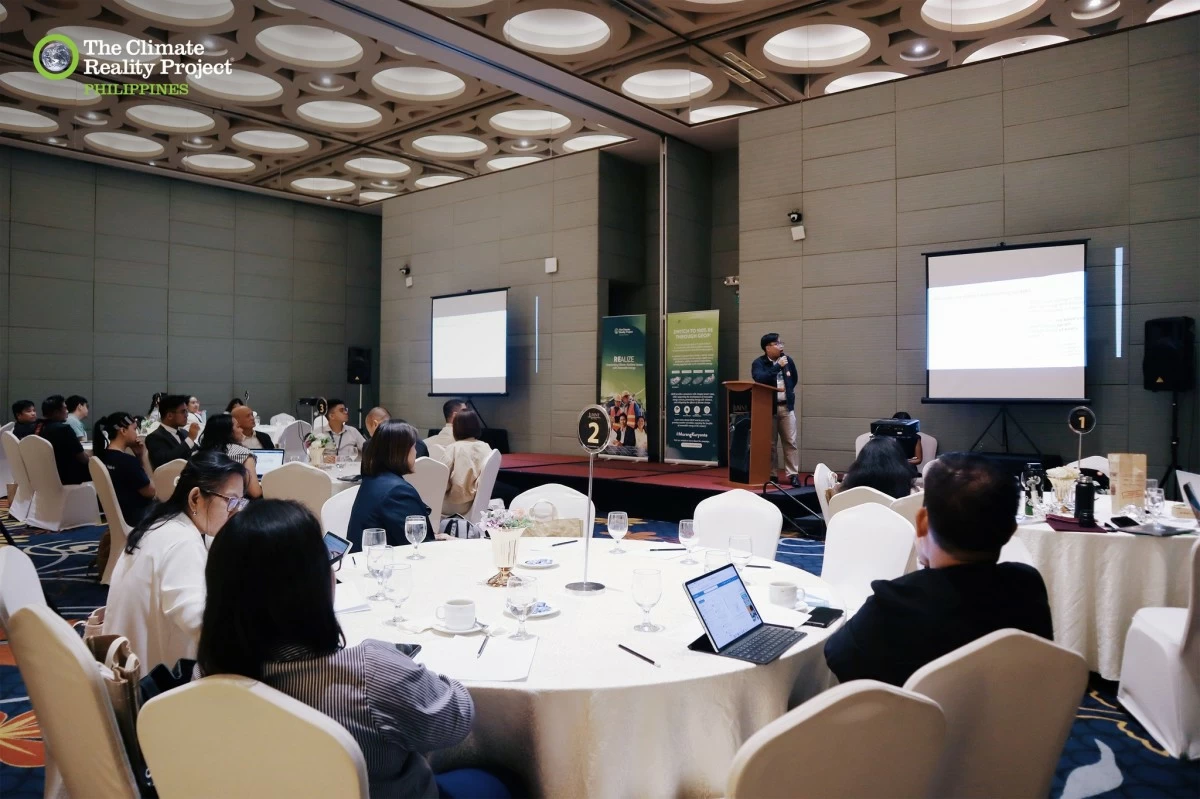
In 2024, Climate Reality Philippines gathered representatives from the healthcare sector to discuss how hospitals can shift to renewable energy via GEOP.
GEOP empowers electricity consumers to choose renewable energy as their source of electricity, offering institutions a way to reduce emissions while managing long-term energy costs. Yet participation from the healthcare sector remains limited. Out of 852 GEOP participants nationwide, only 16 are hospitals.
One of them is Mary Chiles Hospital, which transitioned to renewable energy under GEOP in November 2025. Seeking an affordable and reliable energy solution, the hospital partnered with 350 Pilipinas, a civil society organization working on climate and energy issues.
Another example is Healthway Cancer Care Hospital, a private specialty cancer hospital in Taguig. By switching to renewable energy through GEOP, the hospital supports its mission to provide high-quality care while reducing its carbon footprint. It demonstrates that even energy-intensive specialty facilities can lead the way in sustainability.
Although these examples demonstrate the potential of GEOP to help hospitals integrate renewable energy into their operations and align sustainability with patient care, participation among hospitals remains limited.
Addressing the challenges of going green
Powering hospitals requires substantial energy consumption 24/7, as life-saving equipment, emergency rooms, and patient care demand uninterrupted power. However, some GEOP suppliers rely heavily on solar and wind energy in their portfolios, which generate electricity only at certain times of the day.

Powering hospitals requires massive energy consumption 24/7, which stakeholders think current renewable energy supply might not be able to sustain. (Photo by Arthur Uzoagba, Pexels)
This mismatch between continuous demand and variable supply has made it more difficult for hospitals to participate fully in GEOP, even as they remain committed to renewable energy and sustainability.
This is a challenge faced by many other establishments seeking to shift to clean energy through GEOP, as reported in Climate Reality Philippines’ recently published policy brief on the program.
Borne out of the organization’s work on renewable energy promotion and stakeholder engagement, the document outlines issues and possible solutions surrounding GEOP implementation. These include enhancing information campaigns to raise awareness, lowering the energy requirement to participate in the program, and streamlining existing GEOP processes.
Taking challenges into account, the Department of Energy in January 2026 signed and released amendments to GEOP to address these concerns. A key feature is volume matching, which allows renewable energy suppliers to match total renewable energy demand over a defined period, such as a month, rather than requiring real-time matching.
This provides suppliers with some flexibility in serving customers that operate beyond the peak hours of solar and wind generation, such as hospitals.
The amendments also lowered the participation threshold from 100 kilowatts (kW) to 50kW, opening the door for smaller health facilities, including barangay health clinics, to join GEOP.
Combined, volume matching and the lower threshold provide a pathway for both large hospitals and smaller community clinics to reduce their carbon footprint while maintaining a reliable energy supply.
With the GEOP amendments now in effect, full implementation rests on the Energy Regulatory Commission updating the corresponding omnibus rules. For the healthcare sector, this represents a tangible opportunity to align operational needs with sustainability goals.
With these reforms, the principle of “first, do no harm” extends beyond the patient’s bedside, ensuring that the very energy powering hospitals becomes part of the cure – for patients and for the planet.