






 Business
The Economy
Philippines ranks near bottom globally in AI readiness, raising risks for BPO sector
Business
The Economy
Philippines ranks near bottom globally in AI readiness, raising risks for BPO sector
Philippines ranks near bottom globally in AI readiness, raising risks for BPO sector



The Philippines lags behind its Association of Southeast Asian Nations (ASEAN)-5 peers and ranks among the bottom five countries globally in harnessing artificial intelligence (AI), according to London-based think tank Capital Economics.
In a Feb. 16 report, Capital Economics’ AI Economic Impact Index—which measures a country’s ability to capitalize on AI—placed the Philippines 43rd out of 47 countries in February 2026, with a score of just 21 out of 100.
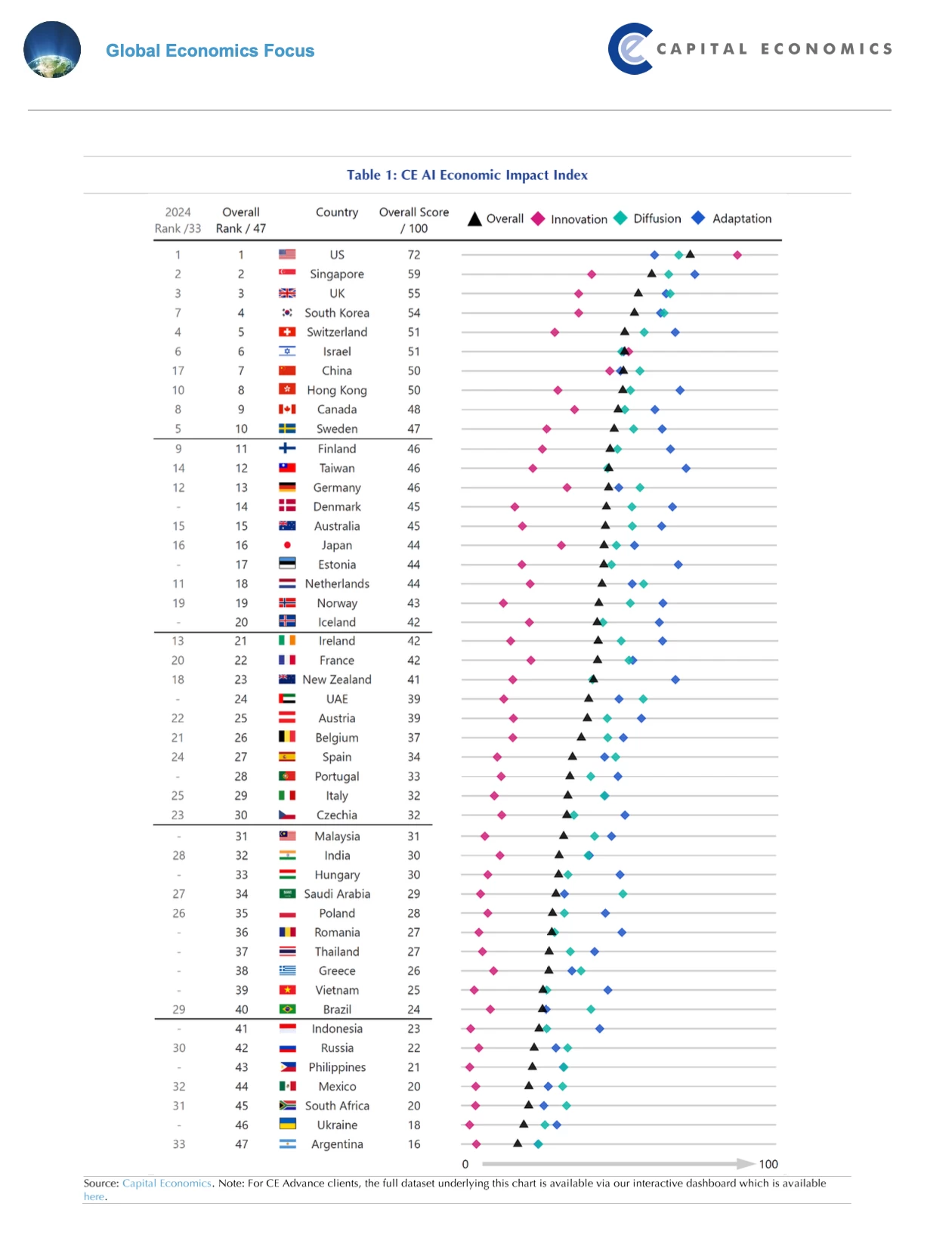
The report showed that the Philippines was not included in the prior 2024 AI Economic Impact Index, which covered 33 nations, suggesting that February 2026 could mark the country’s first appearance in the index if it had been excluded from the initial 2023 dataset.
Economists Carl Gunvaldsen and Vicky Redwood, the think tank’s economist and senior economic advisor, noted that the Philippines shares the bottom five of the index with Mexico, South Africa, Ukraine, and Argentina.
Among its ASEAN-5 peers, the Philippines ranked the lowest: Singapore ranked second globally; Malaysia, 31st; Thailand, 37th; and Indonesia, 41st.
The think tank warned that the Philippines could be among the countries most affected if AI reduces the size of the business process outsourcing (BPO) sector. India is also at risk, as both nations have built large BPO industries thanks to low labor costs and sizable English-literate workforces.
Meanwhile, wider adoption of AI in manufacturing—such as software that operates industrial robots—could displace assembly workers across dozens of emerging markets (EMs).
Globally, Capital Economics stressed that the United States (US) continues to lead in AI adoption, while “Asian Tigers” and the United Kingdom (UK) remain key beneficiaries. Europe, however, presents a more mixed picture.
The think tank noted that the most notable change in the 2026 rankings is China’s leap, moving from 17th in 2024 to seventh this year, scoring 50 points. This surge was driven by an improved outlook for China’s ability to diffuse AI across its economy.
Data from the report showed the US ranked first with 72 points, followed by Singapore with 59 points, and the UK with 55 points, with their rankings unchanged from the 2024 index. China’s improvement reflects significant progress in applying and adopting AI.
According to Capital Economics, the US leads due to its strength in both AI innovation and widespread adoption, while China initially scored high in innovation when the index was first published in 2023 but lagged in its ability to diffuse and apply AI across the economy.
The think tank also observed that EMs outside Asia continue to rank significantly lower than other countries. While AI adoption among the population may be high in some of these nations, the technology alone is unlikely to address deeper structural challenges, including weak governance and institutional inefficiencies.
“We assume that the countries that score highest on our AI index will generally see the biggest productivity gains from AI over the next couple of decades,” the think tank added. “But other factors will also affect productivity growth. And in some cases, we suspect that the benefits of AI may fall short of what the index suggests.”
“And resource misallocation in China means that even if AI is diffused as we expect, it might not translate into a proportional boost to productivity. We still believe that the AI revolution is likely to accentuate the economic outperformance of the US over the eurozone and China,” the think tank said.