






Manila Bulletin
 Philippines
National
DepEd urges private sector to help solve classroom shortage, literacy gaps
Philippines
National
DepEd urges private sector to help solve classroom shortage, literacy gaps
Philippines
National
DepEd urges private sector to help solve classroom shortage, literacy gaps
DepEd urges private sector to help solve classroom shortage, literacy gaps
Angara, private sector push literacy, PPP classrooms, EdTech at 2026 PBEd Leadership Forum
Published Feb 18, 2026 03:05 pm


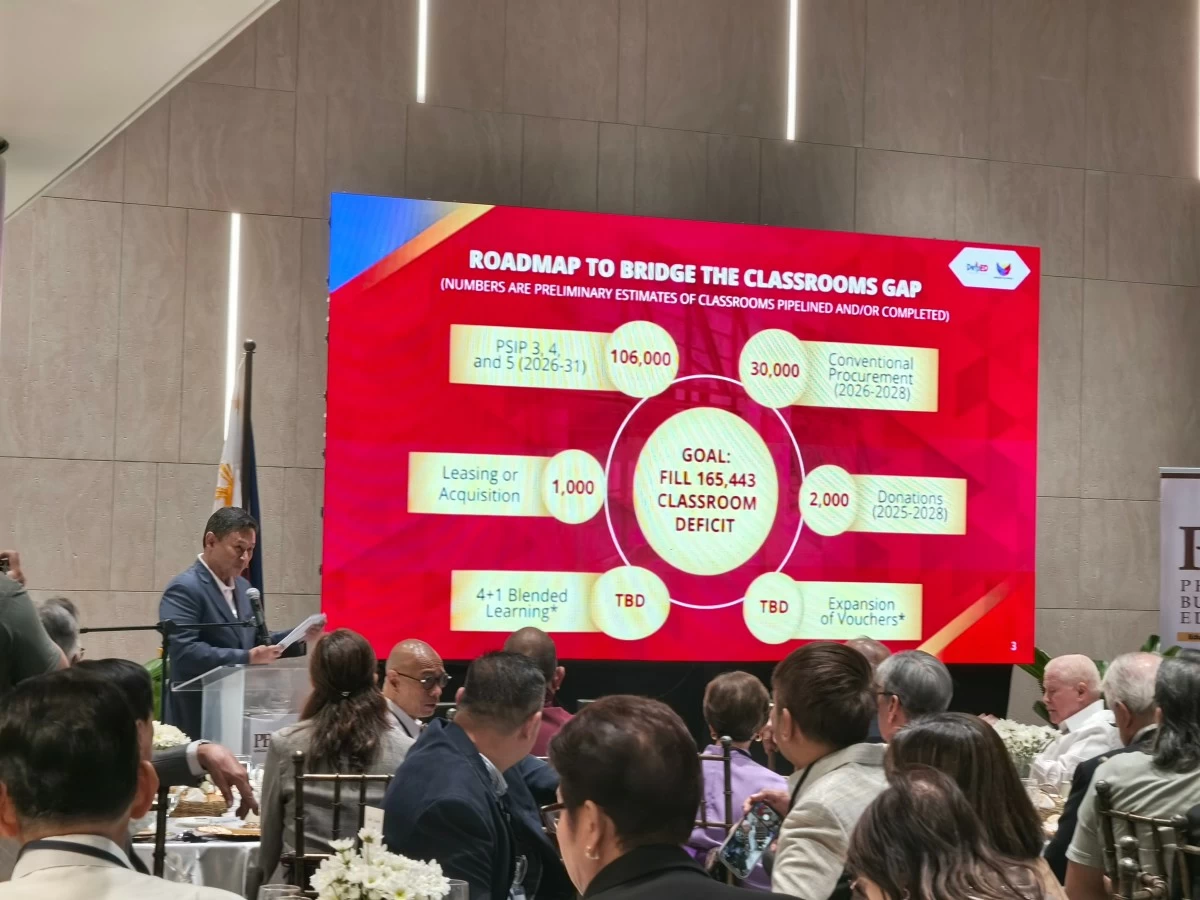
Department of Education (DepEd) Secretary Sonny Angara joins business and government leaders at the 2026 PBEd Leadership Forum in Makati City to discuss literacy, classroom shortages, and education technology reforms aimed at building a future-ready Filipino workforce. (Merlina Hernando-Malipot/Manila Bulletin)
Education leaders, business executives, and government officials convened on Wednesday, February 18, at the 2026 Philippine Business for Education (PBEd) Leadership Forum in Makati City, where the Department of Education (DepEd) called for stronger public-private collaboration to address the country’s literacy gaps, classroom shortages, and digital transformation needs.
The invitation-only forum, held at PHINMA Plaza, highlighted joint efforts to build a future-ready Filipino workforce and strengthen the country’s long-term economic resilience.
Angara calls for private sector help to close 165,000-classroom gap
DepEd Secretary Sonny Angara urged business leaders to play a central role in addressing the country’s estimated 165,000-classroom shortage, emphasizing the urgency of accelerating school construction and modernization.
Angara noted that the scale and urgency of the education crisis require deeper collaboration between government and industry.
DepEd is expanding its public-private partnership (PPP) program to speed up infrastructure delivery, with plans to build up to 106,000 classrooms in the coming years.An initial 16,000 classrooms have already been approved, targeting areas with the most severe shortages.
Angara noted that traditional procurement can take two to seven years, while PPP arrangements can reduce timelines to as little as one to two years.
“PPP is the bridge between urgency and execution,” Angara said. “We invite the private sector not as donors, but as co-architects of national development,” he added.Literacy,
EdTech integration key to future-ready workforce
Beyond infrastructure, DepEd and its partners emphasized that improving foundational literacy remains a top priority to ensure students develop essential skills needed for higher education and employment.
Participants also underscored the importance of integrating education technology (EdTech) to enhance teaching quality and expand access to learning.
DepEd’s digital transformation strategy includes the rollout of its PSIP Connect initiative, which aims to establish a nationwide digital backbone for schools.
The agency has also partnered with Khan Academy, benefiting more than 2,800 public schools by improving student performance in mathematics and helping teachers streamline lesson preparation.
“We are embedding technology into the core of our system to ensure that Filipino learners are prepared for the future,” Angara said.
Business, economic leaders back education reforms
The forum gathered influential leaders from business and civil society, including PBEd Chairman Ramon del Rosario Jr. and PBEd President Chito Salazar, alongside representatives from major business groups and economic agencies.
Officials from the Department of Finance and the Department of Economy, Planning, and Development also participated, signaling broader government support for education reforms.
In his opening remarks, Salazar stressed that stronger partnerships are essential to address systemic education gaps, improve learning outcomes, and align education with workforce demands.
“Education reform is, at its core, an investment in our people and in the country we hope to become,” Salazar said.
“The choices we make now—and the actions we take after today—will shape not just the next plan, but the next generation of Filipinos,” he added.
Public-private partnership seen as key to national development
PBEd reaffirmed its commitment to working with DepEd and industry partners to strengthen education quality and workforce readiness.
Angara stressed that private sector participation brings not only funding but also technical expertise and innovation.
“Education has always been a shared responsibility, but today, it must also be a shared investment,” he said. “This is a nation-building strategy,” he added.
The forum underscored a unified push to invest in literacy programs, classroom construction, and education technology—seen as critical steps to ensure Filipino learners can compete in a rapidly evolving global economy.