







A life larger than politics
The Jose de Venecia I knew
Published Feb 18, 2026 03:58 pm


When the story of Jose de Venecia Jr.’s life is told in history books, much will be written about his unprecedented five terms as Speaker of the House in the postwar Philippine Congress, his far-sighted legislation, and his tireless presence on the global stage.
They will speak of the Dollar Remittance Program he championed, which gave dignity and security to millions of overseas Filipino workers and their families; of the Bases Conversion and Development Act, which transformed former military camps into thriving centers of opportunity like Bonifacio Global City and Clark; of the Build-Operate-Transfer Law, which laid the foundation for modern public-private partnerships; and of the Philippine Economic Zone Act, which opened gateways for investment, industry, and employment across our archipelago.
But before all of those achievements, he was, first and foremost, a man of immense heart. To many, he was a mentor. To me — for twenty-seven years — he was a guide, a father figure, and the first person who believed in a young aide long before that young aide believed in himself.
He was not a man who harbored resentment. In a political world often crowded with wounded egos and sharpened tongues, he chose a different path. Those who criticized him harshly, even unfairly, were never met with retaliation. I never heard him speak ill of his detractors. He met offense with forgiveness and hostility with quiet dignity. Even after devastating personal tragedies and political setbacks, bitterness never found a home in his heart.
Many misunderstood him because he often spoke in grand terms. He dreamed not only of local progress but of Asia’s shared future, of interfaith harmony, of parliamentary cooperation across borders, of dialogue where others saw only division. Perhaps he was misunderstood because he was ahead of his time — thinking in global dimensions when others were confined to local horizons. Leaders who dream beyond the next election cycle and imagine possibilities for generations yet unborn are rare. That was his gift.
It was this expansive vision that led him to build institutions that would outlive him. He founded and nurtured the International Conference of Asian Political Parties — bringing together ruling and opposition parties from across the continent to sit at one table in dialogue rather than discord. He was instrumental in strengthening the Asian Parliamentary Assembly, encouraging legislators from diverse systems and traditions to cooperate on common regional concerns. He also helped establish the Asian Peace and Reconciliation Council, envisioning it as a platform where elder statesmen and leaders could quietly mediate conflicts and promote understanding across Asia’s fault lines.
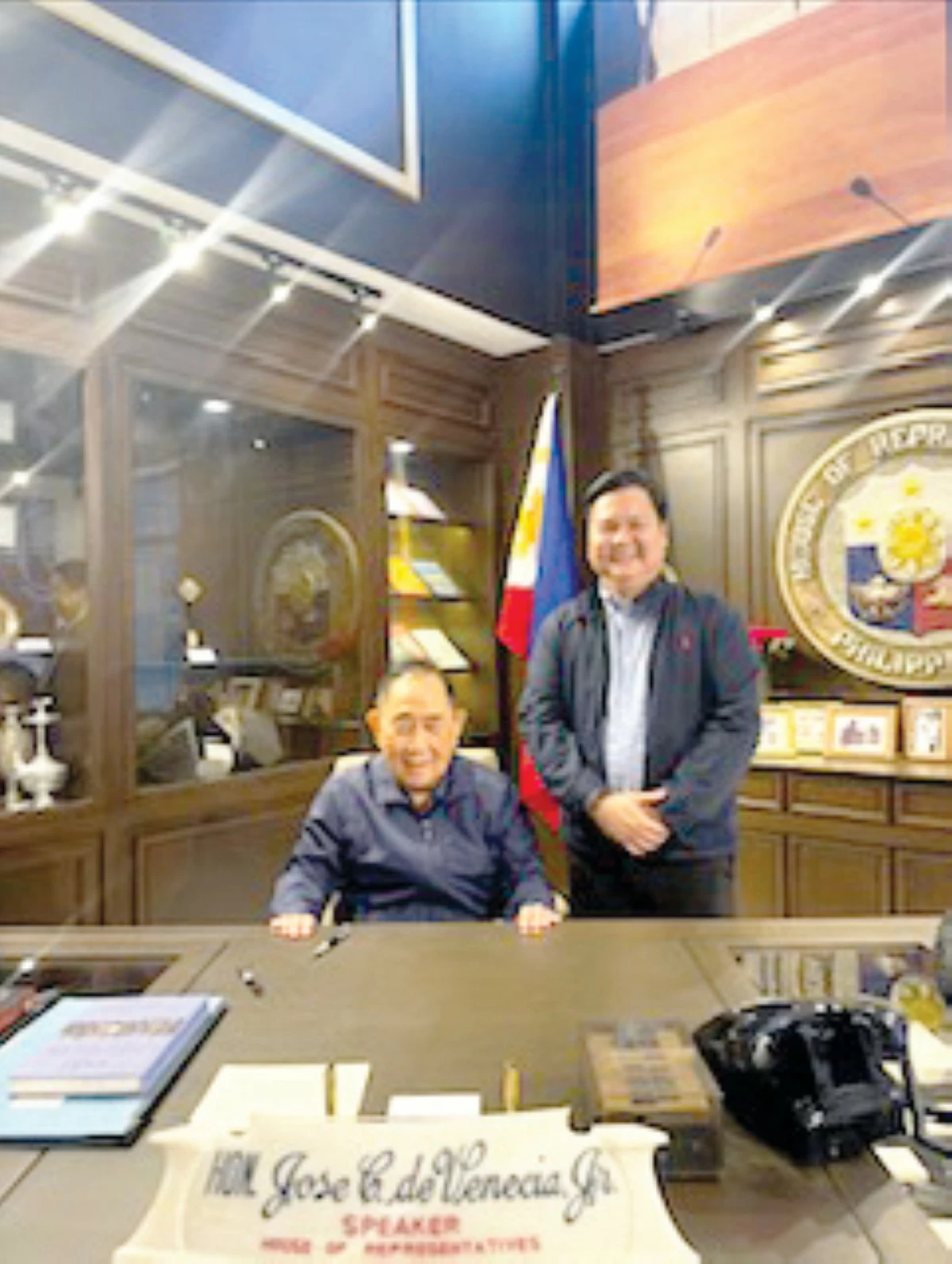
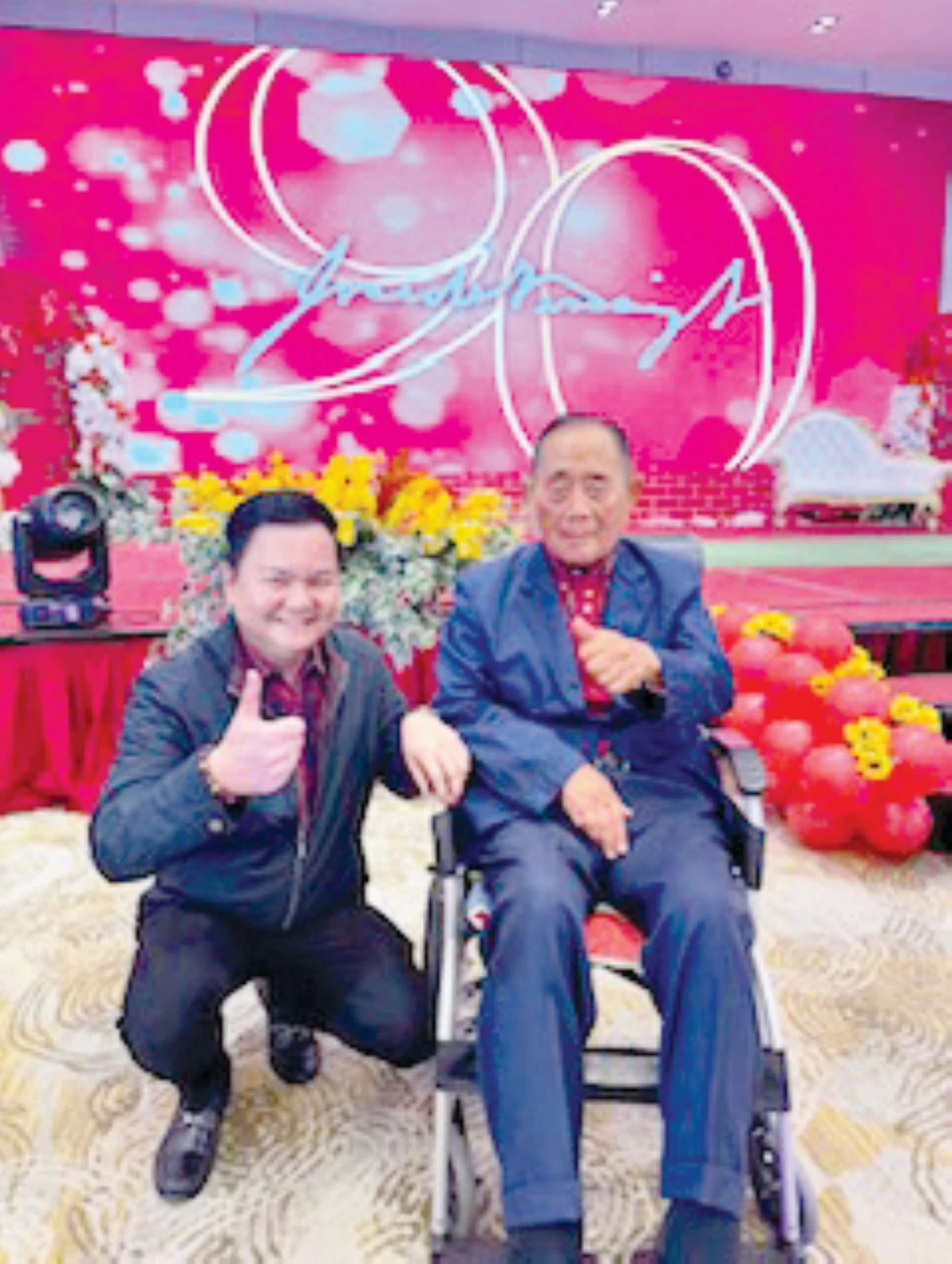
The Author with Jose de Venecia, Jr.
To him, these were not mere conferences or ceremonial gatherings. They were living bridges — fragile at times, but necessary — spanning cultures, ideologies, and histories. He believed Asia must speak to itself before it could speak to the world.
He was a voracious reader. History, poetry, the speeches of great statesmen — he absorbed them not as ornaments of intellect, but as wells of wisdom. He devoured newspapers daily. In airport lounges, while others drifted into idle chatter, he read. On the plane, he read. In his suite before sleep, he read — often with CNN murmuring softly in the background.
On foreign trips, I would go to wake him in the morning, only to find him already awake, glasses low on his nose, papers spread around him like constellations of thought. Though he was a brilliant statesman, he never quite mastered a remote control. I would switch on the television for him. Mobile phones baffled him, but geopolitical crises never did. With a gentle laugh, he would say he belonged to the 18th century.
He was also a meticulous writer. Speeches I drafted would return to me adorned with loops of ink, arrows, and careful insertions — the markings of an old-school editor. That discipline traced back to his early days as editor-in-chief during his student years at Ateneo and later as a young foreign correspondent and columnist in the 1950s. To him, words were sacred, especially when they carried the hopes of a nation.
But perhaps the deepest thread running through his life was peace — his lifelong, unrelenting pursuit of it.
Long before peace processes became fashionable rhetoric, he risked reputation and comfort to open doors long sealed by mistrust. In the early 1990s, when the echoes of mutiny and instability still unsettled the Republic, he reached out to the RAM-SFP-YOU military rebels. Through patient dialogue, he helped pave the way for a ceasefire in 1992 and, ultimately, a formal peace agreement in 1995 — a breakthrough many believed impossible.
In the southern Philippines, he helped break new ground with the Moro National Liberation Front. He did not negotiate from a distance. He crossed deserts and political minefields alike, traveling to Libya to meet Colonel Muammar Qaddafi and help advance the peace talks with the MNLF. It was not a journey of spectacle, but of conviction — a willingness to go where others hesitated, to sit with adversaries, and to insist that dialogue was stronger than distrust. Those efforts contributed to the 1996 Final Peace Agreement, ending decades of fratricidal conflict and opening a fragile but hopeful path toward unity.
He also recognized early the importance of engaging the Moro Islamic Liberation Front, initiating channels of communication as early as 1997, when few dared to try. For him, no door was ever permanently closed if there was still a chance for conversation.
Beyond our shores, during the turbulence of the 1990s, he undertook one of the boldest acts of quiet diplomacy of his generation. He traveled to Baghdad to meet Saddam Hussein in order to secure the release of Filipino overseas workers imprisoned in Iraq. In a city most feared to enter, he sat across from power so that ordinary Filipinos could return home. His presence there was not about politics — it was about people. And because he went, mothers embraced their children again, and children saw their parents come home.
Throughout these missions, he carried no weapon but his words, no shield but his faith in dialogue. To him, peace was not merely the absence of war. It was the triumph of understanding over fear, the stubborn belief that even the most entrenched conflicts could yield to patient conversation.
One of his favorite songs was “The Impossible Dream,” and I have always felt it was more than music to him — it was a manifesto. “To dream the impossible dream. To fight the unbeatable foe…” Those were not just lyrics; they were the architecture of his life. He believed that what seems unattainable today may, with courage and persistence, become tomorrow’s reality.
Sometimes, in lighter moments, I would tease him and say he was like Don Quixote — the idealistic knight chasing visions across vast plains — and I, his loyal Sancho Panza, fortunate to follow. He would laugh. But like that storied knight, his dreams were never foolish illusions. They were seeds — planted patiently, watered by faith, and often blooming years later in places few expected.
As I look back now, what fills my heart is not only pride in what he accomplished, but gratitude for who he was. To have served him was more than a profession; it was a vocation. To have been mentored by him was more than instruction; it was formation. To have been loved by him like a son was the greatest honor of my life.
History will remember his titles — Speaker, statesman, peacemaker. But those of us who walked beside him will remember the quieter things: the rustle of newspapers at dawn, the careful edits in blue ink, the laughter over simple jokes, the steady voice that chose forgiveness over fury.
Thank you, Sir — for teaching us that peace is always worth pursuing, that prosperity must be shared, and that no dream is too distant for a heart brave enough to chase it.
(The author served as a staff member — and later as Special Assistant — to former five-time Speaker Jose de Venecia, beginning in 1995 at the age of 20. For nearly three decades, until 2022, he accompanied and assisted Speaker De Venecia in his meetings and speaking engagements throughout the Philippines and abroad.)