






Manila Bulletin
 Philippines
National
PH Army readies 3 infantry divisions for BARMM parliamentary polls as terror threats dwindle
Philippines
National
PH Army readies 3 infantry divisions for BARMM parliamentary polls as terror threats dwindle
Philippines
National
PH Army readies 3 infantry divisions for BARMM parliamentary polls as terror threats dwindle
PH Army readies 3 infantry divisions for BARMM parliamentary polls as terror threats dwindle
Published Feb 16, 2026 04:29 pm


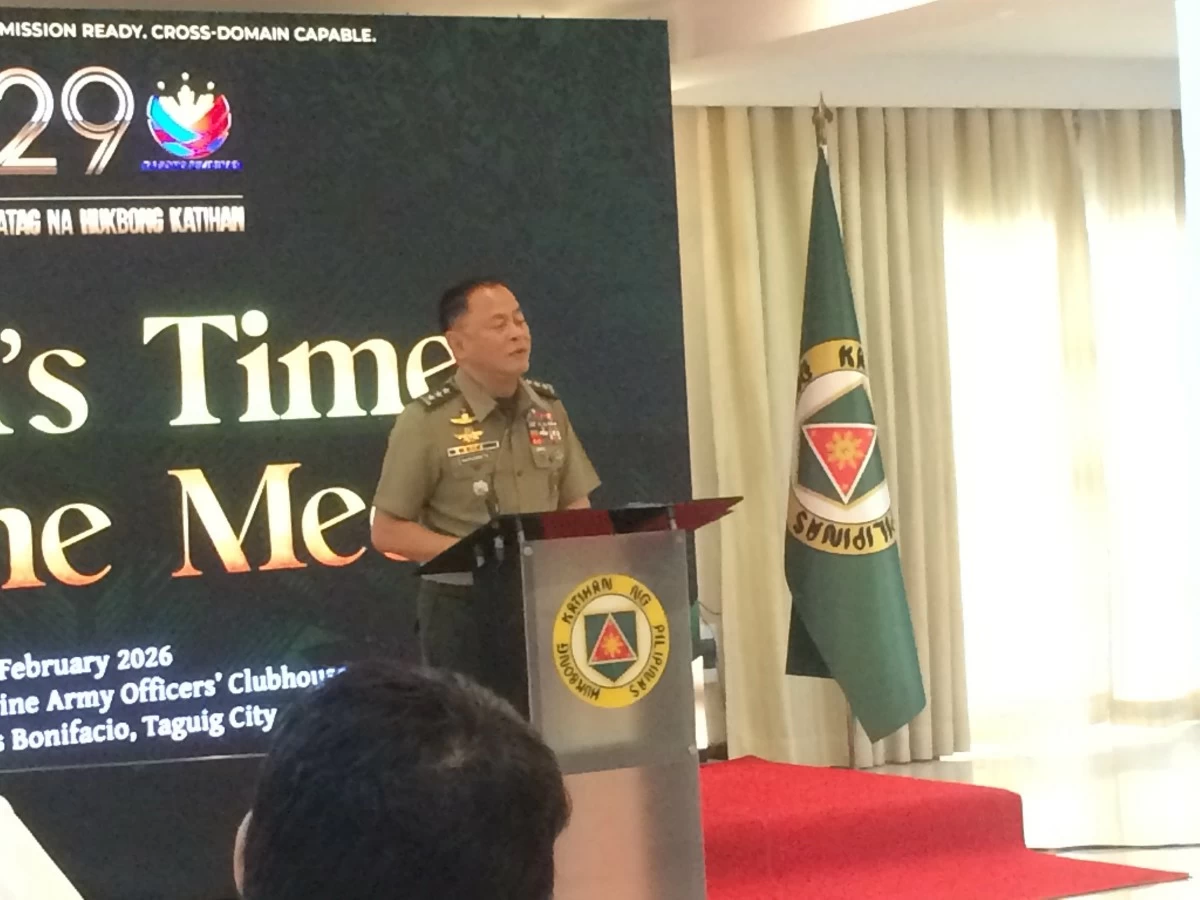
Philippine Army Commanding General, Lt. Gen. Antonio Nafarrete speaks during a press conference at the Army headquarters in Fort Bonifacio, Taguig City on Feb. 16, 2026. (Photo: Martin A. Sadongdong / MANILA BULLETIN)
The Philippine Army (PA) is preparing to mobilize three full infantry divisions to secure the first Bangsamoro parliamentary elections this September.
Lt. Gen. Antonio Nafarrete, PA commanding general, expressed confidence in maintaining peace during the polls, citing a significant decline in local terrorist strength as a key factor for the optimistic outlook. He said the 1st Infantry Division (1ID), 6th Infantry Division (6ID), and 11th Infantry Division (11ID) are more than capable of securing the region as Bangsamoros exercise their right to vote.
“We have enough forces to cover everybody. We have our templates ready and our forces are capable of securing the election,” Nafarrete said in a press conference at the Army headquarters in Fort Bonifacio, Taguig City.
After being postponed four times, the inaugural parliamentary elections in the Bangsamoro Autonomous Region in Muslim Mindanao (BARMM) are set to be held in September.
Juan Miguel Zubiri, the Senate Majority Floor Leader and principal author of Senate Bill 1823 which reset the first regular BARMM polls, is pushing for the elections to take place on September 14.
The Commission on Elections (Comelec) has said it is amenable to conducting the BARMM elections in September.
Minimal terror threat
To ensure that the parliamentary polls will be peaceful, Nafarette said the Army continues to conduct internal security operations against local terror groups.
However, the Army chief disputed the results of the Global Terrorism Index (GTI) 2025 released last week that showed the Philippines as one of the top countries facing persistent security threats due to terrorism.
The GTI report ranked the Philippines as 20th out of 163 countries impacted by terrorism after earning a score of 5.17 on a 10-point scale, with 10 as the worst.
Published annually by the Sydney-based Institute for Economics and Peace, the GTI report provides a comprehensive analysis of terrorism trends across several countries, with the 2025 report highlighting that 98 percent of terrorism-related deaths occurred in conflict zones.
It assessed terrorism based on four indicators: the number of incidents, fatalities, injuries, and hostages. These factors are weighted over a five-year span to reflect long-term impact instead of short-term surges.
However, Nafarrete argued that the figures should be updated to reflect the actual situation on the ground.
According to Nafarette, the once-formidable Abu Sayyaf Group (ASG) has been effectively neutralized in its former strongholds as Sulu is now declared an “ASG-free” region. In Basilan, the group has been reduced to “lawless elements” rather than a structured terrorist threat.
The military also reported that the remaining forces of Dawlah Islamiyah (DI) and the Maute Group are now extremely limited. In Lanao del Sur, estimates suggest fewer than 10 members remain in the Marawi area. In Maguindanao, ISIS-linked elements are described as “very, very minimal.”
"I think kailangan iupdate nila ang data nila (they need to update their data),” Nafarrete said.
“We are very, very confident that we will be able to finish this since [the threat] is very minimal in other areas,” he added.
Focus on loose firearms
While the terrorist threat has slowed, security forces are shifting their focus to local conflicts and the proliferation of illegal weapons. Most recorded violent incidents in BARMM are now attributed to “rido” or family feuds.
Nafarette said the Army remains focused on recovering loose firearms to prevent family conflicts from escalating into larger security issues ahead of the parliamentary polls.
Ongoing normalization efforts with the Moro Islamic Liberation Front (MILF) also continue to play a role in the security landscape, he shared.
Further, Nafarrete said the Army is working closely with local government units (LGUs) and the Philippine National Police (PNP) to track remaining lawless elements.
He said this “whole-of-nation” approach aims to prevent recruitment by providing communities with better opportunities.
“It is not a security responsibility alone. It is a shared responsibility,” the official added.