ADVERTISEMENT

'First feline' Larry marks 15 years as Britain's political top cat

Published Feb 15, 2026 11:43 pm
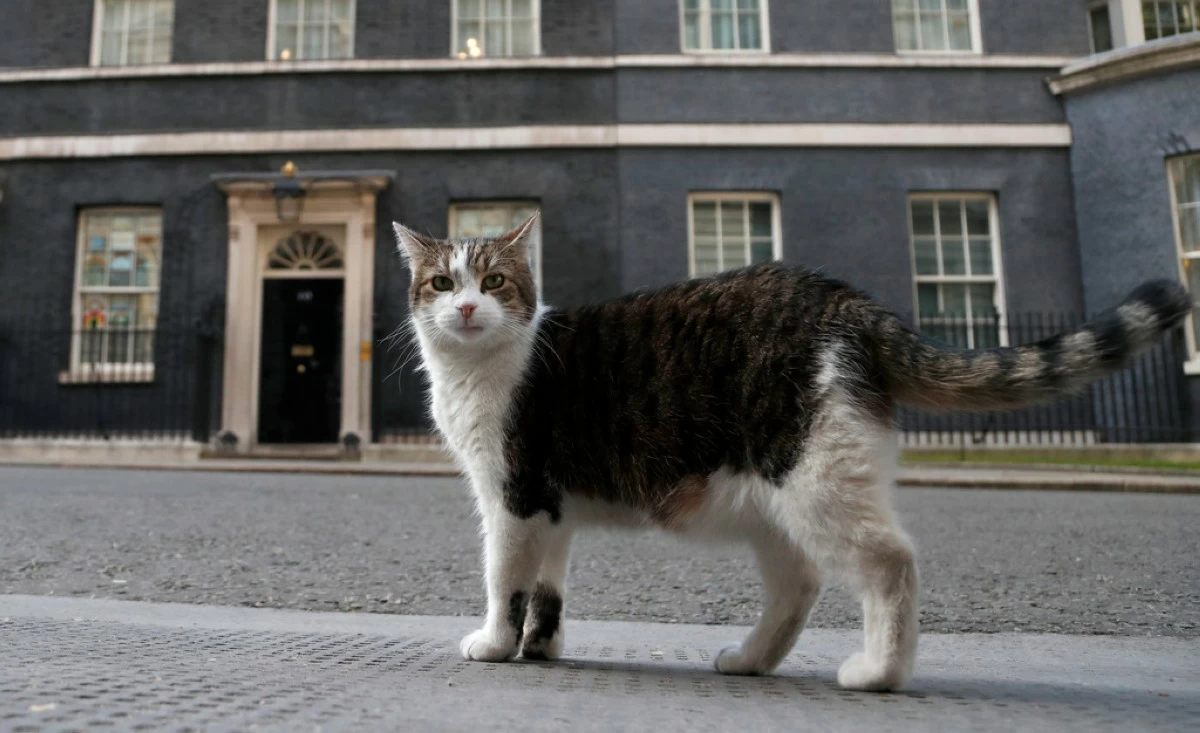
Larry, the official 10 Downing Street cat walks outside 10 Downing Street before the nationwide Clap for Carers to recognise and support National Health Service (NHS) workers and carers fighting the coronavirus pandemic, in London, Thursday, May 21, 2020. (AP Photo/Frank Augstein, File)
LONDON (AP) — In turbulent political times, stability comes with four legs, whiskers and a fondness for napping.
Larry the cat celebrates 15 years on Sunday as the British government’s official rodent-catcher and unofficial first feline, a reassuring presence who has served under six prime ministers. Sometimes it seems like they have served under him.
“Larry the cat’s approval ratings will be very high,” said Philip Howell, a Cambridge University professor who has studied the history of human-animal relations. “And prime ministers tend not to hit those numbers.
"He represents stability, and that’s at a premium."
The gray-and-white tabby’s rags-to-riches story has taken him from stray on the streets to Britain’s seat of power, 10 Downing St., where he bears the official title Chief Mouser to the Cabinet Office.
Adopted from London’s Battersea Dogs and Cats Home by then-Prime Minister David Cameron, Larry entered Downing Street on Feb. 15, 2011. According to a profile on the U.K. government website, his duties include “greeting guests to the house, inspecting security defenses and testing antique furniture for napping quality.”
Larry roams freely and has a knack for upstaging world leaders arriving at 10 Downing St.’s famous black door, to the delight of news photographers.
“He’s great at photo-bombing,” said Justin Ng, a freelance photographer who has come to know Larry well over the years. “If there’s a foreign leader that’s about to visit then we know he’ll just come out at the exact moment that meet-and-greet is about to happen.”
Larry has met many world leaders, who sometimes have to step around or over him. It has been observed that he is largely unfriendly to men, though he took a liking to former U.S. President Barack Obama, and he drew a smile from President Volodymyr Zelenskyy on one of the Ukrainian leader’s visits to London.
When U.S. President Donald Trump visited in 2019, Larry crashed the official doorstep photo and then took a nap under the Beast, the president’s armored car.
Reports of Larry’s rodent-catching skills vary, though he has been photographed snagging the occasional mouse — and, once, a pigeon, which escaped.
“He’s more of a lover than a fighter,” Ng said. “He’s very good at what he does: lounging around and basically showing people that he’s very nonchalant.”
Larry has cohabited, sometimes uneasily, with prime ministerial pets including Boris Johnson’s Jack Russell cross Dilyn and Rishi Sunak’s Labrador retriever Nova. He is kept well away from current Prime Minister Keir Starmer’s family cats, JoJo and Prince, who inhabit the private family quarters while Larry rules the working areas of Downing Street.
He had a volatile relationship with Palmerston, diplomatic top cat at the Foreign Office across the street from No. 10. The pair were caught tussling several times before Palmerston retired in 2020. Palmerston died this month in Bermuda, where he was serving as “feline relations consultant” to the governor.
Meanwhile, Larry abides. He is 18 or 19, and has slowed down a bit, but continues to patrol his turf and to sleep on a window ledge above a radiator just inside the No. 10 door.
He is British soft power in feline form, and woe betide any prime minister who got rid of him.
“A cat-hating PM, that seems to me to be political suicide,” said Howell.
He said Larry’s status as nonpartisan “official pet” sets him apart from the American presidential pets – most often dogs – that U.S. leaders have sometimes deployed to soften their image.
“The fact that cats are less tractable is part of the charm, too,” Howell said. “He’s sort of whimsically not partisan in a political sense, but he tends to take to some people and not to others and he won’t necessarily sit where you want him to sit and pose where you want him to pose.
“There is a certain kind of unruliness about Larry which I think would endear him, certainly, to Brits.”

Related Tags

World news
ADVERTISEMENT
.most-popular .layout-ratio{ padding-bottom: 79.13%; } @media (min-width: 768px) and (max-width: 1024px) { .widget-title { font-size: 15px !important; } }

{{ articles_filter_1561_widget.title }}

.most-popular .layout-ratio{ padding-bottom: 79.13%; } @media (min-width: 768px) and (max-width: 1024px) { .widget-title { font-size: 15px !important; } }

{{ articles_filter_1562_widget.title }}

.most-popular .layout-ratio{ padding-bottom: 79.13%; } @media (min-width: 768px) and (max-width: 1024px) { .widget-title { font-size: 15px !important; } }

{{ articles_filter_1563_widget.title }}

{{ articles_filter_1564_widget.title }}

.mb-article-details { position: relative; } .mb-article-details .article-body-preview, .mb-article-details .article-body-summary{ font-size: 17px; line-height: 30px; font-family: "Libre Caslon Text", serif; color: #000; } .mb-article-details .article-body-preview iframe , .mb-article-details .article-body-summary iframe{ width: 100%; margin: auto; } .read-more-background { background: linear-gradient(180deg, color(display-p3 1.000 1.000 1.000 / 0) 13.75%, color(display-p3 1.000 1.000 1.000 / 0.8) 30.79%, color(display-p3 1.000 1.000 1.000) 72.5%); position: absolute; height: 200px; width: 100%; bottom: 0; display: flex; justify-content: center; align-items: center; padding: 0; } .read-more-background a{ color: #000; } .read-more-btn { padding: 17px 45px; font-family: Inter; font-weight: 700; font-size: 18px; line-height: 16px; text-align: center; vertical-align: middle; border: 1px solid black; background-color: white; } .hidden { display: none; }
function initializeAllSwipers() { // Get all hidden inputs with cms_article_id document.querySelectorAll('[id^="cms_article_id_"]').forEach(function (input) { const cmsArticleId = input.value; const articleSelector = '#article-' + cmsArticleId + ' .body_images'; const swiperElement = document.querySelector(articleSelector); if (swiperElement && !swiperElement.classList.contains('swiper-initialized')) { new Swiper(articleSelector, { loop: true, pagination: false, navigation: { nextEl: '#article-' + cmsArticleId + ' .swiper-button-next', prevEl: '#article-' + cmsArticleId + ' .swiper-button-prev', }, }); } }); } setTimeout(initializeAllSwipers, 3000); const intersectionObserver = new IntersectionObserver( (entries) => { entries.forEach((entry) => { if (entry.isIntersecting) { const newUrl = entry.target.getAttribute("data-url"); if (newUrl) { history.pushState(null, null, newUrl); let article = entry.target; // Extract metadata const author = article.querySelector('.author-section').textContent.replace('By', '').trim(); const section = article.querySelector('.section-info ').textContent.replace(' ', ' '); const title = article.querySelector('.article-title h1').textContent; // Parse URL for Chartbeat path format const parsedUrl = new URL(newUrl, window.location.origin); const cleanUrl = parsedUrl.host + parsedUrl.pathname; // Update Chartbeat configuration if (typeof window._sf_async_config !== 'undefined') { window._sf_async_config.path = cleanUrl; window._sf_async_config.sections = section; window._sf_async_config.authors = author; } // Track virtual page view with Chartbeat if (typeof pSUPERFLY !== 'undefined' && typeof pSUPERFLY.virtualPage === 'function') { try { pSUPERFLY.virtualPage({ path: cleanUrl, title: title, sections: section, authors: author }); } catch (error) { console.error('ping error', error); } } // Optional: Update document title if (title && title !== document.title) { document.title = title; } } } }); }, { threshold: 0.1 } ); function showArticleBody(button) { const article = button.closest("article"); const summary = article.querySelector(".article-body-summary"); const body = article.querySelector(".article-body-preview"); const readMoreSection = article.querySelector(".read-more-background"); // Hide summary and read-more section summary.style.display = "none"; readMoreSection.style.display = "none"; // Show the full article body body.classList.remove("hidden"); } document.addEventListener("DOMContentLoaded", () => { let loadCount = 0; // Track how many times articles are loaded const offset = [1, 2, 3, 4, 5, 6, 7, 8, 9, 10]; // Offset values const currentUrl = window.location.pathname.substring(1); let isLoading = false; // Prevent multiple calls if (!currentUrl) { console.log("Current URL is invalid."); return; } const sentinel = document.getElementById("load-more-sentinel"); if (!sentinel) { console.log("Sentinel element not found."); return; } function isSentinelVisible() { const rect = sentinel.getBoundingClientRect(); return ( rect.top < window.innerHeight && rect.bottom >= 0 ); } function onScroll() { if (isLoading) return; if (isSentinelVisible()) { if (loadCount >= offset.length) { console.log("Maximum load attempts reached."); window.removeEventListener("scroll", onScroll); return; } isLoading = true; const currentOffset = offset[loadCount]; window.loadMoreItems().then(() => { let article = document.querySelector('#widget_1690 > div:nth-last-of-type(2) article'); intersectionObserver.observe(article) loadCount++; }).catch(error => { console.error("Error loading more items:", error); }).finally(() => { isLoading = false; }); } } window.addEventListener("scroll", onScroll); });

Sign up by email to receive news.