






Manila Bulletin
 Philippines
National
Australian warship in Subic for port visit; transits Kalayaan Island Group
Philippines
National
Australian warship in Subic for port visit; transits Kalayaan Island Group
Philippines
National
Australian warship in Subic for port visit; transits Kalayaan Island Group
Australian warship in Subic for port visit; transits Kalayaan Island Group
Published Feb 15, 2026 11:30 am
|
Updated Feb 15, 2026 01:44 pm


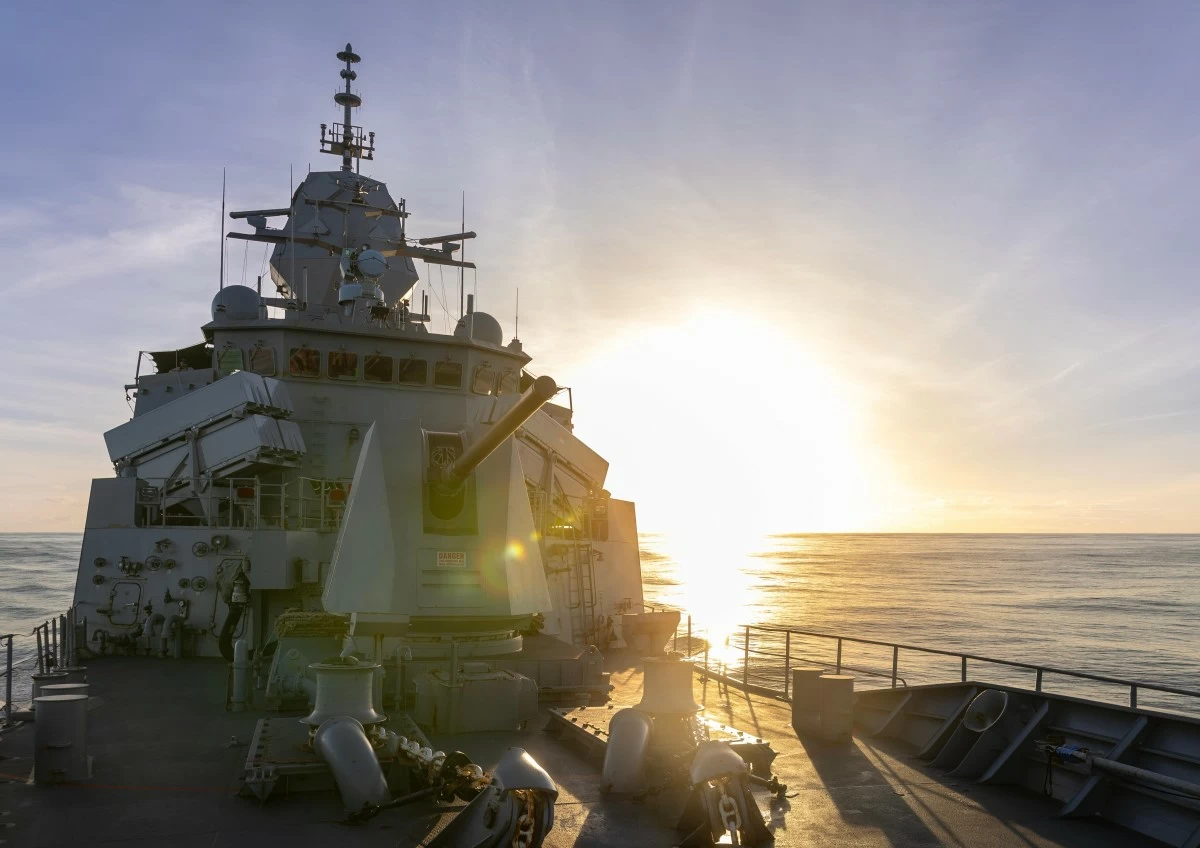
HMAS Toowoomba, a Royal Australian Navy (RAN) frigate, transits the South China Sea near the Spratly Islands from Feb. 9 to 10, 2026 as part of its 2026 regional presence deployment. (Photo courtesy of Leading Seaman Zac Dingle / Defence Australia)
An Australian warship transited the South China Sea near the Kalayaan Island Group (Spratly Islands) and dropped anchor in Subic for a port visit aimed at strengthening maritime ties with the Philippine Navy (PN).
The PN, through the Philippine Fleet (PF), is hosting HMAS Toowoomba, an Anzac-class long-range frigate of the RAN, from Feb. 13 to 16 at the Naval Operating Base Subic.
Toowoomba arrived at Rivera Wharf in Subic Port and was accorded arrival honors. A PN delegation led by Commander Marlon A. Paca-Anas, director of the Fleet Special Services Office, formally received the ship.
The visiting delegation was led by Commander Alicia Harrison, commanding officer of Toowoomba, who paid a courtesy call on PN-PF Commander, Rear Admiral Joe Anthony C. Orbe.
The port visit followed the ship’s safe transit of the South China Sea in the vicinity of the Spratly Islands from February 9 to 10 as part of its 2026 regional presence deployment.
Harrison said “foreign” naval vessels were present during the passage but there was no confrontation, and that all interactions were handled properly.
“Routine transits like this one demonstrate Australia’s commitment to a peaceful, stable and prosperous Indo-Pacific, where sovereignty and agreed rules and norms are respected,” she said.
Harrison stressed that at all points, Toowoomba was operating in international waters in accordance with international law.
“This transit reaffirms Australian vessels and aircraft will continue to exercise our rights to freedom of navigation and overflight in accordance with international law, particularly the United Nations Convention on the Law of the Sea,” she noted.
She added that regional presence deployments are vital to protecting Australia’s interests, preserving an international rules-based order, enhancing cooperation and relationships with regional partners and allies, and developing capability and interoperability.
“Australia has a decades-long history of conducting maritime activities in the region, including in the South China Sea, which is a vital waterway for the entire international community,” Harrison said.
Australia has maintained a near-continuous presence in the region in recent years through the deployment of RAN ships and other Australian Defence Force (ADF) assets.
In Subic, discussions between the Philippine Fleet and the Australian contingent focused on expanding maritime cooperation. Both sides discussed ways to enhance interoperability and identify future joint activities.
The port visit included subject matter expert exchanges conducted aboard Toowoomba. Fleet personnel joined workshops on replenishment at sea and seaworthiness of vessels.
“These areas are considered vital to sustaining maritime operations and ensuring readiness,” said Commander Randy P. Garbo, director of the PN-PF public affairs office.
He said the engagement also prepares both navies for the upcoming Exercise Kakadu, RAN’s premier biennial maritime exercise, set this March.
The Navy is expected to deploy a Miguel Malvar-class frigate to the exercise, according to PN spokesperson Capt. Marissa Martinez.