ADVERTISEMENT

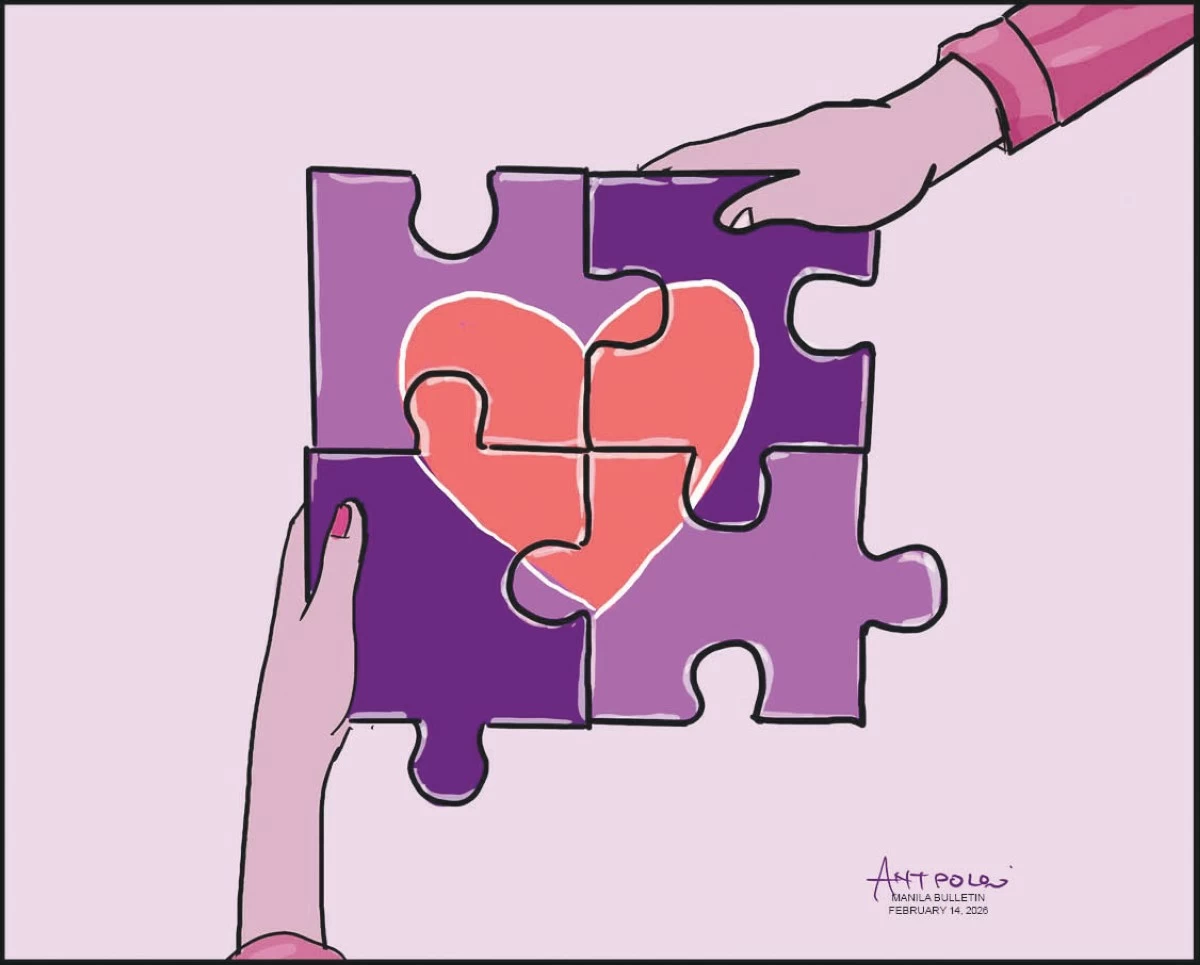
Love, broadly given: Strengthening the social fabric that binds generations

Published Feb 14, 2026 12:05 am  |  Updated Feb 13, 2026 05:52 pm
For many, Valentine’s Day arrives wrapped in predictable gestures — roses, ribbons and restaurant reservations. It is a welcome ritual to celebrate romance and devotion. Yet for a nation navigating anxious times, perhaps the truest observance of the day calls us to something broader and more enduring than candlelight and confections.
Love, at its best, is not confined to romance. It is a virtue — steady, generous and quietly transformative. It is found in the daily decision to place another’s well-being alongside our own. Today, Valentine’s Day, we might consider reclaiming the holiday not by diminishing its traditions, but by enlarging them.
For 126 years, Manila Bulletin has chronicled the story of our people and one truth appears again and again in our archives: Filipinos endure not by sentiment alone, but by sacrifice, solidarity and service.
Love, in our tradition, has never been confined to courtship.
It is found in the quiet heroism of mothers and fathers who leave for overseas work so their children may have opportunities they themselves did not.
It is seen in neighbors who arrive unasked when a typhoon floods a barangay, bringing food, blankets and steady hands.
It is present in parish volunteers who organize relief drives, in jeepney drivers who extend kindness to a struggling passenger, and in teachers who dig into their own modest resources so their pupils can learn with dignity.
The need for such quiet acts has not diminished. If anything, it has grown. We live in an age of speed and distraction, when disagreement too often drowns out decency. Public discourse can feel sharp-edged. Loneliness, though seldom visible, is widespread. Under such conditions, a single act of kindness can carry significant weight.
What might it look like to honor Valentine’s Day in this spirit?
It may be as simple as writing a note of gratitude to a teacher who shaped a life long ago, or to a colleague whose diligence often goes unremarked. It may mean checking in on an elderly neighbor, or extending patience in a long queue when tempers run thin. It may be choosing civility in conversation where disagreement would be easier.
For congregations and civic groups, Valentine’s Day offers an occasion to reaffirm bonds of fellowship. A community meal, a blood drive, a coordinated effort to assist a struggling household — these are expressions of love that ripple outward. They strengthen the social fabric that binds town to town and generation to generation.
Even within marriage and romance, the most meaningful tokens are rarely the most extravagant. A faithful presence through hardship, a willingness to forgive, a shared commitment to weather life’s uncertainties — these are the foundations upon which lasting affection rests.
To broaden our understanding of Valentine’s Day is not to scorn its sentiment, but to deepen it. Romance remains a worthy and beautiful expression of love. Yet if the holiday begins and ends at the dinner table, we have missed an opportunity.
In a world inclined toward self-interest, choosing kindness is a quiet act of courage. It affirms that we belong to one another. It declares that courtesy and compassion are not antiquated virtues but living necessities.
Today, let us celebrate love in all its forms: in romance, certainly, but also in responsibility; in affection, but also in action. Let us give generously of our time, our patience and our goodwill.
Love, broadly given, remains the surest foundation of a strong and decent society.
ADVERTISEMENT
.most-popular .layout-ratio{ padding-bottom: 79.13%; } @media (min-width: 768px) and (max-width: 1024px) { .widget-title { font-size: 15px !important; } }

{{ articles_filter_1561_widget.title }}

.most-popular .layout-ratio{ padding-bottom: 79.13%; } @media (min-width: 768px) and (max-width: 1024px) { .widget-title { font-size: 15px !important; } }

{{ articles_filter_1562_widget.title }}

.most-popular .layout-ratio{ padding-bottom: 79.13%; } @media (min-width: 768px) and (max-width: 1024px) { .widget-title { font-size: 15px !important; } }

{{ articles_filter_1563_widget.title }}

{{ articles_filter_1564_widget.title }}

.mb-article-details { position: relative; } .mb-article-details .article-body-preview, .mb-article-details .article-body-summary{ font-size: 17px; line-height: 30px; font-family: "Libre Caslon Text", serif; color: #000; } .mb-article-details .article-body-preview iframe , .mb-article-details .article-body-summary iframe{ width: 100%; margin: auto; } .read-more-background { background: linear-gradient(180deg, color(display-p3 1.000 1.000 1.000 / 0) 13.75%, color(display-p3 1.000 1.000 1.000 / 0.8) 30.79%, color(display-p3 1.000 1.000 1.000) 72.5%); position: absolute; height: 200px; width: 100%; bottom: 0; display: flex; justify-content: center; align-items: center; padding: 0; } .read-more-background a{ color: #000; } .read-more-btn { padding: 17px 45px; font-family: Inter; font-weight: 700; font-size: 18px; line-height: 16px; text-align: center; vertical-align: middle; border: 1px solid black; background-color: white; } .hidden { display: none; }
function initializeAllSwipers() { // Get all hidden inputs with cms_article_id document.querySelectorAll('[id^="cms_article_id_"]').forEach(function (input) { const cmsArticleId = input.value; const articleSelector = '#article-' + cmsArticleId + ' .body_images'; const swiperElement = document.querySelector(articleSelector); if (swiperElement && !swiperElement.classList.contains('swiper-initialized')) { new Swiper(articleSelector, { loop: true, pagination: false, navigation: { nextEl: '#article-' + cmsArticleId + ' .swiper-button-next', prevEl: '#article-' + cmsArticleId + ' .swiper-button-prev', }, }); } }); } setTimeout(initializeAllSwipers, 3000); const intersectionObserver = new IntersectionObserver( (entries) => { entries.forEach((entry) => { if (entry.isIntersecting) { const newUrl = entry.target.getAttribute("data-url"); if (newUrl) { history.pushState(null, null, newUrl); let article = entry.target; // Extract metadata const author = article.querySelector('.author-section').textContent.replace('By', '').trim(); const section = article.querySelector('.section-info ').textContent.replace(' ', ' '); const title = article.querySelector('.article-title h1').textContent; // Parse URL for Chartbeat path format const parsedUrl = new URL(newUrl, window.location.origin); const cleanUrl = parsedUrl.host + parsedUrl.pathname; // Update Chartbeat configuration if (typeof window._sf_async_config !== 'undefined') { window._sf_async_config.path = cleanUrl; window._sf_async_config.sections = section; window._sf_async_config.authors = author; } // Track virtual page view with Chartbeat if (typeof pSUPERFLY !== 'undefined' && typeof pSUPERFLY.virtualPage === 'function') { try { pSUPERFLY.virtualPage({ path: cleanUrl, title: title, sections: section, authors: author }); } catch (error) { console.error('ping error', error); } } // Optional: Update document title if (title && title !== document.title) { document.title = title; } } } }); }, { threshold: 0.1 } ); function showArticleBody(button) { const article = button.closest("article"); const summary = article.querySelector(".article-body-summary"); const body = article.querySelector(".article-body-preview"); const readMoreSection = article.querySelector(".read-more-background"); // Hide summary and read-more section summary.style.display = "none"; readMoreSection.style.display = "none"; // Show the full article body body.classList.remove("hidden"); } document.addEventListener("DOMContentLoaded", () => { let loadCount = 0; // Track how many times articles are loaded const offset = [1, 2, 3, 4, 5, 6, 7, 8, 9, 10]; // Offset values const currentUrl = window.location.pathname.substring(1); let isLoading = false; // Prevent multiple calls if (!currentUrl) { console.log("Current URL is invalid."); return; } const sentinel = document.getElementById("load-more-sentinel"); if (!sentinel) { console.log("Sentinel element not found."); return; } function isSentinelVisible() { const rect = sentinel.getBoundingClientRect(); return ( rect.top < window.innerHeight && rect.bottom >= 0 ); } function onScroll() { if (isLoading) return; if (isSentinelVisible()) { if (loadCount >= offset.length) { console.log("Maximum load attempts reached."); window.removeEventListener("scroll", onScroll); return; } isLoading = true; const currentOffset = offset[loadCount]; window.loadMoreItems().then(() => { let article = document.querySelector('#widget_1690 > div:nth-last-of-type(2) article'); intersectionObserver.observe(article) loadCount++; }).catch(error => { console.error("Error loading more items:", error); }).finally(() => { isLoading = false; }); } } window.addEventListener("scroll", onScroll); });

Sign up by email to receive news.