

ADVERTISEMENT

New astronauts launch to the International Space Station after medical evacuation

Published Feb 13, 2026 08:51 pm
CAPE CANAVERAL, Fla. (AP) — A new crew rocketed toward the International Space Station on Friday to replace the astronauts who returned to Earth early in NASA's first medical evacuation.
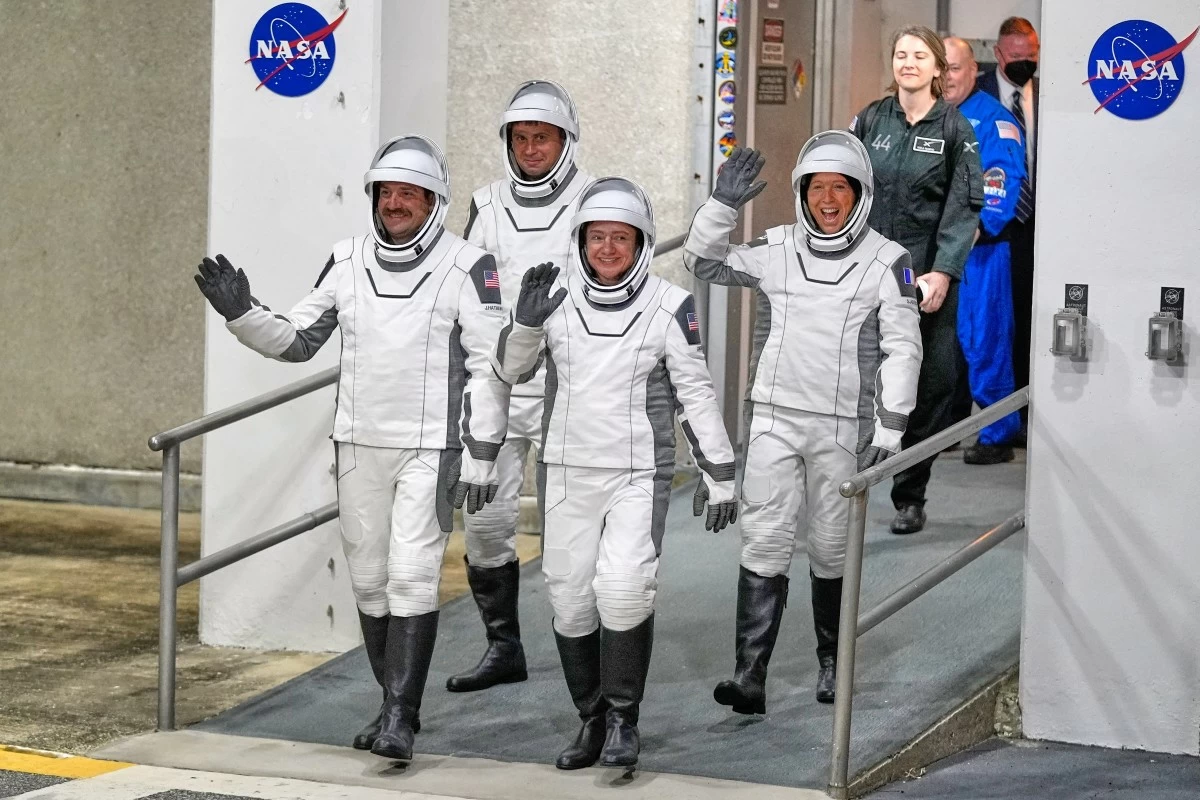
Crew 12 astronauts, from left, pilot Jack Hathaway, Russian cosmonaut Andrei Fedyaev, commander Jessica Meir and ESA astronaut Sophia Adenot, of France, leave the Operations and Checkout building before heading to pad 40 at the Cape Canaveral Space Force Station in Cape Canaveral, Fla., Friday, Feb. 13, 2026, on a mission to the International Space Station. (AP Photo/John Raoux)
SpaceX launched the replacements as soon as possible at NASA's request, sending the U.S., French and Russian astronauts on an expected eight- to nine-month mission stretching until fall. The four should arrive at the orbiting lab on Saturday, filling the vacancies left by their evacuated colleagues last month and bringing the space station back to full staff.
"It turns out Friday the 13th is a very lucky day," SpaceX Launch Control radioed once the astronauts reached orbit. "That was quite a ride," replied the crew's commander, Jessica Meir.
NASA had to put spacewalks on hold and deferred other duties while awaiting the arrival of Americans Meir and Jack Hathaway, France's Sophie Adenot and Russia's Andrei Fedyaev. They'll join three other astronauts — one American and two Russians — who kept the space station running the past month.
Satisfied with medical procedures already in place, NASA ordered no extra checkups for the crew ahead of liftoff and no new diagnostic equipment was packed. An ultrasound machine already up there for research went into overdrive on Jan. 7 when used on the ailing crew member. NASA has not revealed the ill astronaut's identity or health issue. All four returning astronauts went straight to the hospital after splashing down in the Pacific near San Diego.
It was the first time in 65 years of human spaceflight that NASA cut short a mission for medical reasons.
With missions becoming longer, NASA is constantly looking at upgrades to the space station's medical gear, said deputy program manager Dina Contella. "But there are a lot of things that are just not practical and so that's when you need to bring astronauts home from space," she said earlier this week.
In preparation for moon and Mars trips where health care will be even more challenging, the new arrivals will test a filter designed to turn drinking water into emergency IV fluid, try out an ultrasound system that relies on artificial intelligence and augmented reality instead of experts on the ground, and perform ultrasound scans on their jugular veins in a blood clot study.
They also will demonstrate their moon-landing skills in a simulated test.
Adenot is only the second French woman to launch to space. She was 14 when Claudie Haignere flew to Russia's space station Mir in 1996, inspiring her to become an astronaut. Haignere cheered her on from the Florida launch site, wishing her "Bon vol," French for "Have a good flight," and "Ad astra," Latin for "To the stars."
"I thought it would have been a quiet joy with pride for Sophie, but it was so hugely emotional to see her with a successful launch," Haignere said.
Hathaway, like Adenot, is new to space, while Meir and Fedyaev are making their second station trip. Just before liftoff, Fedyaev led the crew in a cry of "Poyekhali" — Russian for "Let's Go" — the word uttered at liftoff by the world's first person in space, the Soviet Union's Yuri Gagarin, in 1961.
On her first mission in 2019, Meir took part in the first all-female spacewalk. The other half of that spacewalk, Christina Koch, is among the four Artemis II astronauts waiting to fly around the moon as early as March. A ship-to-ship radio linkup is planned between the two crews.
Meir wasn't sure astronauts would return to the moon during her career. "Now we're right here on the precipice of the Artemis II mission," she said ahead of liftoff. "The fact that they will be in space at the same time as us … it's so cool to be an astronaut now, it's so exciting."
SpaceX launched the latest crew from Cape Canaveral Space Force Station. Elon Musk's company is preparing its neighboring Kennedy Space Center launch pad for the super-sized Starships, which NASA needs to land astronauts on the moon.

Related Tags

world news
ADVERTISEMENT
.most-popular .layout-ratio{ padding-bottom: 79.13%; } @media (min-width: 768px) and (max-width: 1024px) { .widget-title { font-size: 15px !important; } }

{{ articles_filter_1561_widget.title }}

.most-popular .layout-ratio{ padding-bottom: 79.13%; } @media (min-width: 768px) and (max-width: 1024px) { .widget-title { font-size: 15px !important; } }

{{ articles_filter_1562_widget.title }}

.most-popular .layout-ratio{ padding-bottom: 79.13%; } @media (min-width: 768px) and (max-width: 1024px) { .widget-title { font-size: 15px !important; } }

{{ articles_filter_1563_widget.title }}

{{ articles_filter_1564_widget.title }}

.mb-article-details { position: relative; } .mb-article-details .article-body-preview, .mb-article-details .article-body-summary{ font-size: 17px; line-height: 30px; font-family: "Libre Caslon Text", serif; color: #000; } .mb-article-details .article-body-preview iframe , .mb-article-details .article-body-summary iframe{ width: 100%; margin: auto; } .read-more-background { background: linear-gradient(180deg, color(display-p3 1.000 1.000 1.000 / 0) 13.75%, color(display-p3 1.000 1.000 1.000 / 0.8) 30.79%, color(display-p3 1.000 1.000 1.000) 72.5%); position: absolute; height: 200px; width: 100%; bottom: 0; display: flex; justify-content: center; align-items: center; padding: 0; } .read-more-background a{ color: #000; } .read-more-btn { padding: 17px 45px; font-family: Inter; font-weight: 700; font-size: 18px; line-height: 16px; text-align: center; vertical-align: middle; border: 1px solid black; background-color: white; } .hidden { display: none; }
function initializeAllSwipers() { // Get all hidden inputs with cms_article_id document.querySelectorAll('[id^="cms_article_id_"]').forEach(function (input) { const cmsArticleId = input.value; const articleSelector = '#article-' + cmsArticleId + ' .body_images'; const swiperElement = document.querySelector(articleSelector); if (swiperElement && !swiperElement.classList.contains('swiper-initialized')) { new Swiper(articleSelector, { loop: true, pagination: false, navigation: { nextEl: '#article-' + cmsArticleId + ' .swiper-button-next', prevEl: '#article-' + cmsArticleId + ' .swiper-button-prev', }, }); } }); } setTimeout(initializeAllSwipers, 3000); const intersectionObserver = new IntersectionObserver( (entries) => { entries.forEach((entry) => { if (entry.isIntersecting) { const newUrl = entry.target.getAttribute("data-url"); if (newUrl) { history.pushState(null, null, newUrl); let article = entry.target; // Extract metadata const author = article.querySelector('.author-section').textContent.replace('By', '').trim(); const section = article.querySelector('.section-info ').textContent.replace(' ', ' '); const title = article.querySelector('.article-title h1').textContent; // Parse URL for Chartbeat path format const parsedUrl = new URL(newUrl, window.location.origin); const cleanUrl = parsedUrl.host + parsedUrl.pathname; // Update Chartbeat configuration if (typeof window._sf_async_config !== 'undefined') { window._sf_async_config.path = cleanUrl; window._sf_async_config.sections = section; window._sf_async_config.authors = author; } // Track virtual page view with Chartbeat if (typeof pSUPERFLY !== 'undefined' && typeof pSUPERFLY.virtualPage === 'function') { try { pSUPERFLY.virtualPage({ path: cleanUrl, title: title, sections: section, authors: author }); } catch (error) { console.error('ping error', error); } } // Optional: Update document title if (title && title !== document.title) { document.title = title; } } } }); }, { threshold: 0.1 } ); function showArticleBody(button) { const article = button.closest("article"); const summary = article.querySelector(".article-body-summary"); const body = article.querySelector(".article-body-preview"); const readMoreSection = article.querySelector(".read-more-background"); // Hide summary and read-more section summary.style.display = "none"; readMoreSection.style.display = "none"; // Show the full article body body.classList.remove("hidden"); } document.addEventListener("DOMContentLoaded", () => { let loadCount = 0; // Track how many times articles are loaded const offset = [1, 2, 3, 4, 5, 6, 7, 8, 9, 10]; // Offset values const currentUrl = window.location.pathname.substring(1); let isLoading = false; // Prevent multiple calls if (!currentUrl) { console.log("Current URL is invalid."); return; } const sentinel = document.getElementById("load-more-sentinel"); if (!sentinel) { console.log("Sentinel element not found."); return; } function isSentinelVisible() { const rect = sentinel.getBoundingClientRect(); return ( rect.top < window.innerHeight && rect.bottom >= 0 ); } function onScroll() { if (isLoading) return; if (isSentinelVisible()) { if (loadCount >= offset.length) { console.log("Maximum load attempts reached."); window.removeEventListener("scroll", onScroll); return; } isLoading = true; const currentOffset = offset[loadCount]; window.loadMoreItems().then(() => { let article = document.querySelector('#widget_1690 > div:nth-last-of-type(2) article'); intersectionObserver.observe(article) loadCount++; }).catch(error => { console.error("Error loading more items:", error); }).finally(() => { isLoading = false; }); } } window.addEventListener("scroll", onScroll); });

Sign up by email to receive news.