







Mayon, Kanlaon emit ash; alert levels unchanged
Published Feb 13, 2026 10:28 am


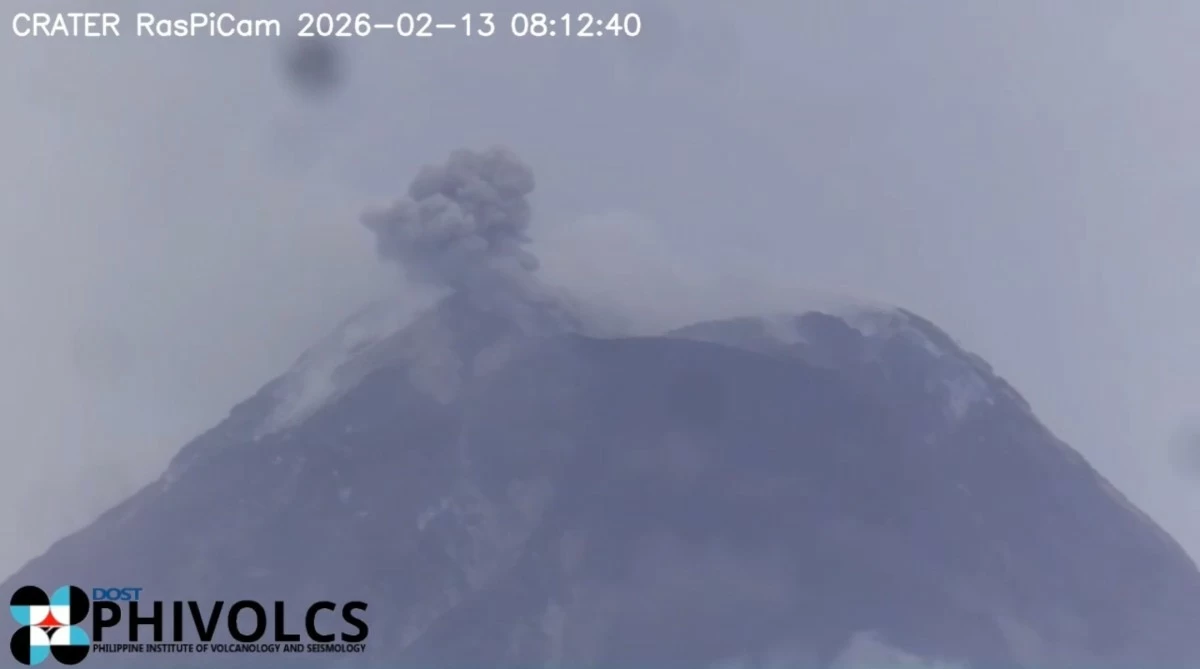
Mayon Volcano releases a grayish ash plume from its summit crater on Feb. 13, 2026, rising about 50 meters before drifting west-southwest, as recorded by monitoring cameras of the Philippine Institute of Volcanology and Seismology. The volcano remains under Alert Level 3 amid continued effusive activity, including lava flows, rockfalls, and intermittent pyroclastic density currents. (Phivolcs/Screenshot)
Ash emissions were recorded at Mayon Volcano in Albay and Kanlaon Volcano in Negros Island early Friday, Feb. 13, as the Philippine Institute of Volcanology and Seismology (Phivolcs) reported continued unrest at the two active volcanoes.
At Mayon, Phivolcs said grayish ash plumes rose about 50 meters above the summit crater at 8:21 a.m. and 8:27 a.m. before drifting west-southwest, while the effusive eruption at the summit continued.
Based on monitoring from 12 a.m. on Feb. 12 to 12 a.m. on Feb. 13, lava flows remained active in the Basud, Bonga, and Mi-isi gullies, reaching about 3.8 kilometers, 1.6 kilometers, and 1.3 kilometers from the crater, respectively.
During the same period, the volcano recorded 352 rockfall events and nine pyroclastic density currents (PDCs), locally known as “uson,” while a fair crater glow was also visible to the naked eye.
Sulfur dioxide emissions at Mayon remained high, with the latest measurement on Feb. 10 reaching 3,749 tons per day, according to Phivolcs.
Mayon remains under Alert Level 3, indicating intensified magmatic unrest and the potential for hazardous eruptions.
Under this alert level, ongoing activity can continue to generate lava flows, collapse-fed rockfalls, and PDCs on the southern and eastern upper slopes, while possible lava fountaining or moderate explosions could affect all sectors of the volcano.
Phivolcs reiterated that the public should stay out of the six-kilometer permanent danger zone because of the hazards posed by lava flows, rockfalls, and PDCs.
Residents within the eight-kilometer radius should also be ready for possible evacuation if monitoring parameters escalate and the alert level is raised to Alert Level 4.
Meanwhile, at Kanlaon, Phivolcs reported an ash emission at the summit crater at 12:50 a.m. that lasted about 17 minutes and produced plumes rising up to 300 meters before drifting southwest.
Alert Level 2 remains in effect over Kanlaon, indicating increased unrest that could lead to short-lived steam-driven or explosive eruptions capable of producing hazards such as PDCs, ashfall, rockfalls, and ballistic projectiles.
Residents within the four-kilometer permanent danger zone were advised to remain evacuated, while those within six kilometers of the summit were urged to stay alert, especially with the risk of lahars along rivers and streams during heavy rainfall.
Civil aviation authorities were also warned to avoid flying near the summit.