ADVERTISEMENT

The digital plumbing: Why infrastructure is the heart of modern romance

Published Feb 12, 2026 07:54 am

As Valentine’s Day approaches, millions of users are turning to dating apps to find a match. With over 360 million global users and a market generating $6 billion annually, the stakes for these platforms are higher than ever. However, according to Samuel Liu, principal product manager at Equinix, a smooth "swipe-to-match" experience doesn't happen by magic—it relies on a sophisticated foundation of "digital plumbing."

In a competitive landscape where the average user juggles multiple apps, a single second of lag can lead to a deleted account. To keep the sparks flying, app providers must master the invisible infrastructure of data centers, cloud services, and interconnected networks.

Love is Local: The Power of the Edge

Dating is fundamentally a local activity. Most users want to find someone nearby, chat instantly, and meet in person. To facilitate this, dating app infrastructure must reside at the digital edge—physically close to where users actually live and work.

Latency Matters: When data travels long distances to a remote data center and back (a "hairpin" scenario), delays occur.
Proximity is Key: If two users are in Singapore and the app’s data center is also in Singapore, the match happens in real-time.
The Frustration Factor: High latency leads to delayed notifications and frozen chats, pushing users toward competitors.

Inside the Dating Ecosystem

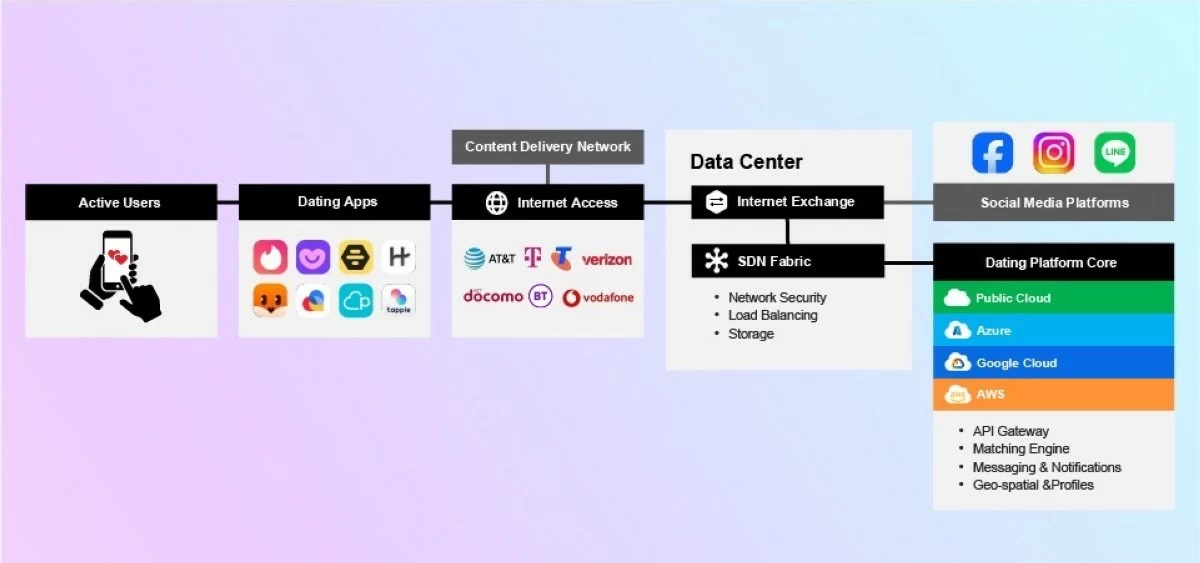
A successful dating app is rarely a solo act. By deploying inside interconnection hubs, such as Equinix IBX data centers, providers can link up with a vast ecosystem of partners:

Mobile Networks: Ensuring seamless connectivity on the go.
Cloud Providers: Powering the complex AI algorithms that match profiles based on preferences.
CDNs (Content Delivery Networks): Caching photos and videos close to the user for instant loading.
Payment and Social Integration: Handling subscriptions and secure logins through third-party platforms.

While dating algorithms might seem unromantic, Liu notes they function much like retail recommendation engines—analyzing vast amounts of data to find the perfect "product" (or person) for the user.

Secure Connections and Global Scale

Privacy is paramount in the world of online dating. Many providers now adopt a hybrid cloud approach to balance scalability with security. By keeping sensitive personal data on private infrastructure while using the cloud for messaging and matching, apps can maintain strict data sovereignty.

Equinix supports this by offering:

Direct Cloud On-ramps: Access to major cloud providers in dozens of global metros.
Equinix Fabric: Private interconnection that bypasses the public internet, ensuring data moves over secure, predictable pathways.
Load Balancing: Managing the massive traffic spikes that occur during peak dating seasons like early February.

The Bottom Line

The "digital plumbing" behind your favorite dating app is what transforms a simple swipe into a real-world connection. By prioritizing low latency and a robust ecosystem, app providers ensure that when love is in the air, the technology doesn't get in the way.

ADVERTISEMENT
.most-popular .layout-ratio{ padding-bottom: 79.13%; } @media (min-width: 768px) and (max-width: 1024px) { .widget-title { font-size: 15px !important; } }

{{ articles_filter_1561_widget.title }}

.most-popular .layout-ratio{ padding-bottom: 79.13%; } @media (min-width: 768px) and (max-width: 1024px) { .widget-title { font-size: 15px !important; } }

{{ articles_filter_1562_widget.title }}

.most-popular .layout-ratio{ padding-bottom: 79.13%; } @media (min-width: 768px) and (max-width: 1024px) { .widget-title { font-size: 15px !important; } }

{{ articles_filter_1563_widget.title }}

{{ articles_filter_1564_widget.title }}

.mb-article-details { position: relative; } .mb-article-details .article-body-preview, .mb-article-details .article-body-summary{ font-size: 17px; line-height: 30px; font-family: "Libre Caslon Text", serif; color: #000; } .mb-article-details .article-body-preview iframe , .mb-article-details .article-body-summary iframe{ width: 100%; margin: auto; } .read-more-background { background: linear-gradient(180deg, color(display-p3 1.000 1.000 1.000 / 0) 13.75%, color(display-p3 1.000 1.000 1.000 / 0.8) 30.79%, color(display-p3 1.000 1.000 1.000) 72.5%); position: absolute; height: 200px; width: 100%; bottom: 0; display: flex; justify-content: center; align-items: center; padding: 0; } .read-more-background a{ color: #000; } .read-more-btn { padding: 17px 45px; font-family: Inter; font-weight: 700; font-size: 18px; line-height: 16px; text-align: center; vertical-align: middle; border: 1px solid black; background-color: white; } .hidden { display: none; }
function initializeAllSwipers() { // Get all hidden inputs with cms_article_id document.querySelectorAll('[id^="cms_article_id_"]').forEach(function (input) { const cmsArticleId = input.value; const articleSelector = '#article-' + cmsArticleId + ' .body_images'; const swiperElement = document.querySelector(articleSelector); if (swiperElement && !swiperElement.classList.contains('swiper-initialized')) { new Swiper(articleSelector, { loop: true, pagination: false, navigation: { nextEl: '#article-' + cmsArticleId + ' .swiper-button-next', prevEl: '#article-' + cmsArticleId + ' .swiper-button-prev', }, }); } }); } setTimeout(initializeAllSwipers, 3000); const intersectionObserver = new IntersectionObserver( (entries) => { entries.forEach((entry) => { if (entry.isIntersecting) { const newUrl = entry.target.getAttribute("data-url"); if (newUrl) { history.pushState(null, null, newUrl); let article = entry.target; // Extract metadata const author = article.querySelector('.author-section').textContent.replace('By', '').trim(); const section = article.querySelector('.section-info ').textContent.replace(' ', ' '); const title = article.querySelector('.article-title h1').textContent; // Parse URL for Chartbeat path format const parsedUrl = new URL(newUrl, window.location.origin); const cleanUrl = parsedUrl.host + parsedUrl.pathname; // Update Chartbeat configuration if (typeof window._sf_async_config !== 'undefined') { window._sf_async_config.path = cleanUrl; window._sf_async_config.sections = section; window._sf_async_config.authors = author; } // Track virtual page view with Chartbeat if (typeof pSUPERFLY !== 'undefined' && typeof pSUPERFLY.virtualPage === 'function') { try { pSUPERFLY.virtualPage({ path: cleanUrl, title: title, sections: section, authors: author }); } catch (error) { console.error('ping error', error); } } // Optional: Update document title if (title && title !== document.title) { document.title = title; } } } }); }, { threshold: 0.1 } ); function showArticleBody(button) { const article = button.closest("article"); const summary = article.querySelector(".article-body-summary"); const body = article.querySelector(".article-body-preview"); const readMoreSection = article.querySelector(".read-more-background"); // Hide summary and read-more section summary.style.display = "none"; readMoreSection.style.display = "none"; // Show the full article body body.classList.remove("hidden"); } document.addEventListener("DOMContentLoaded", () => { let loadCount = 0; // Track how many times articles are loaded const offset = [1, 2, 3, 4, 5, 6, 7, 8, 9, 10]; // Offset values const currentUrl = window.location.pathname.substring(1); let isLoading = false; // Prevent multiple calls if (!currentUrl) { console.log("Current URL is invalid."); return; } const sentinel = document.getElementById("load-more-sentinel"); if (!sentinel) { console.log("Sentinel element not found."); return; } function isSentinelVisible() { const rect = sentinel.getBoundingClientRect(); return ( rect.top < window.innerHeight && rect.bottom >= 0 ); } function onScroll() { if (isLoading) return; if (isSentinelVisible()) { if (loadCount >= offset.length) { console.log("Maximum load attempts reached."); window.removeEventListener("scroll", onScroll); return; } isLoading = true; const currentOffset = offset[loadCount]; window.loadMoreItems().then(() => { let article = document.querySelector('#widget_1690 > div:nth-last-of-type(2) article'); intersectionObserver.observe(article) loadCount++; }).catch(error => { console.error("Error loading more items:", error); }).finally(() => { isLoading = false; }); } } window.addEventListener("scroll", onScroll); });

Sign up by email to receive news.