







Lava flows, 'uson', gas emissions continue at Mayon Volcano
Published Feb 12, 2026 11:37 am


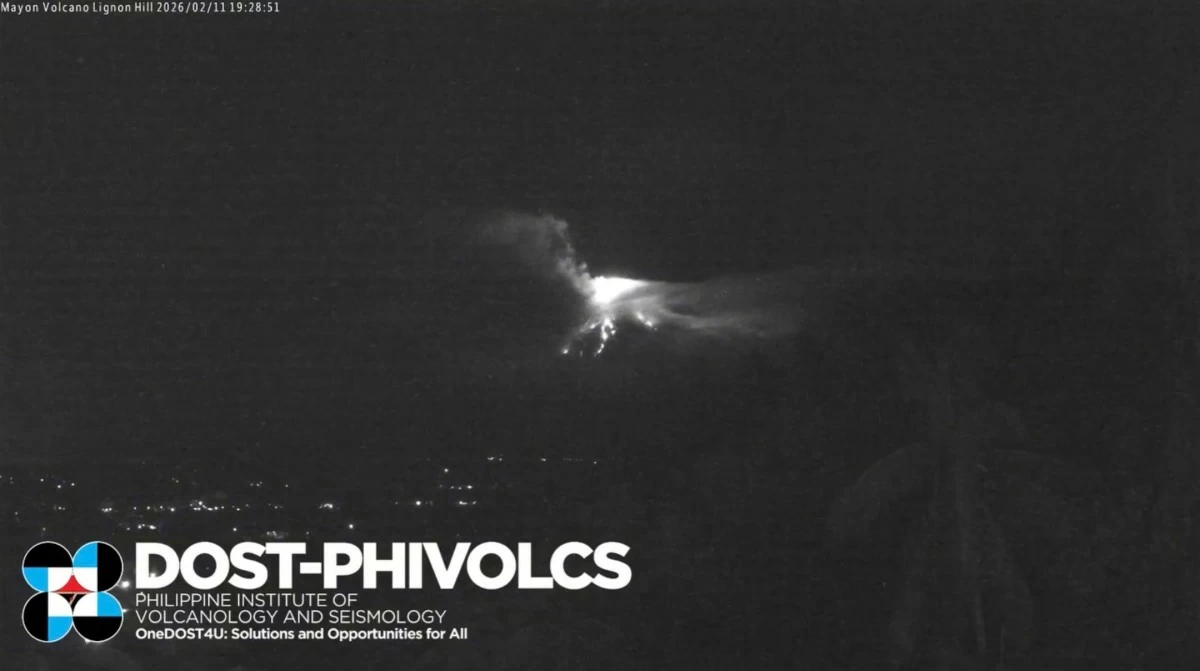
Incandescent lava flows and summit collapse at Mayon Volcano on the evening of Feb. 11, 2026, feeding lava down the Basud, Bonga, and Mi-isi Gullies while generating pyroclastic density currents and rockfalls. (Philippine Institute of Volcanology and Seismology)
Mayon Volcano in Albay continued its eruption on Wednesday, Feb. 11, marking the 37th consecutive day of lava effusion, pyroclastic density currents (PDCs) or “uson,” and rockfall.
In an update early Thursday, Feb. 12, the Philippine Institute of Volcanology and Seismology (Phivolcs) reported that lava from the summit crater has reached radial distances of about 3.8 kilometers in the Basud Gully to the east, 1.6 kilometers in the Bonga Gully to the southeast, and 1.3 kilometers in the Mi-isi Gully to the south.
Between 12 a.m. on Feb. 11 and 12 a.m. on Feb. 12, the volcano recorded 372 rockfall events, 19 PDCs, and seven volcanic earthquakes.
Crater glow remained visible to the naked eye, showing continuous magma activity at the summit.
Sulfur dioxide emissions remained high, averaging 3,749 tons on Feb. 10.
A moderate gas emission also produced a 400-meter-high plume that drifted northwest and southwest.
Alert Level 3 remains in effect over Mayon.
Phivolcs reminded the public that entry into the six-kilometer permanent danger zone is strictly prohibited due to the hazards posed by lava flows, PDCs, rockfalls, and ash.
Residents within the eight-kilometer extended zone, particularly on the southern and eastern slopes, should stay vigilant and be prepared for evacuation if monitoring parameters suddenly escalate.