ADVERTISEMENT

DSWD targets 130,000 beneficiaries in 'Tara, Basa!' reading program in 2026

Published Feb 11, 2026 01:34 pm
DSWD
DSWD
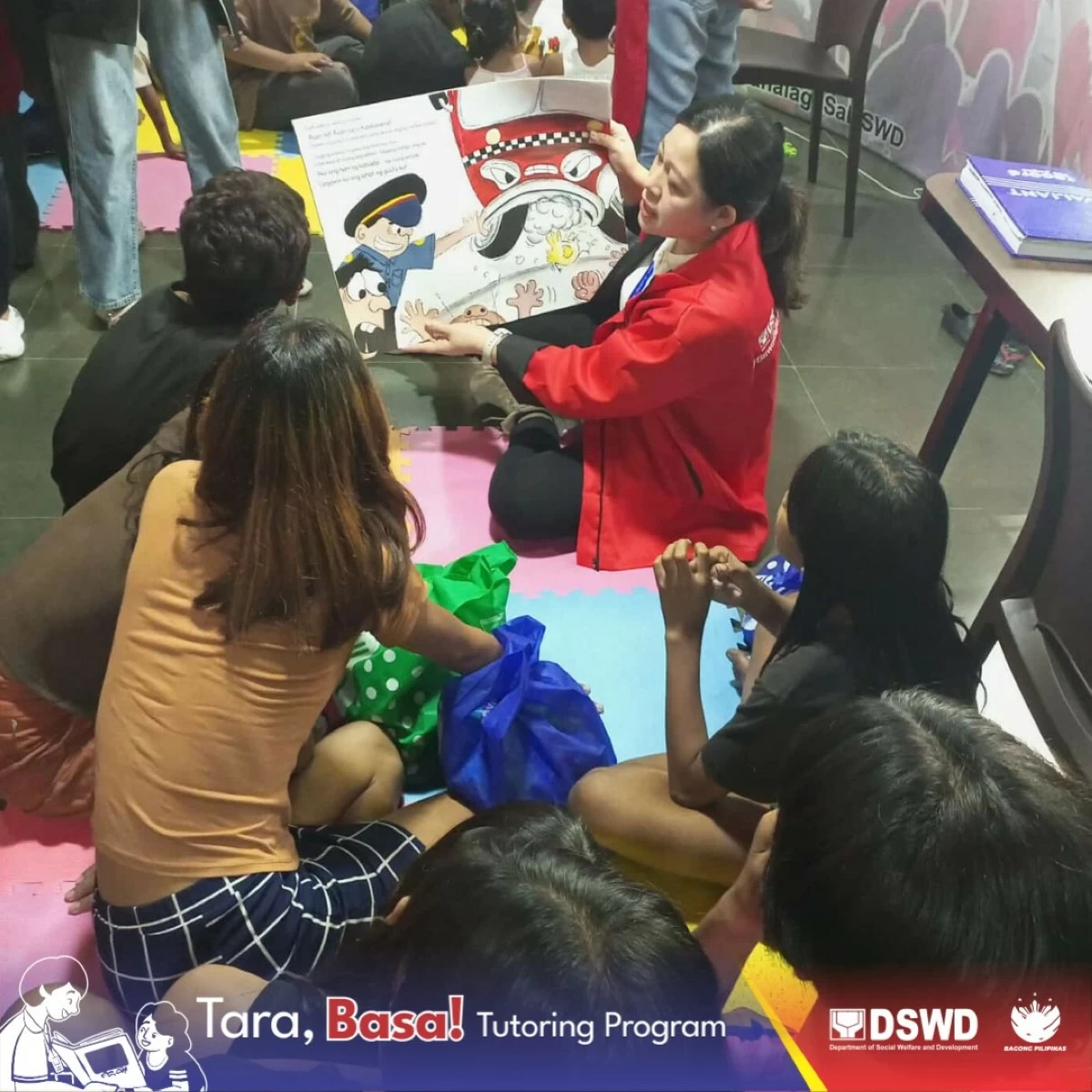
The Department of Social Welfare and Development (DSWD) is set to expand its Tara, Basa! Tutoring Program (TBTP) this year, aiming to benefit at least 130,000 learners, college student-tutors, and parents through cash-for-work, cash-for-training, and parenting and learning sessions.
DSWD Undersecretary for Innovations and Program Development Edu Punay, who also serves as the National Program Director of the TBTP, is coordinating with local government units (LGUs), state universities, and partner organizations nationwide to strengthen the program.
The TBTP engages college students from low-income families as tutors and youth development workers, helping elementary learners improve literacy skills while supporting parents to become active learning partners at home.
“New partnerships with LGUs and state universities have already been planned in the first quarter, and we are prioritizing expansion in geographically isolated and disadvantaged areas (GIDAs),” DSWD Assistant Secretary and spokesperson Irene Dumlao said on Wednesday, Feb. 11.
As part of the expansion, the DSWD signed a memorandum of agreement (MOA) with the Calaca City LGU and Calaca City Global College on Feb. 9, allowing over 300 beneficiaries to join the pilot implementation in the city.
Another partnership is set to be formalized in Romblon on Feb. 12, with DSWD Secretary Rex Gatchalian scheduled to attend the MOA signing.
The program will involve the provincial government, the municipalities of Romblon, Romblon State University, the Department of Education, and community partners.
About 1,150 individuals, including learners, parents, tutors, and youth development workers are expected to benefit from learning sessions starting in the second quarter.
“The directive of Secretary Rex Gatchalian is clear: the DSWD should not only be known for providing ‘ayuda’ during crises. Development is a core part of our work. Many students stop pursuing college due to financial constraints, and the TBTP helps address this by providing them additional income while enabling them to contribute to nation-building,” Dumlao said.
From the pilot implementation in 2023 to 2025, 34,981 2nd- to 4th-year college students in state universities and local government-run colleges received cash-for-work compensation for providing tutorial services.
In 2025 alone, 128,568 tutors, youth development workers, learners, and parents benefited from the program.
The TBTP is a restructured educational assistance initiative designed to promote a holistic learning environment by engaging college students in nation-building while supporting literacy development among elementary learners.

Related Tags

DSWD TARA BASA!
ADVERTISEMENT
.most-popular .layout-ratio{ padding-bottom: 79.13%; } @media (min-width: 768px) and (max-width: 1024px) { .widget-title { font-size: 15px !important; } }

{{ articles_filter_1561_widget.title }}

.most-popular .layout-ratio{ padding-bottom: 79.13%; } @media (min-width: 768px) and (max-width: 1024px) { .widget-title { font-size: 15px !important; } }

{{ articles_filter_1562_widget.title }}

.most-popular .layout-ratio{ padding-bottom: 79.13%; } @media (min-width: 768px) and (max-width: 1024px) { .widget-title { font-size: 15px !important; } }

{{ articles_filter_1563_widget.title }}

{{ articles_filter_1564_widget.title }}

.mb-article-details { position: relative; } .mb-article-details .article-body-preview, .mb-article-details .article-body-summary{ font-size: 17px; line-height: 30px; font-family: "Libre Caslon Text", serif; color: #000; } .mb-article-details .article-body-preview iframe , .mb-article-details .article-body-summary iframe{ width: 100%; margin: auto; } .read-more-background { background: linear-gradient(180deg, color(display-p3 1.000 1.000 1.000 / 0) 13.75%, color(display-p3 1.000 1.000 1.000 / 0.8) 30.79%, color(display-p3 1.000 1.000 1.000) 72.5%); position: absolute; height: 200px; width: 100%; bottom: 0; display: flex; justify-content: center; align-items: center; padding: 0; } .read-more-background a{ color: #000; } .read-more-btn { padding: 17px 45px; font-family: Inter; font-weight: 700; font-size: 18px; line-height: 16px; text-align: center; vertical-align: middle; border: 1px solid black; background-color: white; } .hidden { display: none; }
function initializeAllSwipers() { // Get all hidden inputs with cms_article_id document.querySelectorAll('[id^="cms_article_id_"]').forEach(function (input) { const cmsArticleId = input.value; const articleSelector = '#article-' + cmsArticleId + ' .body_images'; const swiperElement = document.querySelector(articleSelector); if (swiperElement && !swiperElement.classList.contains('swiper-initialized')) { new Swiper(articleSelector, { loop: true, pagination: false, navigation: { nextEl: '#article-' + cmsArticleId + ' .swiper-button-next', prevEl: '#article-' + cmsArticleId + ' .swiper-button-prev', }, }); } }); } setTimeout(initializeAllSwipers, 3000); const intersectionObserver = new IntersectionObserver( (entries) => { entries.forEach((entry) => { if (entry.isIntersecting) { const newUrl = entry.target.getAttribute("data-url"); if (newUrl) { history.pushState(null, null, newUrl); let article = entry.target; // Extract metadata const author = article.querySelector('.author-section').textContent.replace('By', '').trim(); const section = article.querySelector('.section-info ').textContent.replace(' ', ' '); const title = article.querySelector('.article-title h1').textContent; // Parse URL for Chartbeat path format const parsedUrl = new URL(newUrl, window.location.origin); const cleanUrl = parsedUrl.host + parsedUrl.pathname; // Update Chartbeat configuration if (typeof window._sf_async_config !== 'undefined') { window._sf_async_config.path = cleanUrl; window._sf_async_config.sections = section; window._sf_async_config.authors = author; } // Track virtual page view with Chartbeat if (typeof pSUPERFLY !== 'undefined' && typeof pSUPERFLY.virtualPage === 'function') { try { pSUPERFLY.virtualPage({ path: cleanUrl, title: title, sections: section, authors: author }); } catch (error) { console.error('ping error', error); } } // Optional: Update document title if (title && title !== document.title) { document.title = title; } } } }); }, { threshold: 0.1 } ); function showArticleBody(button) { const article = button.closest("article"); const summary = article.querySelector(".article-body-summary"); const body = article.querySelector(".article-body-preview"); const readMoreSection = article.querySelector(".read-more-background"); // Hide summary and read-more section summary.style.display = "none"; readMoreSection.style.display = "none"; // Show the full article body body.classList.remove("hidden"); } document.addEventListener("DOMContentLoaded", () => { let loadCount = 0; // Track how many times articles are loaded const offset = [1, 2, 3, 4, 5, 6, 7, 8, 9, 10]; // Offset values const currentUrl = window.location.pathname.substring(1); let isLoading = false; // Prevent multiple calls if (!currentUrl) { console.log("Current URL is invalid."); return; } const sentinel = document.getElementById("load-more-sentinel"); if (!sentinel) { console.log("Sentinel element not found."); return; } function isSentinelVisible() { const rect = sentinel.getBoundingClientRect(); return ( rect.top < window.innerHeight && rect.bottom >= 0 ); } function onScroll() { if (isLoading) return; if (isSentinelVisible()) { if (loadCount >= offset.length) { console.log("Maximum load attempts reached."); window.removeEventListener("scroll", onScroll); return; } isLoading = true; const currentOffset = offset[loadCount]; window.loadMoreItems().then(() => { let article = document.querySelector('#widget_1690 > div:nth-last-of-type(2) article'); intersectionObserver.observe(article) loadCount++; }).catch(error => { console.error("Error loading more items:", error); }).finally(() => { isLoading = false; }); } } window.addEventListener("scroll", onScroll); });

Sign up by email to receive news.