ADVERTISEMENT

Mayon's February 9 pyroclastic flows largest so far but activity remains steady — Phivolcs

Published Feb 10, 2026 01:27 pm
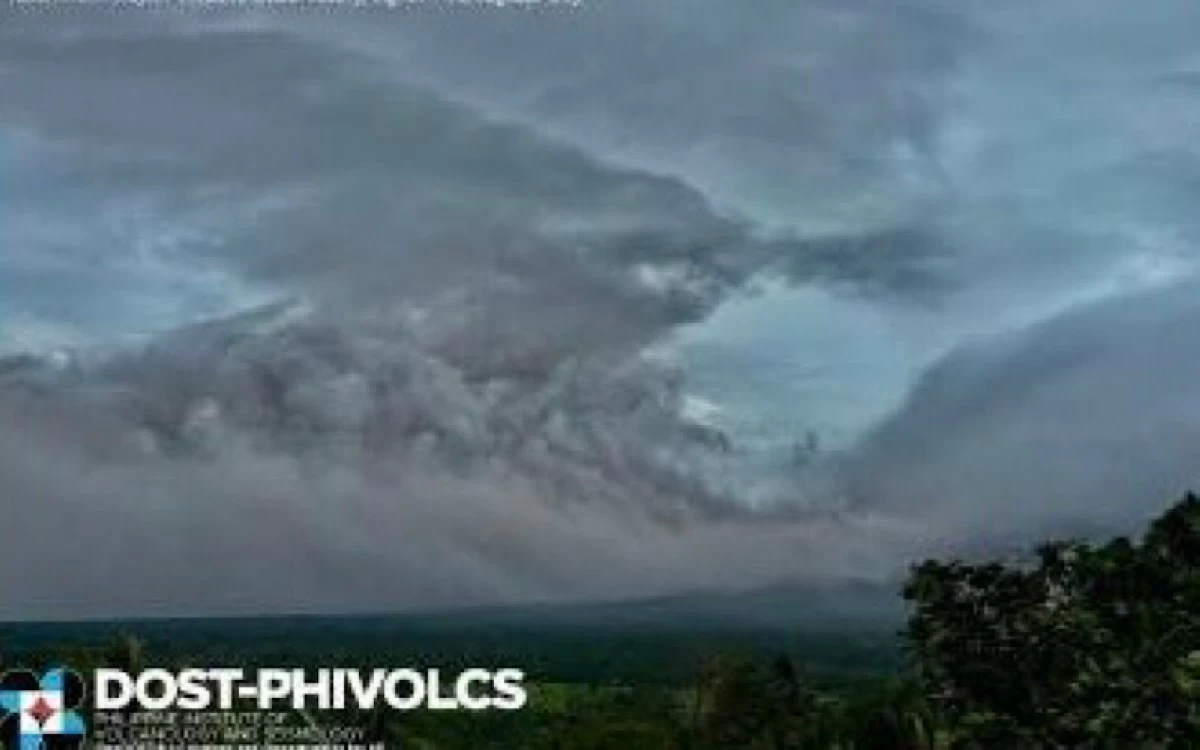
The largest pyroclastic density current from Mayon Volcano traveled four kilometers down the Mi-isi Gully on Monday, Feb. 9, triggering a two-kilometer-tall ash plume and ashfall in Albay. (Philippine Institute of Volcanology and Seismology)
Hot gas, ash, and rock raced down the Mi-isi Gully in Albay on Monday, Feb. 9, as Mayon Volcano produced the largest pyroclastic density currents (PDCs) of its 2026 eruption.
In an update early Tuesday, Feb. 10, the Philippine Institute of Volcanology and Seismology (Phivolcs) explained that the PDCs were triggered by lava-fed collapses at the summit crater, which disintegrated deposits of oxidized and degassed lava and generated brownish ash clouds.
A series of at least 12 major PDCs swept down Mayon’s slopes between 10:35 a.m. and 11:37 a.m. on Feb. 9, with the largest occurring at 10:59 a.m. and lasting seven minutes.
Phivolcs said the 10:59 AM flow and the subsequent events traveled as far as four kilometers down the Mi-isi Gully, marking the farthest runouts recorded so far in the 2026 eruption.
“Based on total seismic energy release, the Feb. 9, 2026 major PDC activity represents only a brief intensification of unrest at Mayon, which has progressed in near-steady conditions since the onset of eruption,” Phivolcs said.
PDCs, locally called “uson,” are fast-moving avalanches of hot gas, ash, and fragmented rock that can travel at hundreds of kilometers per hour.
Unlike slower lava flows, they sweep down slopes suddenly and unpredictably, carrying enough heat and force to destroy everything in their path.
Phivolcs explained that even a mostly effusive, or non-explosive, eruption like Mayon’s can suddenly produce these dangerous flows if lava collapses from the summit.
The Feb. 9 PDCs also produced prominent ash clouds more than two kilometers tall, drifting southwest with winds of roughly 40 kilometers per hour.
Several barangays were blanketed in ash, including Sua, Cabangan, Tumpa, Quirangay, Sumlang, Ligban, Libod, Bariw, Salugan, Anoling, and Gapo in Camalig, and Travesia, Sinungtan, Maninila, Quitago, Ilawod, Inamnan Pequeño, Lower Binogsacan, Doña Mercedes, Malipo, Poblacion, Quibongbongan, Tandarora, San Rafael, and Masarawag in Guinobatan.
Since the eruption began on Jan. 6, Phivolcs said Mayon has produced 1,690 PDCs, 9,941 rockfalls, and 1,346 volcanic earthquakes.
Lava flows have advanced between 1.3 and 3.8 kilometers down the Mi-isi, Bonga, and Basud Gullies, while ground measurements show the eastern and northeastern flanks are still swelling from magma intrusion.
Mayon Volcano remains under Alert Level 3, signaling continuing magmatic unrest.
Phivolcs reminded the public that effusive eruption continues to feed new lava flows, PDCs, and rockfalls on the southern and eastern slopes.
Residents were advised to refrain from entering the six-kilometer permanent danger zone.
“Residents within the eight-kilometer radius, particularly on the southern and eastern slopes of Mayon, must also be prepared for evacuation in case monitoring parameters suddenly escalate and the volcano status is stepped up to Alert Level 4,” Phivolcs added.

Related Tags

PHIVOLCS MAYON PYROCLASTIC DENSITY CURRENT ERUPTION EFFUSIVE ERUPTION
ADVERTISEMENT
.most-popular .layout-ratio{ padding-bottom: 79.13%; } @media (min-width: 768px) and (max-width: 1024px) { .widget-title { font-size: 15px !important; } }

{{ articles_filter_1561_widget.title }}

.most-popular .layout-ratio{ padding-bottom: 79.13%; } @media (min-width: 768px) and (max-width: 1024px) { .widget-title { font-size: 15px !important; } }

{{ articles_filter_1562_widget.title }}

.most-popular .layout-ratio{ padding-bottom: 79.13%; } @media (min-width: 768px) and (max-width: 1024px) { .widget-title { font-size: 15px !important; } }

{{ articles_filter_1563_widget.title }}

{{ articles_filter_1564_widget.title }}

.mb-article-details { position: relative; } .mb-article-details .article-body-preview, .mb-article-details .article-body-summary{ font-size: 17px; line-height: 30px; font-family: "Libre Caslon Text", serif; color: #000; } .mb-article-details .article-body-preview iframe , .mb-article-details .article-body-summary iframe{ width: 100%; margin: auto; } .read-more-background { background: linear-gradient(180deg, color(display-p3 1.000 1.000 1.000 / 0) 13.75%, color(display-p3 1.000 1.000 1.000 / 0.8) 30.79%, color(display-p3 1.000 1.000 1.000) 72.5%); position: absolute; height: 200px; width: 100%; bottom: 0; display: flex; justify-content: center; align-items: center; padding: 0; } .read-more-background a{ color: #000; } .read-more-btn { padding: 17px 45px; font-family: Inter; font-weight: 700; font-size: 18px; line-height: 16px; text-align: center; vertical-align: middle; border: 1px solid black; background-color: white; } .hidden { display: none; }
function initializeAllSwipers() { // Get all hidden inputs with cms_article_id document.querySelectorAll('[id^="cms_article_id_"]').forEach(function (input) { const cmsArticleId = input.value; const articleSelector = '#article-' + cmsArticleId + ' .body_images'; const swiperElement = document.querySelector(articleSelector); if (swiperElement && !swiperElement.classList.contains('swiper-initialized')) { new Swiper(articleSelector, { loop: true, pagination: false, navigation: { nextEl: '#article-' + cmsArticleId + ' .swiper-button-next', prevEl: '#article-' + cmsArticleId + ' .swiper-button-prev', }, }); } }); } setTimeout(initializeAllSwipers, 3000); const intersectionObserver = new IntersectionObserver( (entries) => { entries.forEach((entry) => { if (entry.isIntersecting) { const newUrl = entry.target.getAttribute("data-url"); if (newUrl) { history.pushState(null, null, newUrl); let article = entry.target; // Extract metadata const author = article.querySelector('.author-section').textContent.replace('By', '').trim(); const section = article.querySelector('.section-info ').textContent.replace(' ', ' '); const title = article.querySelector('.article-title h1').textContent; // Parse URL for Chartbeat path format const parsedUrl = new URL(newUrl, window.location.origin); const cleanUrl = parsedUrl.host + parsedUrl.pathname; // Update Chartbeat configuration if (typeof window._sf_async_config !== 'undefined') { window._sf_async_config.path = cleanUrl; window._sf_async_config.sections = section; window._sf_async_config.authors = author; } // Track virtual page view with Chartbeat if (typeof pSUPERFLY !== 'undefined' && typeof pSUPERFLY.virtualPage === 'function') { try { pSUPERFLY.virtualPage({ path: cleanUrl, title: title, sections: section, authors: author }); } catch (error) { console.error('ping error', error); } } // Optional: Update document title if (title && title !== document.title) { document.title = title; } } } }); }, { threshold: 0.1 } ); function showArticleBody(button) { const article = button.closest("article"); const summary = article.querySelector(".article-body-summary"); const body = article.querySelector(".article-body-preview"); const readMoreSection = article.querySelector(".read-more-background"); // Hide summary and read-more section summary.style.display = "none"; readMoreSection.style.display = "none"; // Show the full article body body.classList.remove("hidden"); } document.addEventListener("DOMContentLoaded", () => { let loadCount = 0; // Track how many times articles are loaded const offset = [1, 2, 3, 4, 5, 6, 7, 8, 9, 10]; // Offset values const currentUrl = window.location.pathname.substring(1); let isLoading = false; // Prevent multiple calls if (!currentUrl) { console.log("Current URL is invalid."); return; } const sentinel = document.getElementById("load-more-sentinel"); if (!sentinel) { console.log("Sentinel element not found."); return; } function isSentinelVisible() { const rect = sentinel.getBoundingClientRect(); return ( rect.top < window.innerHeight && rect.bottom >= 0 ); } function onScroll() { if (isLoading) return; if (isSentinelVisible()) { if (loadCount >= offset.length) { console.log("Maximum load attempts reached."); window.removeEventListener("scroll", onScroll); return; } isLoading = true; const currentOffset = offset[loadCount]; window.loadMoreItems().then(() => { let article = document.querySelector('#widget_1690 > div:nth-last-of-type(2) article'); intersectionObserver.observe(article) loadCount++; }).catch(error => { console.error("Error loading more items:", error); }).finally(() => { isLoading = false; }); } } window.addEventListener("scroll", onScroll); });

Sign up by email to receive news.