







Clearing the classroom backlog; fixing PH educational system's foundations
Published Feb 9, 2026 12:05 am
|
Updated Feb 8, 2026 04:21 pm


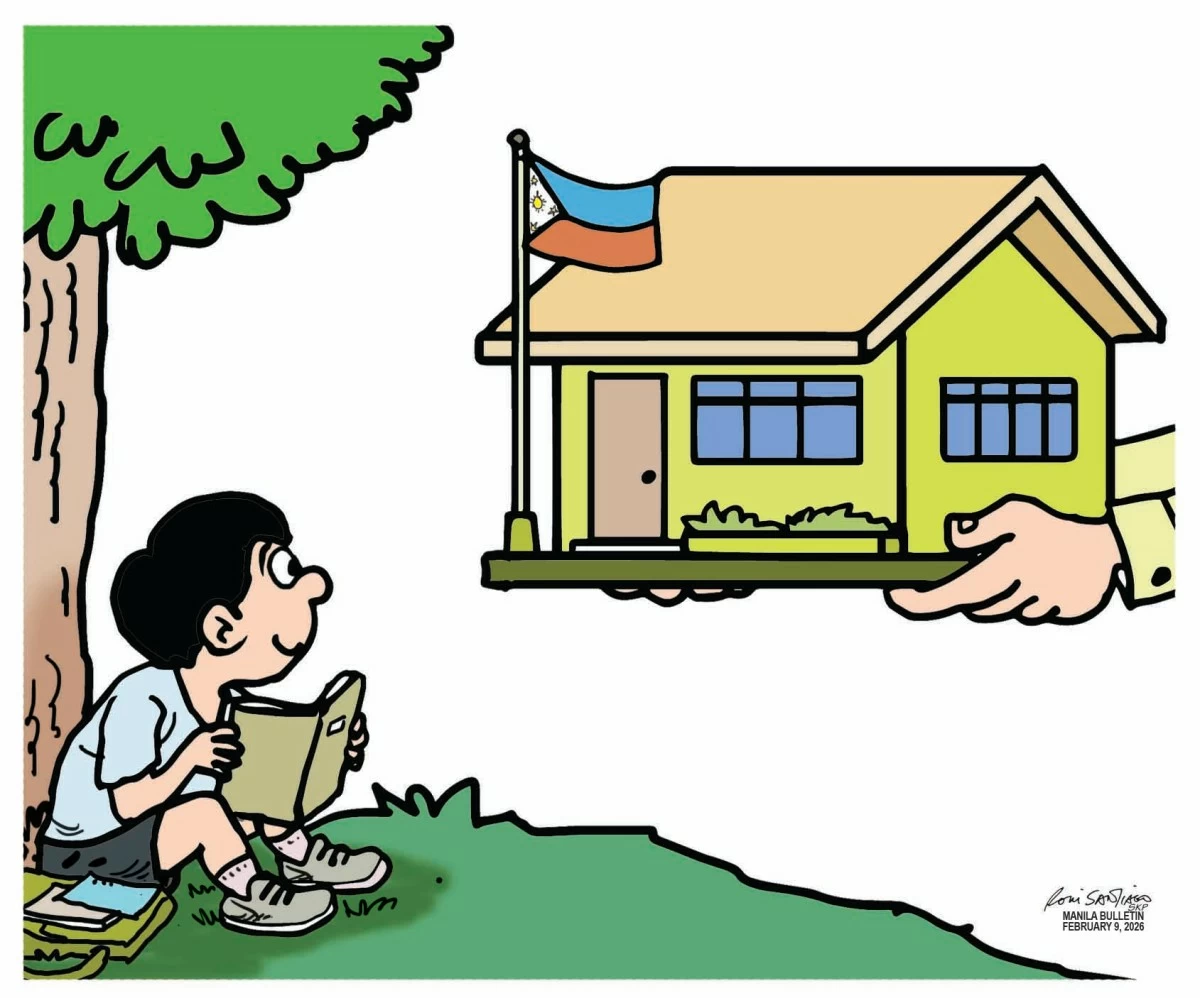
Few issues cut closer to the heart of national development than the state of Philippine education. At the most basic level, learning cannot take place without classrooms, teachers, and a system that values mastery over mere promotion. Today, the Department of Education (DepEd) confronts these challenges head-on. The urgency of the challenges facing the nation calls for faster, more decisive executive action.
The country continues to grapple with a severe classroom backlog, the cumulative result of decades of underinvestment, rapid population growth, and uneven local capacity. DepEd’s recent move to adopt a more decentralized strategy—empowering local government units (LGUs) to directly oversee school construction projects—is a pragmatic response. In principle, it brings decision-making closer to communities, shortens bureaucratic lines, and allows solutions to be tailored to local realities.
Yet, decentralization is not a magic wand. Without strong national standards, transparent procurement rules, and tight monitoring, devolved school construction risks becoming uneven, delayed, or vulnerable to the same inefficiencies that have plagued other infrastructure programs. DepEd must therefore strengthen its project management spine: establish a real-time, publicly accessible dashboard on classroom needs and construction progress; deploy technical assistance teams to weaker LGUs; and strictly enforce timelines and quality benchmarks. Clearing the classroom backlog must be treated not as a routine program, but as an emergency response with clear accountability.
Beyond bricks and mortar, DepEd Secretary Sonny Angara’s push to reshape early learning deserves strong support. Prioritizing reading proficiency, values formation, and foundational skills for younger learners directly addresses what many educators have long warned about: students advancing through the system without mastering the basics. A child who cannot read with comprehension by Grade 3 is already at a severe disadvantage, no matter how many classrooms are built later.
This renewed focus on fundamentals aligns well with DepEd’s decision to gradually phase out long-standing practices such as grade transmutation and automatic “mass promotion.” While these policies were often motivated by compassion, they have unintentionally lowered standards and masked deep learning gaps. Promotion without mastery is not kindness; it is a quiet form of neglect that burdens students in later years with frustration and failure.
However, removing these crutches must be matched with stronger support systems. Teachers need continuous training in early literacy and numeracy instruction. Schools must have access to diagnostic tools that identify struggling learners early. Remedial programs, including summer reading camps, after-school tutoring, and community-based learning hubs, should be scaled up — especially in disadvantaged areas.
To enhance DepEd’s executive action, three imperatives stand out. First, data must drive decisions. Classroom shortages, reading levels, teacher deployment, and dropout risks should be mapped with precision, allowing resources to be targeted where they matter most. Second, inter-agency and LGU coordination must be institutionalized, not improvised. Education outcomes depend on housing, health, nutrition, and connectivity—areas beyond DepEd’s sole control. Third, reform momentum must be insulated from the vagaries of political whim and expediency.
Education policy requires continuity, consistency, and the courage to sustain difficult reforms even when results take time.
Clearing the classroom backlog and fixing foundational learning are not separate tasks; they are two sides of the same national obligation. If done right, they can restore confidence in public education and reaffirm a simple truth: that every Filipino child deserves not just a seat in a classroom, but a real chance to learn, grow, and succeed.