ADVERTISEMENT

Phivolcs warns of possible lahars at Kanlaon amid heavy rains from 'Basyang'

Published Feb 6, 2026 01:15 pm
PAGASA
PAGASA
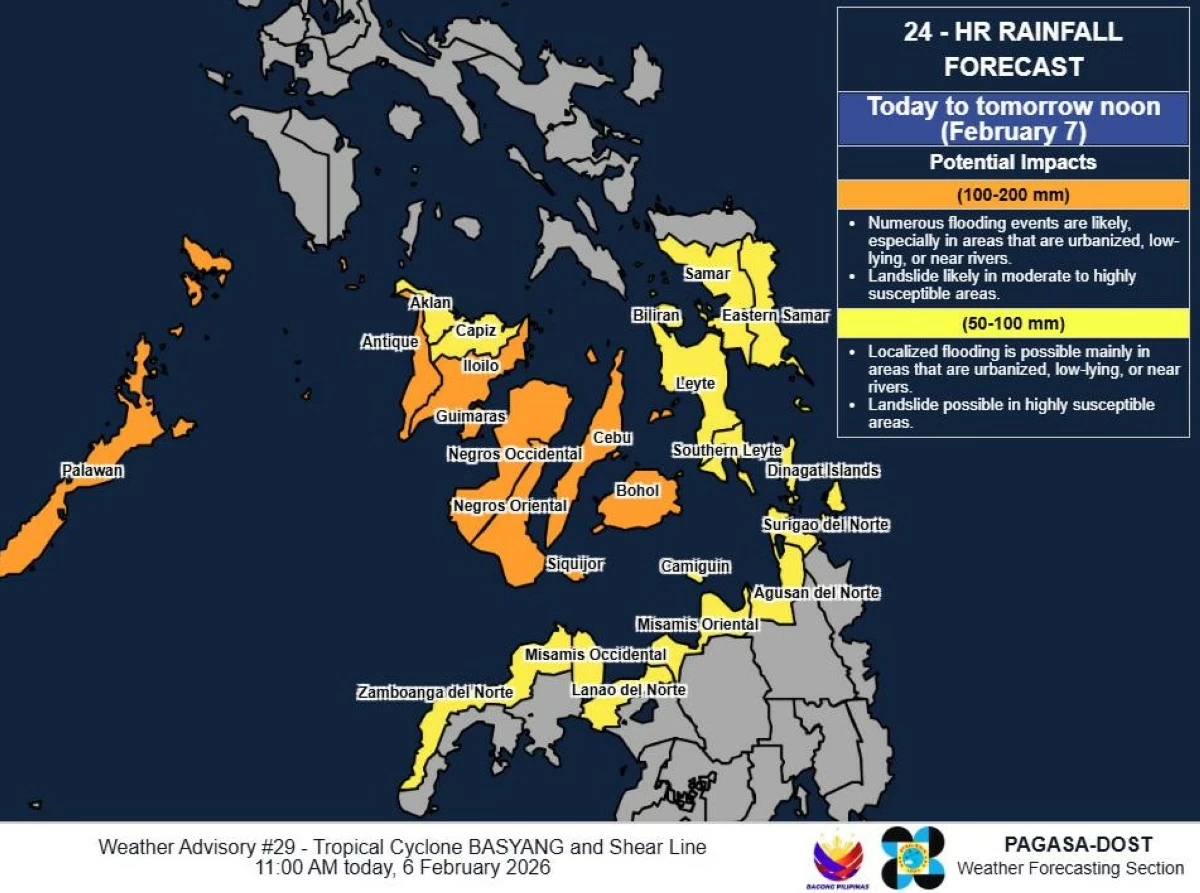
The Philippine Institute of Volcanology and Seismology (Phivolcs) warned of possible lahars and sediment-laden streamflows at Kanlaon Volcano as Tropical Depression Basyang (Penha) is expected to bring heavy to intense rainfall to Negros Island and the rest of the Visayas.
In a lahar advisory issued at 10:30 a.m. on Friday, Feb. 6, Phivolcs said prolonged heavy to intense rainfall could generate life-threatening volcanic sediment flows along major channels draining the southern, western and eastern slopes of Kanlaon, which is currently under Alert Level 2 (increased unrest).
It explained that intense rains may erode loose materials from remnant pyroclastic density current deposits from the Oct. 24, 2025 explosive eruption, as well as ashfall from that event and from more recent ash emissions, triggering post-eruption lahars.
It added that non-eruption lahars are also possible in areas on the upper slopes that were recently exposed by landslides or weakened during the passage of Supertyphoon Tino last November, which may trigger debris to be carried into rivers that have previously delivered destructive flows to downstream communities.
Phivolcs said communities in Bago City, La Carlota City, La Castellana, Moises Padilla and San Carlos City in Negros Occidental, as well as Canlaon City in Negros Oriental, may be affected by lahars, sediment-laden streamflows, flooding and siltation, particularly those located along the following channels: Ibid River, Cotcot River, Talaptapan River, Malaiba River, Panubigan Creek, Buhangin–Indurayan River, Najalin River, Inyawan River, Maragandang River, Panun-an Creek, Intiguiwan River, Camansi River, Maao River, Tokon-tokon River, Masulog River, Binalbagan River, Taco Creek and Linothangan River.
Residents in these areas, as well as those further downstream, were advised to be prepared in case evacuation becomes necessary and to avoid crossing affected streams, even those farther downslope of the volcano.
Phivolcs added that Kanlaon lahars, which were shown during Supertyphoon Tino are capable of transporting large volumes of gravel and boulders, which could threaten communities through strong impact, inundation, burial and washout.

Related Tags

KANLAON PHIVOLCS TROPICAL STORM BASYANG PENHA LAHAR HEAVY RAIN
ADVERTISEMENT
.most-popular .layout-ratio{ padding-bottom: 79.13%; } @media (min-width: 768px) and (max-width: 1024px) { .widget-title { font-size: 15px !important; } }

{{ articles_filter_1561_widget.title }}

.most-popular .layout-ratio{ padding-bottom: 79.13%; } @media (min-width: 768px) and (max-width: 1024px) { .widget-title { font-size: 15px !important; } }

{{ articles_filter_1562_widget.title }}

.most-popular .layout-ratio{ padding-bottom: 79.13%; } @media (min-width: 768px) and (max-width: 1024px) { .widget-title { font-size: 15px !important; } }

{{ articles_filter_1563_widget.title }}

{{ articles_filter_1564_widget.title }}

.mb-article-details { position: relative; } .mb-article-details .article-body-preview, .mb-article-details .article-body-summary{ font-size: 17px; line-height: 30px; font-family: "Libre Caslon Text", serif; color: #000; } .mb-article-details .article-body-preview iframe , .mb-article-details .article-body-summary iframe{ width: 100%; margin: auto; } .read-more-background { background: linear-gradient(180deg, color(display-p3 1.000 1.000 1.000 / 0) 13.75%, color(display-p3 1.000 1.000 1.000 / 0.8) 30.79%, color(display-p3 1.000 1.000 1.000) 72.5%); position: absolute; height: 200px; width: 100%; bottom: 0; display: flex; justify-content: center; align-items: center; padding: 0; } .read-more-background a{ color: #000; } .read-more-btn { padding: 17px 45px; font-family: Inter; font-weight: 700; font-size: 18px; line-height: 16px; text-align: center; vertical-align: middle; border: 1px solid black; background-color: white; } .hidden { display: none; }
function initializeAllSwipers() { // Get all hidden inputs with cms_article_id document.querySelectorAll('[id^="cms_article_id_"]').forEach(function (input) { const cmsArticleId = input.value; const articleSelector = '#article-' + cmsArticleId + ' .body_images'; const swiperElement = document.querySelector(articleSelector); if (swiperElement && !swiperElement.classList.contains('swiper-initialized')) { new Swiper(articleSelector, { loop: true, pagination: false, navigation: { nextEl: '#article-' + cmsArticleId + ' .swiper-button-next', prevEl: '#article-' + cmsArticleId + ' .swiper-button-prev', }, }); } }); } setTimeout(initializeAllSwipers, 3000); const intersectionObserver = new IntersectionObserver( (entries) => { entries.forEach((entry) => { if (entry.isIntersecting) { const newUrl = entry.target.getAttribute("data-url"); if (newUrl) { history.pushState(null, null, newUrl); let article = entry.target; // Extract metadata const author = article.querySelector('.author-section').textContent.replace('By', '').trim(); const section = article.querySelector('.section-info ').textContent.replace(' ', ' '); const title = article.querySelector('.article-title h1').textContent; // Parse URL for Chartbeat path format const parsedUrl = new URL(newUrl, window.location.origin); const cleanUrl = parsedUrl.host + parsedUrl.pathname; // Update Chartbeat configuration if (typeof window._sf_async_config !== 'undefined') { window._sf_async_config.path = cleanUrl; window._sf_async_config.sections = section; window._sf_async_config.authors = author; } // Track virtual page view with Chartbeat if (typeof pSUPERFLY !== 'undefined' && typeof pSUPERFLY.virtualPage === 'function') { try { pSUPERFLY.virtualPage({ path: cleanUrl, title: title, sections: section, authors: author }); } catch (error) { console.error('ping error', error); } } // Optional: Update document title if (title && title !== document.title) { document.title = title; } } } }); }, { threshold: 0.1 } ); function showArticleBody(button) { const article = button.closest("article"); const summary = article.querySelector(".article-body-summary"); const body = article.querySelector(".article-body-preview"); const readMoreSection = article.querySelector(".read-more-background"); // Hide summary and read-more section summary.style.display = "none"; readMoreSection.style.display = "none"; // Show the full article body body.classList.remove("hidden"); } document.addEventListener("DOMContentLoaded", () => { let loadCount = 0; // Track how many times articles are loaded const offset = [1, 2, 3, 4, 5, 6, 7, 8, 9, 10]; // Offset values const currentUrl = window.location.pathname.substring(1); let isLoading = false; // Prevent multiple calls if (!currentUrl) { console.log("Current URL is invalid."); return; } const sentinel = document.getElementById("load-more-sentinel"); if (!sentinel) { console.log("Sentinel element not found."); return; } function isSentinelVisible() { const rect = sentinel.getBoundingClientRect(); return ( rect.top < window.innerHeight && rect.bottom >= 0 ); } function onScroll() { if (isLoading) return; if (isSentinelVisible()) { if (loadCount >= offset.length) { console.log("Maximum load attempts reached."); window.removeEventListener("scroll", onScroll); return; } isLoading = true; const currentOffset = offset[loadCount]; window.loadMoreItems().then(() => { let article = document.querySelector('#widget_1690 > div:nth-last-of-type(2) article'); intersectionObserver.observe(article) loadCount++; }).catch(error => { console.error("Error loading more items:", error); }).finally(() => { isLoading = false; }); } } window.addEventListener("scroll", onScroll); });

Sign up by email to receive news.